




























Views
Downloads




Complete Bonding Properties Worksheet | Grade 11 Chemistry

Paste this activity's link or code into your existing LMS (Google Classroom, Canvas, Teams, Schoology, Moodle, etc.).
Students can open and work on the activity right away, with no student login required.
You'll still be able to track student progress and results from your teacher account.
This Grade 11 chemistry worksheet trains students to defend bonding-property explanations using empirical data and mechanistic reasoning. Learners evaluate melting points, solubility, and conductivity across five synthetic compounds to justify particle-level models. By connecting observations directly to electrostatic forces, students build lasting conceptual mastery of chemical bonding.
At a Glance
- Grade: 11 · Subject: Chemistry
- Standard: High School Chemistry — Construct scientific explanations linking chemical bonding to macroscopic physical properties
- Skill Focus: Defend a Bonding-Property Explanation
- Format: 5 pages · 8 problems · Answer key included · PDF
- Best For: Post-lecture practice and formative assessment
- Time: 45–60 minutes
What's Inside
This 5-page printable resource delivers 8 structured analytical items anchored by a synthetic five-compound data matrix and an electronegativity reference table. Students evaluate thermal and electrical properties to determine bonding character. A thorough 7-page answer key provides complete particle-level model explanations and flags common student misconceptions.
Skill Progression
- Guided practice (Items 1–2): Students extract empirical data from the synthetic table to support claims regarding ionic and molecular structures.
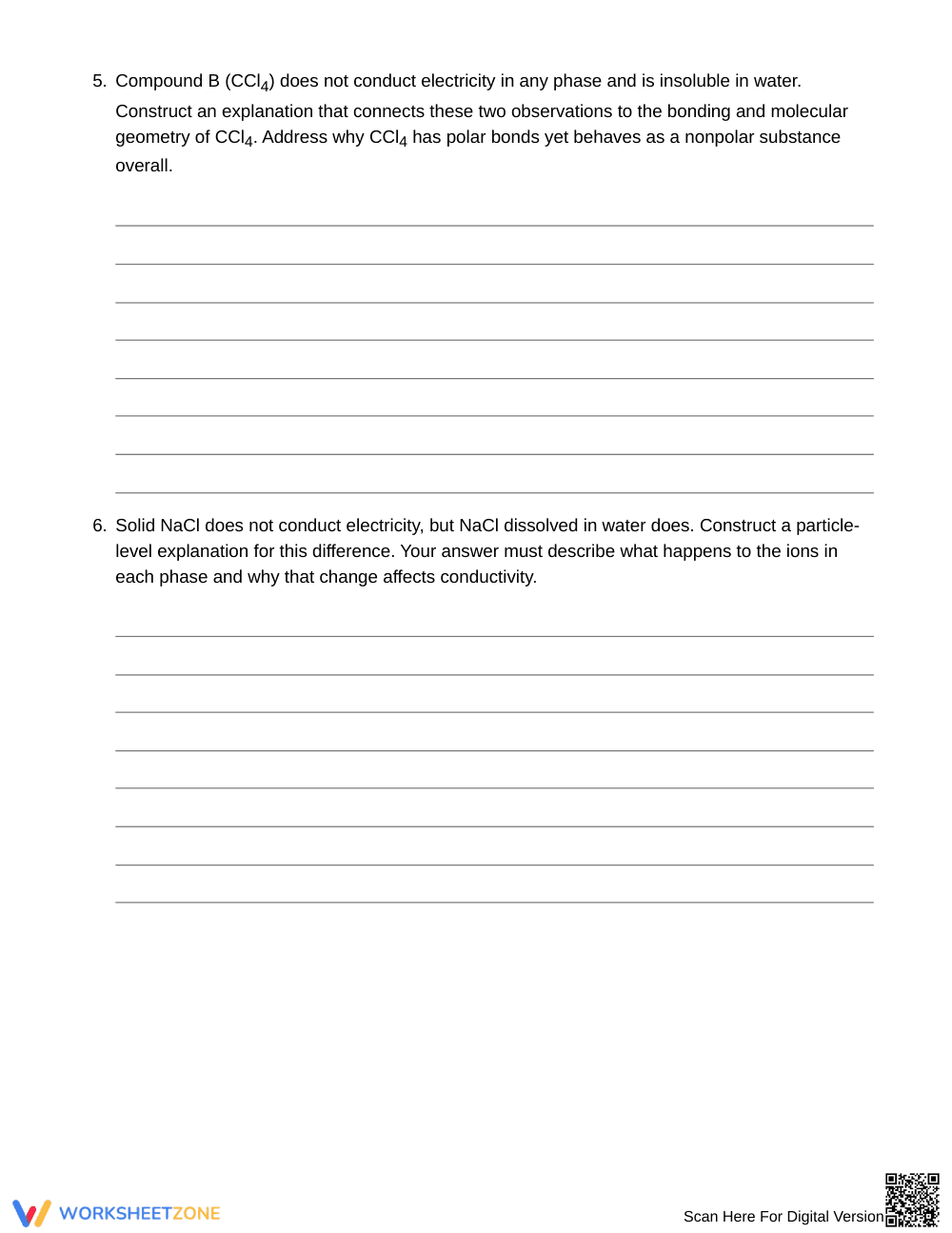
- Supported practice (Items 3–6): Learners construct causal mechanisms connecting properties like melting points and conductivity to ionic charge, lattice energy, and intermolecular forces.
- Independent practice (Items 7–8): Students evaluate competing claims, resolving scientific validity and identifying particle-level errors regarding bond strength.
This sequence implements a gradual-release model, moving learners from evidence identification to autonomous claim evaluation.
Standards Alignment
This activity aligns with high school physical science standards requiring students to construct explanations for how electrostatic forces determine macroscopic matter properties. Students use particulate models and empirical evidence to defend substance classifications based on ionic or covalent bonding. Supporting standards emphasize analyzing electronegativity values. Both standard codes can be copied directly into lesson plans, IEP goals, or district curriculum mapping tools.
How to Use It
Assign this worksheet following direct instruction on intermolecular forces and crystal lattices. During practice, check Item 4 and Item 7 for students incorrectly conflating intermolecular forces with intramolecular covalent bonds. Expected completion time is 45 to 60 minutes in a standard class period.
Who It's For
This worksheet supports Grade 11 chemistry students developing evidence-based argumentation skills. The provided reference values and structured questions support all learners while preserving analytical rigor. Pair this assignment with a laboratory investigation on electrical conductivity or an intermolecular forces reference chart.
Defending scientific explanations through evidence-based arguments requires students to coordinate macroscopic observations with submicroscopic particulate models. According to Fisher & Frey (2014), structured argumentation and scaffolded academic dialogue significantly accelerate conceptual understanding in secondary science classrooms. This Grade 11 chemistry resource targets the core skill of defending bonding-property explanations across 8 rigorous tasks. Students interrogate a synthetic data set containing melting points, boiling points, conductivity, and solubility metrics for five distinct substances. By transitioning from evidence identification to mechanistic articulation and competing claim critique, learners confront pervasive misconceptions—such as confusing intramolecular bonds with intermolecular forces. The 5-page worksheet and 7-page teacher guide supply explicit criteria for evaluating lattice energy, hydration forces, and molecular geometry. Implementing evidence-to-mechanism writing frameworks ensures that 11th-grade students achieve measurable gains in chemical literacy, scientific discourse, and analytical reasoning.


