































Complete Blue Objects Word Search | Grades 7–8 ELA

Paste this activity's link or code into your existing LMS (Google Classroom, Canvas, Teams, Schoology, Moodle, etc.).
Students can open and work on the activity right away, with no student login required.
You'll still be able to track student progress and results from your teacher account.
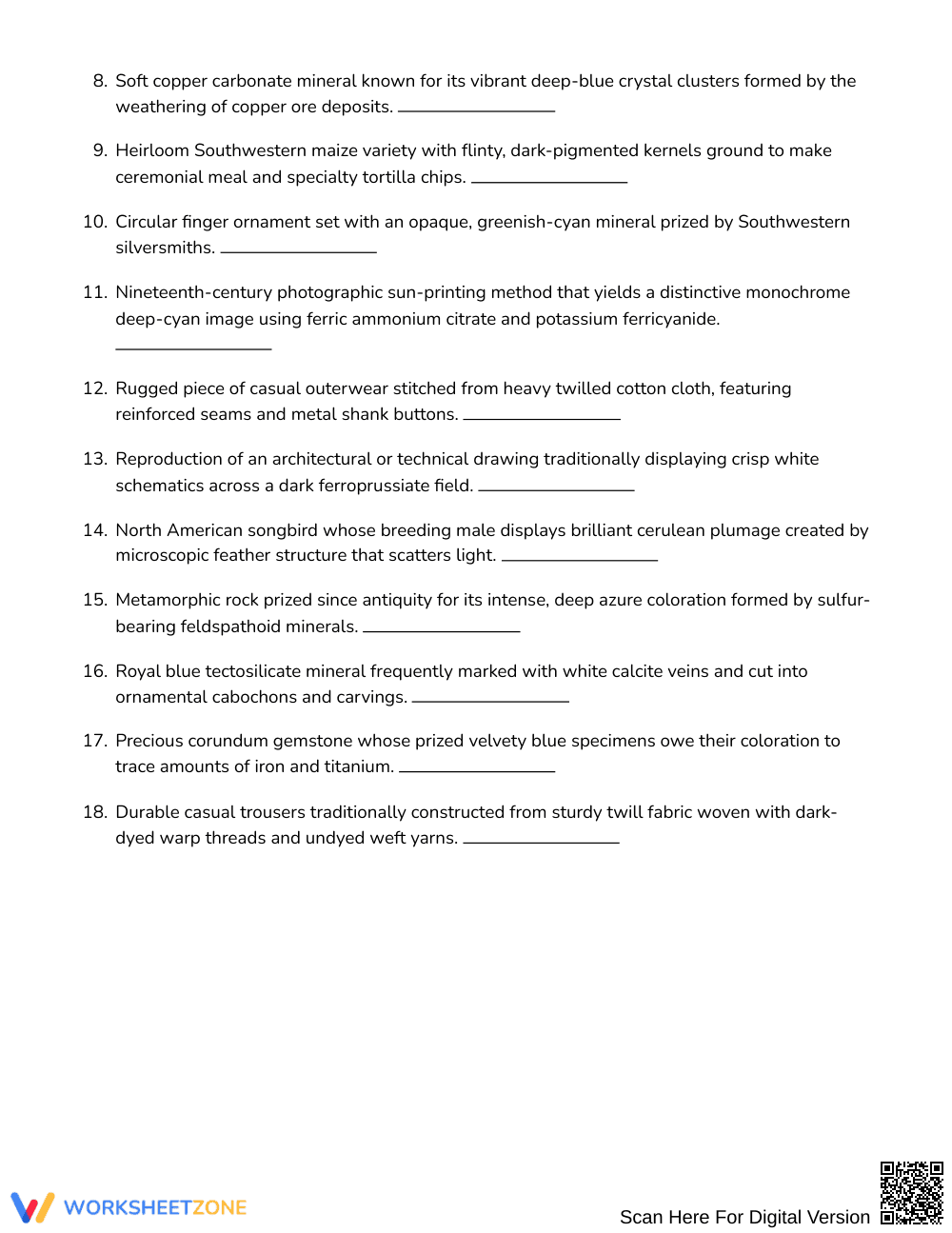
This Grades 7–8 vocabulary word search builds cross-curricular language proficiency by connecting descriptive terminology to natural minerals, organisms, pigments, and manufactured items. Learners read detailed contextual clues to identify 18 specialized terms before locating them within the puzzle. The resource strengthens domain-specific reading comprehension, scientific vocabulary retention, and contextual deduction across middle school English language arts classrooms.
At a Glance
- Grade: Grades 7–8 · Subject: English Language Arts (ELA)
- Standard: Not standards-assessed — vocabulary enrichment
- Skill Focus: Blue in natural and manufactured objects
- Format: 3 pages · 18 words · Answer key included · PDF
- Best For: Vocabulary enrichment and independent study
- Time: 25–35 minutes
What's Inside
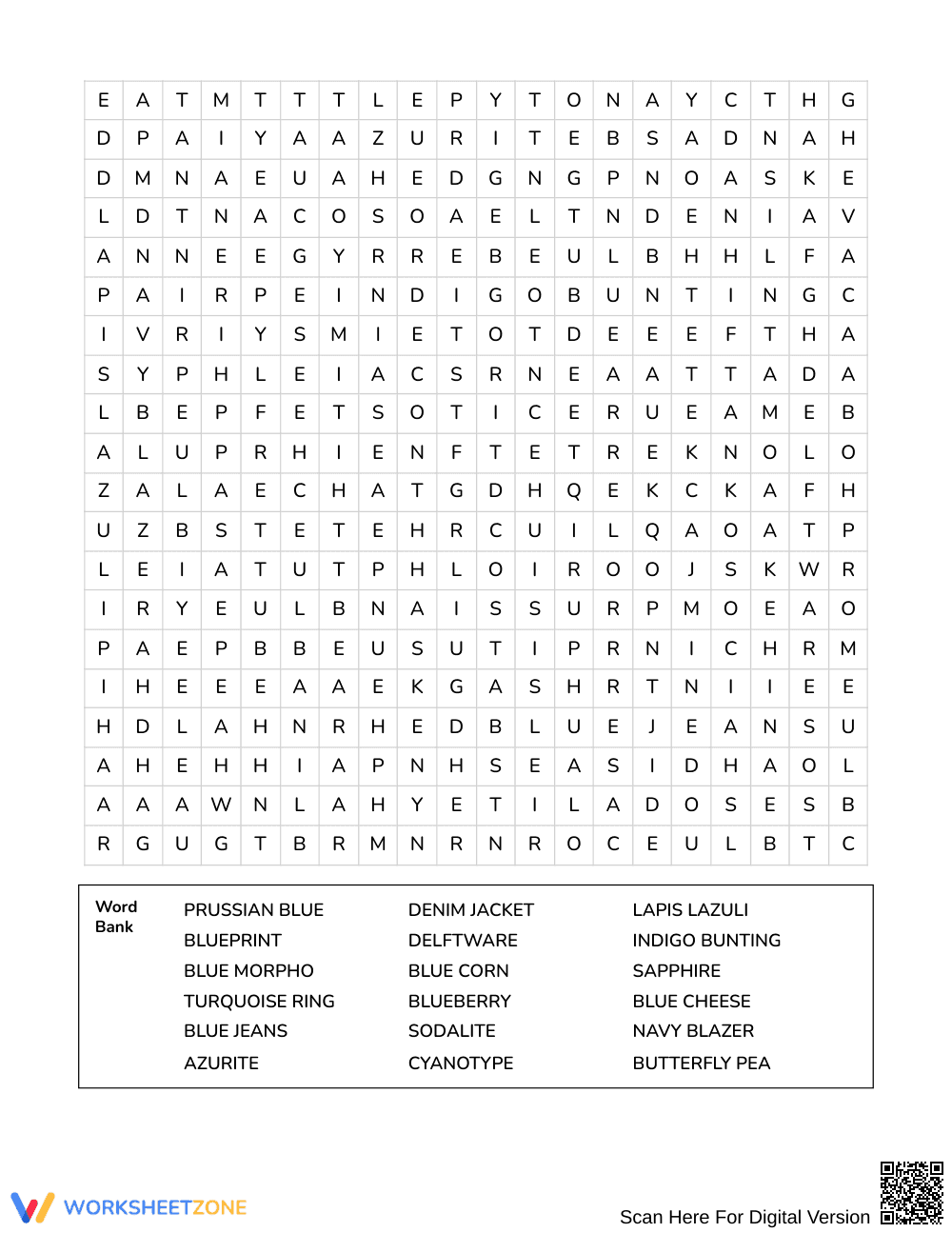
This 3-page printable activity features a full 18-word search challenge paired with substantive informational clues and a complete 4-page answer key. Rather than scanning for isolated terms, students read descriptive definitions addressing mineralogy, textiles, avian biology, and chemistry. The shuffled word bank provides immediate spelling support, while comprehensive solution grids highlight exact letter coordinates for effortless verification.
Puzzle Mechanics and Structure
The puzzle is built around a dense 20 x 20 grid that conceals 18 vocabulary words hidden in eight potential directions: North, Northeast, East, Southeast, South, Southwest, West, and Northwest. Students read each clue to deduce the target blue material or object, consult the shuffled word bank to verify the term, and track diagonal, reverse, and vertical letter pathways throughout the grid.
Standards Alignment
This activity serves strictly as general vocabulary enrichment and is not aligned to a specific standard. The learning tasks emphasize contextual deduction, morphology, and domain-specific terminology across informational disciplines, making it an ideal supplementary exercise to enrich language skills without standard-based reporting constraints.
How to Use It
Deploy this word search during an informational text unit or after direct instruction on descriptive vocabulary. For formative assessment, observe whether students deduce terms directly from the contextual clues or rely primarily on letter-hunting through the word bank. Learners typically complete the full clue analysis and puzzle search within 25 to 35 minutes of independent work.
Who It's For
This activity is designed for Grades 7–8 ELA students exploring nuanced, domain-specific adjectives and nouns. It offers flexible differentiation for visual learners and advanced readers seeking cross-curricular vocabulary extensions. Pair this puzzle naturally with an informational reading passage on material science, pigments, or natural history to anchor abstract terms into concrete textual contexts.
Contextual vocabulary acquisition in middle school ELA relies heavily on exposing learners to sophisticated, domain-specific terminology embedded within rich explanatory contexts. Fisher & Frey (2014) emphasize that intentional word exploration—especially through structured retrieval tasks, definition analysis, and orthographic recognition—substantially deepens reading comprehension and lexical retention across secondary grades. By requiring students to analyze descriptive clues identifying blue natural phenomena and manufactured artifacts before searching a dense letter grid, this activity activates both semantic decoding and visual-orthographic processing. Integrating cross-disciplinary vocabulary, such as lapis lazuli and cyanotype, bridges science and humanities vocabularies to establish robust semantic networks. Rather than memorizing isolated word lists, learners engage with morphological cues and conceptual properties that foster durable word mastery. Consequently, structured vocabulary puzzles that require deductive reasoning support independent lexical growth, reinforcing literacy skills across diverse informational text types.


