





























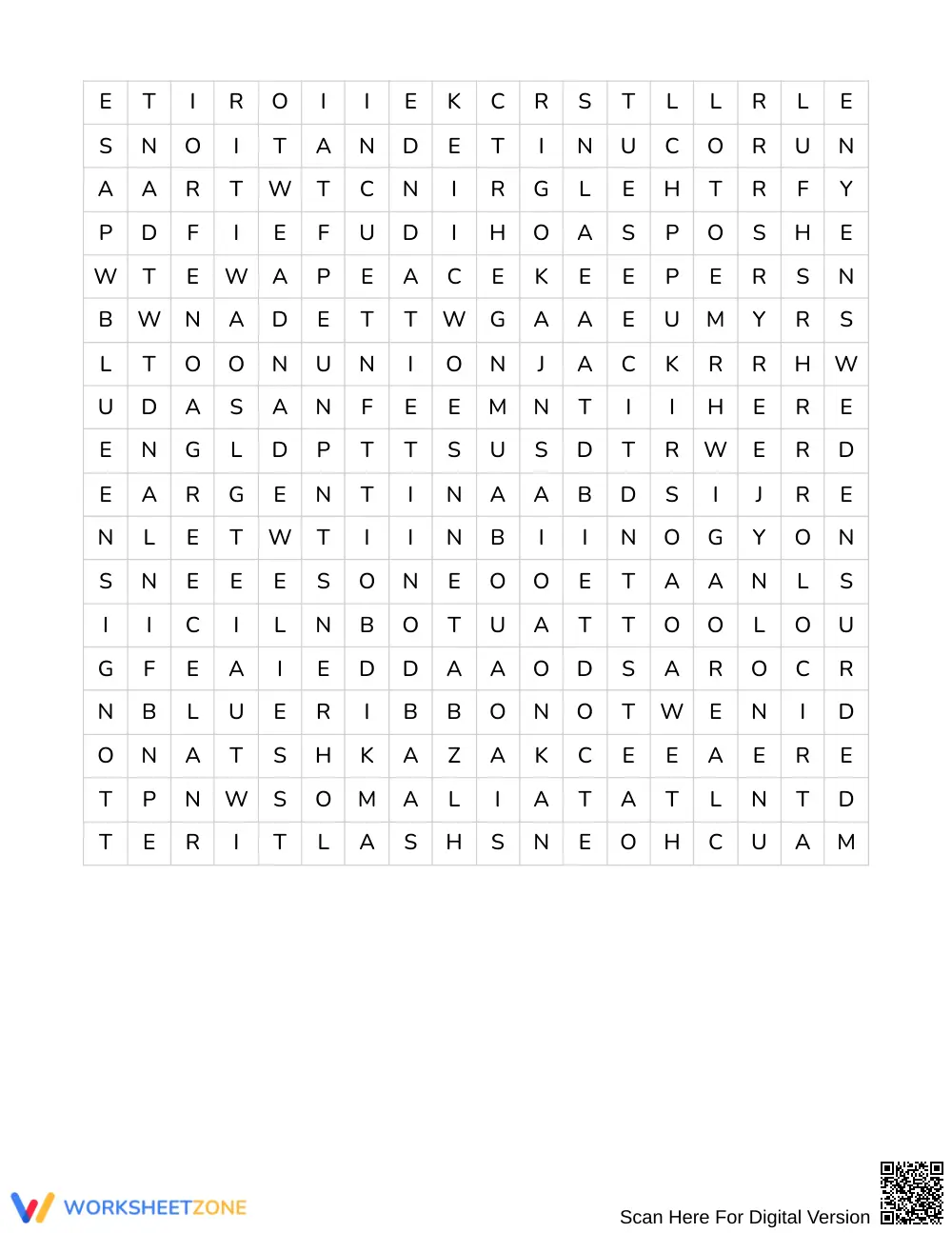


Complete Blue Flags & Symbols Word Search | Grades 6–7 ELA

Paste this activity's link or code into your existing LMS (Google Classroom, Canvas, Teams, Schoology, Moodle, etc.).
Students can open and work on the activity right away, with no student login required.
You'll still be able to track student progress and results from your teacher account.
This Grades 6–7 vocabulary word search engages students in identifying 16 global symbols, national banners, and international emblems distinguished by the color blue. By reading contextual clues rather than scanning a basic list, learners deduce domain-specific terms and locate them in an expanded letter grid to strengthen deductive reasoning and thematic vocabulary.
At a Glance
- Grade: Grades 6–7 · Subject: English Language Arts (ELA)
- Standard: Not standards-assessed — vocabulary enrichment
- Skill Focus: Blue in flags and international symbols
- Format: 3 activity pages · 16 hidden words · Full 4-page answer key included · Printable PDF
- Best For: Vocabulary enrichment, independent seatwork, and fast-finisher challenges
- Time: 20–30 minutes of focused puzzle practice
What's Inside
This 3-page printable activity features a challenging no-bank word search paired with 16 descriptive informational clues. Instead of searching from an explicit list, students analyze descriptions of world banners, diplomatic organizations, and heraldic terms to identify each target word before searching the grid. The resource includes a comprehensive 4-page answer key that displays every word location clearly for quick student self-checking or teacher grading.
How the Puzzle Works
This activity replaces the standard word bank with an investigative clue-solving structure set within an 18 x 18 grid. Students read 16 text clues detailing national flags, defense coalitions, and ceremonial banners to determine the hidden terms. Words are hidden across all eight compass directions: north, northeast, east, southeast, south, southwest, west, and northwest, providing an engaging cognitive challenge.
Standards Alignment
This activity serves as cross-curricular vocabulary enrichment and is not aligned to a specific academic standard. It supports general English Language Arts proficiency by strengthening contextual clue analysis, domain-specific geography vocabulary, and orthographic word recognition without requiring alignment to formal standardized testing benchmarks.
How to Use It
Deploy this puzzle as an independent extension task after direct instruction in non-fiction text features or informational reading, requiring roughly 20 to 30 minutes to complete. Alternatively, use it during collaborative group work where partners discuss the symbolic clues together before scanning the grid. During work time, observe whether students identify terms directly from clue keywords or require support with geography concepts.
Who It's For
This resource is designed for Grades 6–7 students ready for an advanced vocabulary challenge that goes beyond rote search grids. Differentiate by providing an atlas or reference sheet to students needing clue assistance while allowing advanced learners to deduce answers independently. Pair this activity with an informational reading passage on world flags or international alliances to deepen thematic context.
Designed for middle school learners in Grades 6–7, this vocabulary enrichment resource builds background knowledge around world flags and emblems without assessing a formal standard code. According to Fisher & Frey (2014), intentional vocabulary acquisition requires students to interact with domain-specific terms through multiple modalities, including contextual definition, inferential reasoning, and orthographic analysis. Rather than relying on passive word searches that merely reinforce letter scanning, this clue-driven challenge requires students to solve 16 informational descriptions before identifying terms across an 18 x 18 grid. By linking international terminology such as NATO, saltire, and tricolor to their visual and historical meanings, the activity promotes semantic memory and disciplinary literacy. Educators can use this 3-page printable activity and its 4-page answer key to reinforce informational reading skills, support social studies cross-curricular connections, and provide meaningful independent enrichment.


