































Complete Belgian Beer Styles Word Search | Adults ELA

Paste this activity's link or code into your existing LMS (Google Classroom, Canvas, Teams, Schoology, Moodle, etc.).
Students can open and work on the activity right away, with no student login required.
You'll still be able to track student progress and results from your teacher account.
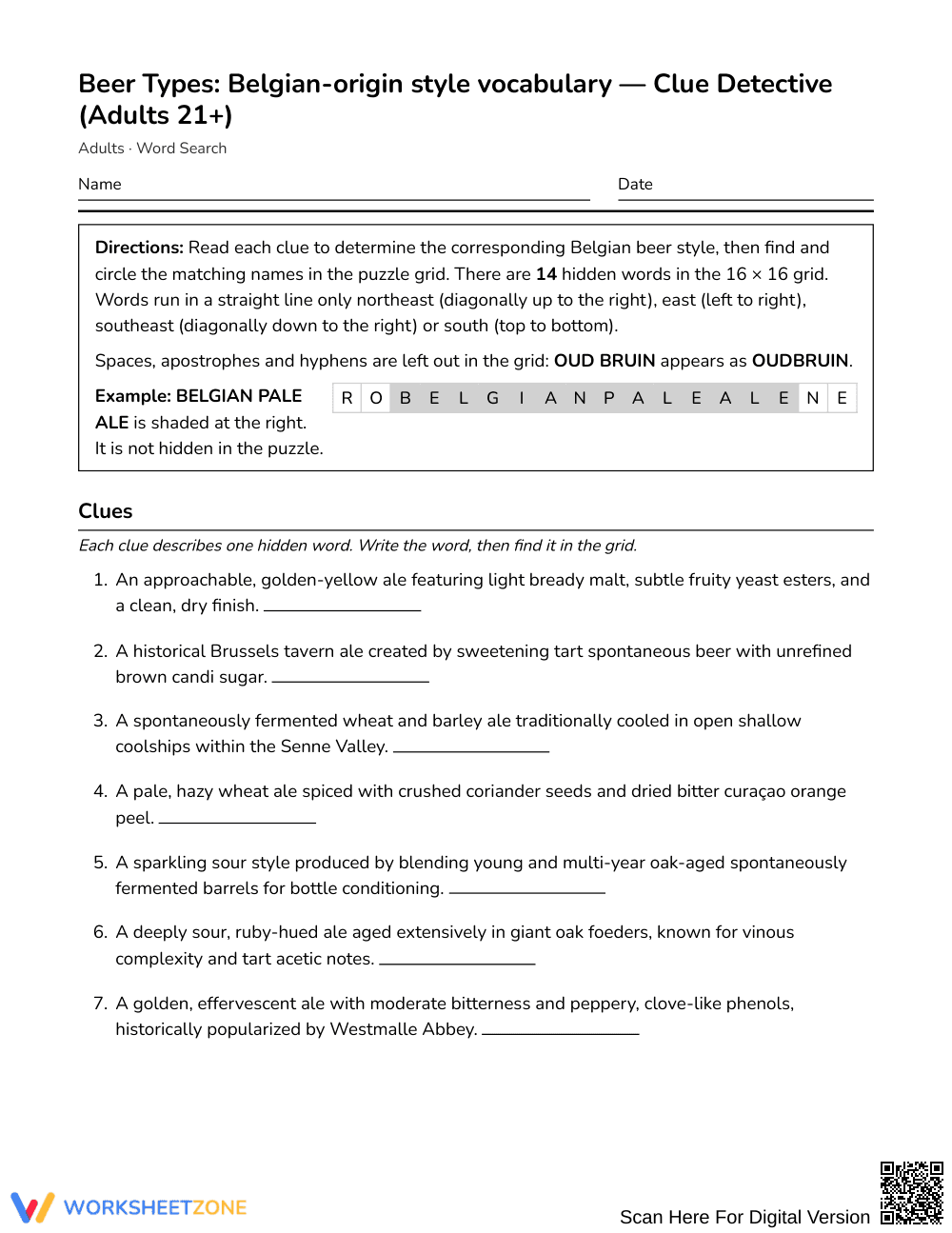
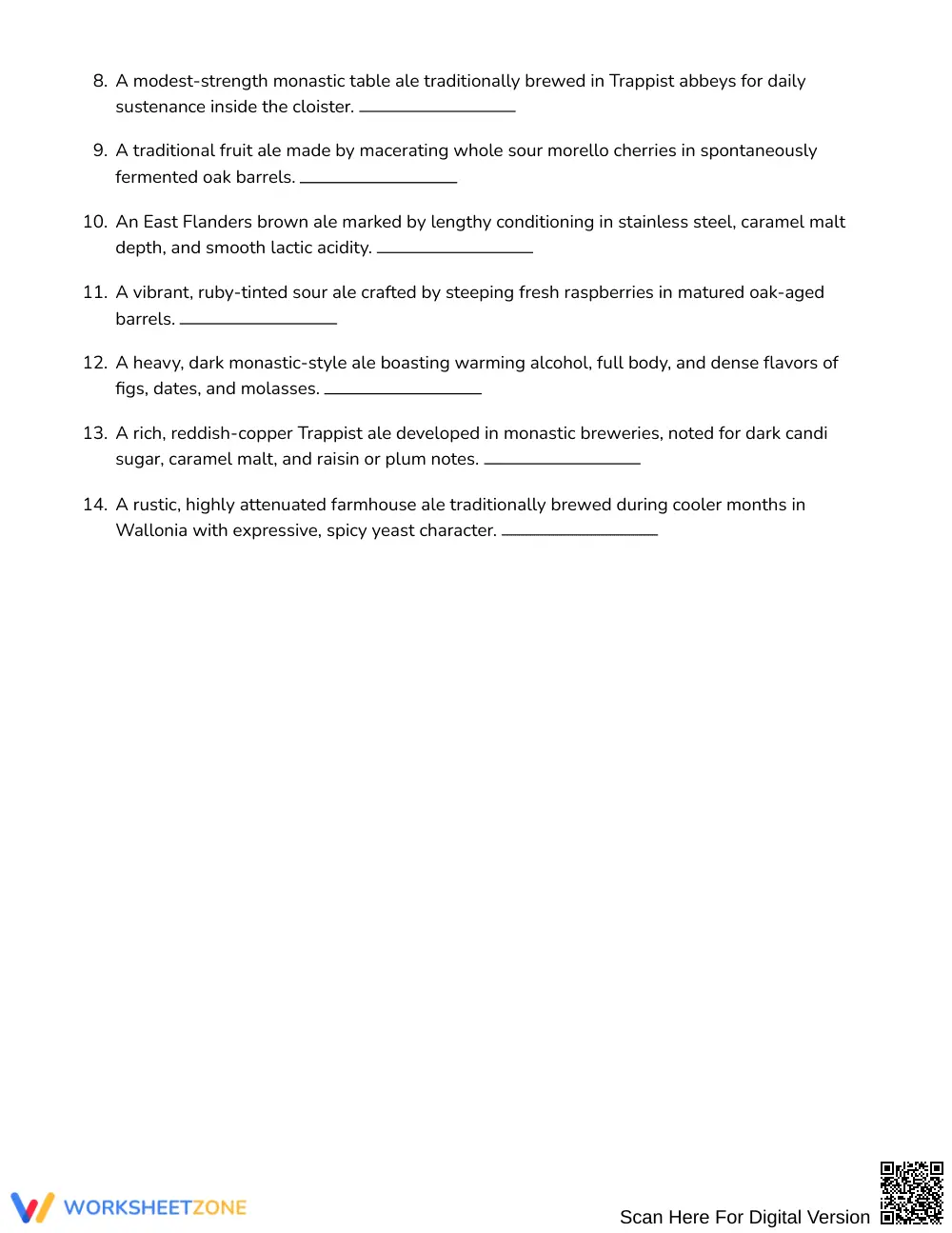
This vocabulary word search develops brewing terminology mastery by challenging adult learners to identify 14 classic Belgian-origin beer styles through descriptive sensory clues. Learners connect specialized definitions covering fermentation, flavor profiles, and regional heritage directly to target vocabulary terms, reinforcing domain-specific reading comprehension and beverage industry lexicon in an engaging, self-contained format.
At a Glance
- Grade: Adults (Age 21+) · Subject: English Language Arts (ELA)
- Standard: Not standards-assessed — technical domain vocabulary enrichment and recognition
- Skill Focus: Belgian-origin brewing style terminology and sensory vocabulary
- Format: 3 pages · 14 words · Complete answer key included · Reproducible PDF
- Best For: Hospitality staff training, culinary coursework, and adult hobbyist workshops
- Time: 20–30 minutes of focused independent or collaborative practice
What's Inside
The activity package spans 3 pages, including a clean clue sheet, a 16 by 16 letter grid, and a full 3-page solution guide. Learners read 14 clue definitions highlighting key brewing traits such as spontaneous fermentation, wild yeast profiles, Trappist traditions, and fruit maceration before searching for each corresponding Belgian beer style.
Puzzle Mechanics and Structure
This Clue Detective activity integrates targeted reading comprehension directly into puzzle-solving mechanics:
- Grid Dimensions: The puzzle features a structured 16 by 16 letter grid containing all 14 target terms.
- Word Orientations: Target vocabulary words run in four distinct directions: northeast (NE), east (E), southeast (SE), and south (S).
- Clue-Based Search: Learners work from detailed historical and sensory clues rather than a simple checklist, using a shuffled word bank to verify terminology before scanning the grid.
Standards Alignment
This resource is designed strictly for specialized vocabulary enrichment and adult informational literacy. It is not aligned to standard elementary or secondary academic benchmarks, providing focused domain terminology for culinary, beverage service, and adult vocational contexts.
How to Use It
Deploy this word search during adult hospitality vocational training following an introductory lecture on European brewing history. Instructors can circulate during the initial clue-solving phase to check whether learners correctly connect descriptive attributes—such as lactic acidity or spontaneous fermentation—to styles like Lambic or Oud Bruin before scanning the grid. Alternatively, distribute the puzzle as an engaging warm-up activity for culinary tasting seminars, allowing 20 to 30 minutes for learners to finish independently or in peer pairs.
Who It's For
This activity is tailored for adult learners, hospitality professionals, culinary arts students, and beverage industry apprentices seeking to master technical style classifications. Instructors can support emerging learners by pairing the puzzle with an introductory beer flavor wheel or sensory anchor chart.
Domain-specific vocabulary acquisition relies on structured exposure to descriptive contextual clues rather than rote memorization of isolated terms. Fisher & Frey (2014) demonstrate that adult and secondary learners build durable conceptual networks when specialized terminology is reinforced through active clue analysis, intentional reading, and targeted retrieval practice. This Belgian beer style word search operationalizes that instructional principle by requiring adult learners to analyze 14 distinct technical sensory descriptions—incorporating brewing processes, historical fermentation techniques, and regional flavor profiles—before identifying target vocabulary within a 16 by 16 puzzle grid. Engaging with informational clues prompts adult learners to evaluate defining attributes such as spontaneous fermentation, monastic brewing traditions, and fruit maceration. Integrating contextual clue decoding with spatial word recognition strengthens long-term lexical retention, reading comprehension, and professional beverage communication skills across vocational hospitality and culinary training environments.


