































Complete Beer Types Word Search | Adults ELA

Paste this activity's link or code into your existing LMS (Google Classroom, Canvas, Teams, Schoology, Moodle, etc.).
Students can open and work on the activity right away, with no student login required.
You'll still be able to track student progress and results from your teacher account.
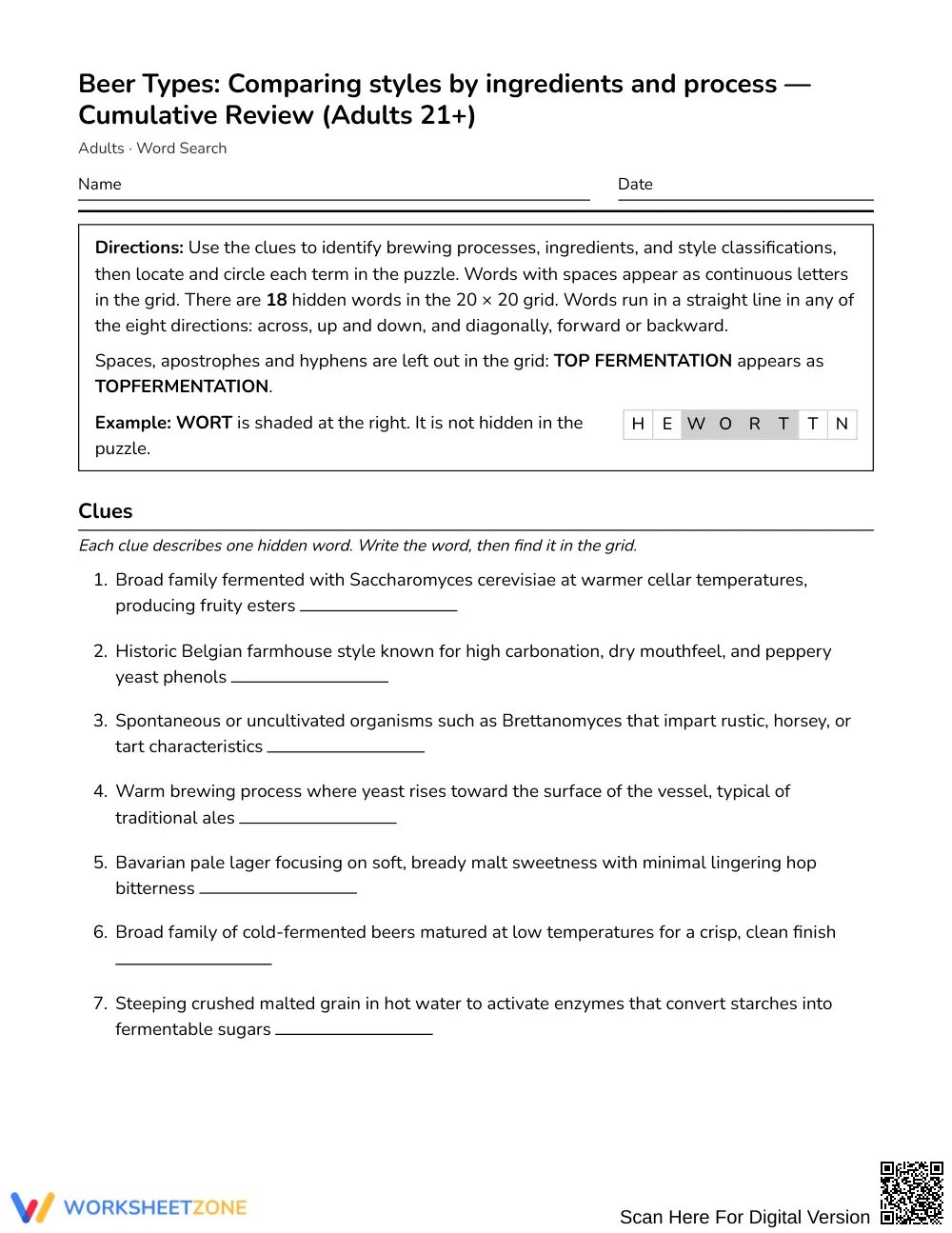
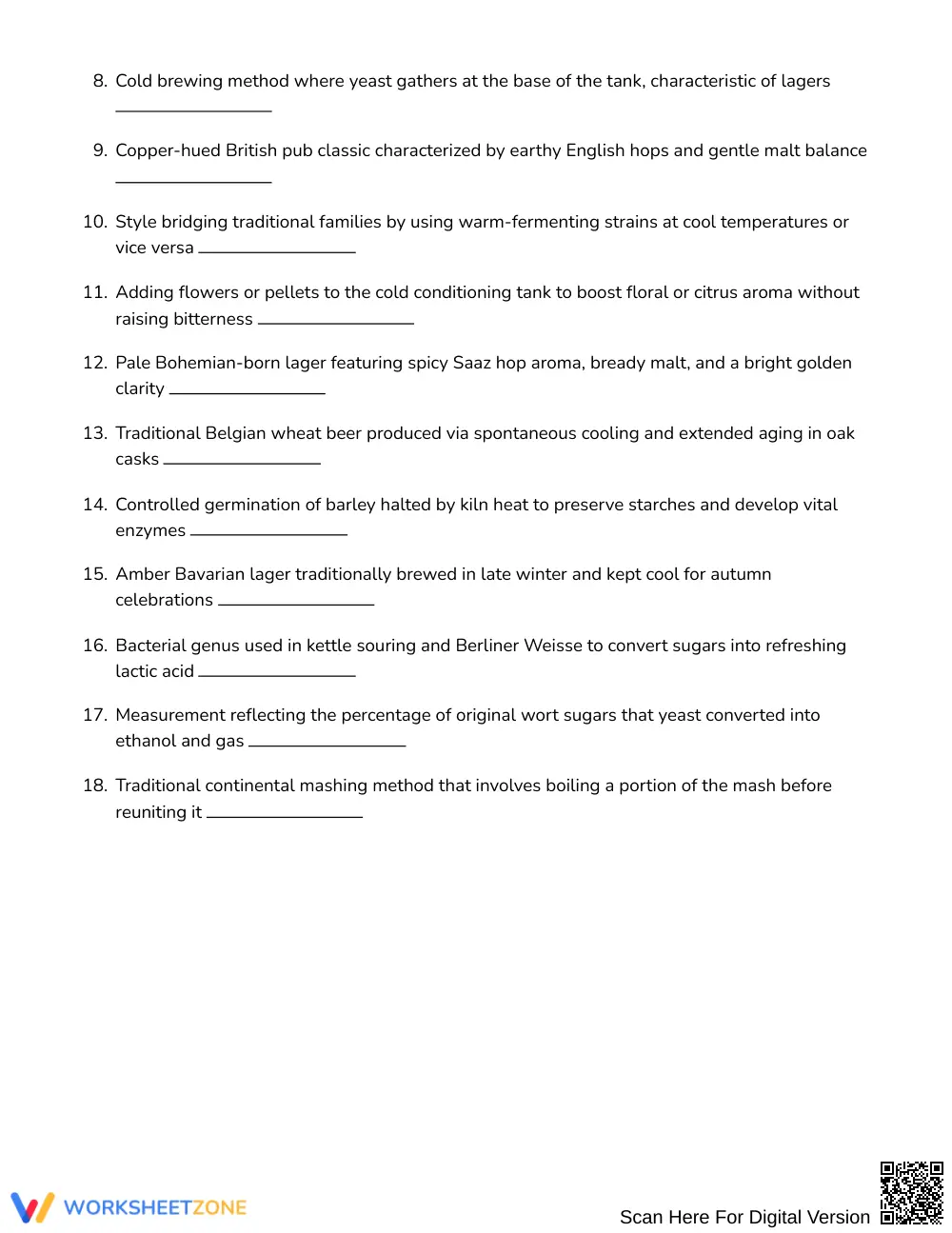
This beer types word search helps adult learners master domain-specific terminology by comparing brewing styles, essential ingredients, and fermentation processes. Learners read descriptive definitions to identify 18 specialized terms—including decoction, attenuation, and wild yeast—before locating them within the grid. The activity reinforces critical brewing concepts while expanding technical vocabulary for hospitality or culinary contexts.
At a Glance
- Grade: Adults · Subject: English Language Arts (ELA)
- Standard: Not standards-assessed — vocabulary enrichment
- Skill Focus: Comparing styles by ingredients and process
- Format: 3 pages · 18 words · Answer key included · PDF
- Best For: Hospitality training or vocabulary review
- Time: 25–35 minutes
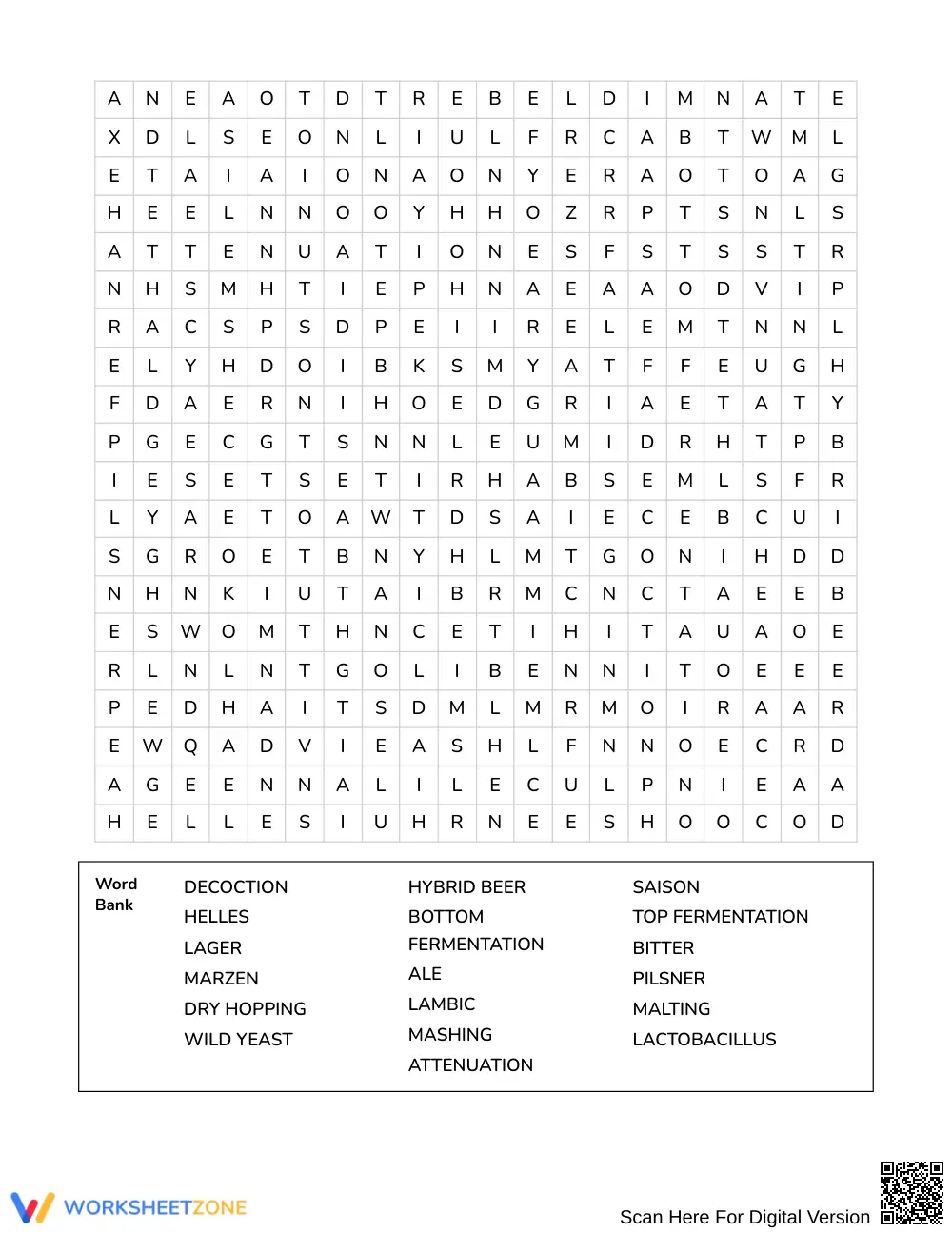
This 3-page printable set delivers an intensive lexical puzzle featuring 18 vocabulary targets. Each target term includes a concise, informational clue explaining its significance in traditional brewing, from top-fermented ales to cold-conditioned lagers. The layout includes an organized word bank, a comprehensive definition list, and a complete 4-page answer key that displays the full word search solution grid for rapid self-checking.
The activity challenges learners through a dense 20-by-20 letter matrix designed to reinforce orthographic recall. Words are hidden across all 8 compass directions: north, northeast, east, southeast, south, southwest, west, and northwest. To complete the puzzle, learners analyze clue prompts regarding yeast strains, mash chemistry, and historical classifications, deduce the matching technical term, and track it through overlapping letter sequences.
This activity provides specialized vocabulary enrichment rather than grade-level standards assessment. It targets technical reading comprehension and domain-specific lexicon within adult vocational education, brewing science, and culinary arts. Learners engage with sophisticated explanatory text defining bacterial fermentation, kiln malt drying, and hop maturation, expanding their working professional lexicon.
Deploy this word search during an introductory beverage service module or as a post-lecture review following instruction on fermentation biochemistry. Instructors can also assign the puzzle as a collaborative warm-up where pairs decode the clues before verifying spelling. During independent work, observe whether learners reference specific contextual markers in the clues—such as temperature distinctions or yeast genera—to deduce answers. Most adult learners finish the full challenge within 25 to 35 minutes.
This resource serves adult learners, continuing education participants, and vocational students in culinary, hospitality, or craft beverage programs. The clue-driven structure provides built-in scaffolding for English language learners by pairing complex technical terms with concrete operational definitions. For a complete instructional unit, pair this review puzzle with an informational text on malt mashing schedules or an authentic tasting sensory evaluation chart.
Domain-specific vocabulary acquisition relies on multiple meaningful encounters with technical terminology contextualized through precise definitions. As Fisher & Frey (2014) established in foundational research on disciplinary literacy, adult learners demonstrate significantly higher retention of complex concepts when orthographic word identification tasks are paired with descriptive conceptual definitions rather than rote isolated term lists. This vocational word search integrates 18 distinct terms covering brewing styles, ingredients, and fermentation mechanics, requiring learners to retrieve functional operational knowledge before locating each target word in the letter matrix. Providing detailed contextual descriptions—such as distinguishing warm top fermentation from cold bottom fermentation—transforms basic visual scanning into active semantic processing. Educational research confirms that structured vocabulary puzzles featuring explicit clue prompts strengthen orthographic memory pathways, build coherent domain schemas, and support adult vocational reading comprehension across technical workplace subjects.


