




























Views
Downloads


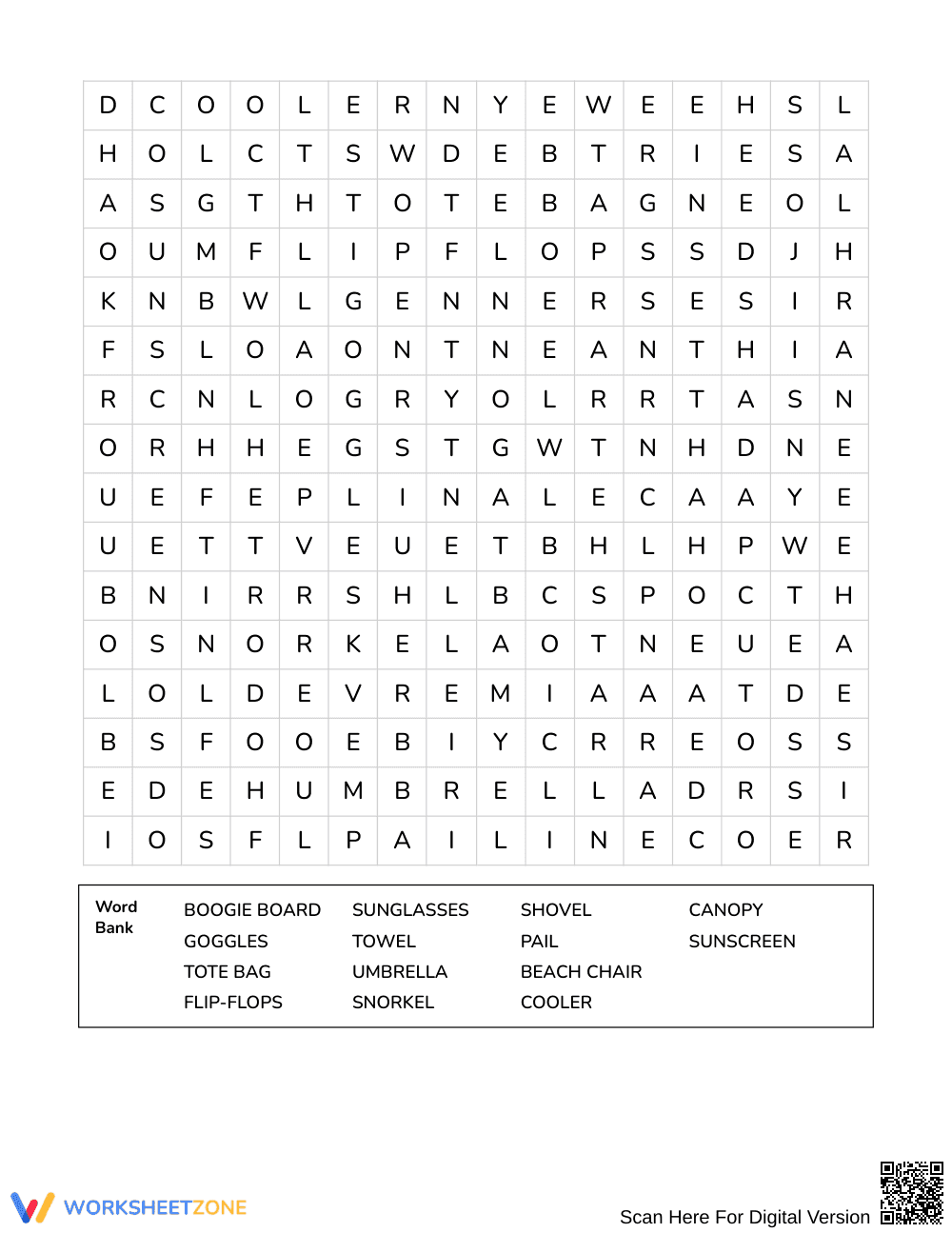

Complete Beach Equipment Word Search | Grades 4–5 ELA

Paste this activity's link or code into your existing LMS (Google Classroom, Canvas, Teams, Schoology, Moodle, etc.).
Students can open and work on the activity right away, with no student login required.
You'll still be able to track student progress and results from your teacher account.
This Grades 4–5 English Language Arts word search builds contextual vocabulary by challenging learners to identify and locate 14 words related to beach outing equipment. Students read descriptive clues to identify functional seaside gear before searching the letter grid, reinforcing word recognition, spelling precision, and reading comprehension through an engaging puzzle format.
At a Glance
- Grade: Grades 4–5 · Subject: ELA
- Standard: Not standards-assessed — vocabulary enrichment
- Skill Focus: Beach outing equipment vocabulary
- Format: 3 pages · 14 words · Answer key included · PDF
- Best For: Vocabulary warm-up or fast-finisher activity
- Time: 15–25 minutes
What's Inside: The resource spans 3 pages featuring an organized puzzle layout paired with full solutions. Students engage with 14 descriptive riddles that define common coastal items, paired with a shuffled word bank. A dedicated answer key displays exact letter coordinates, making self-checking and grading swift and reliable.
Puzzle Mechanics: The activity centers on a 16 x 16 letter grid packed with hidden terms. Learners scan the clues, deduce the target vocabulary, and trace words running northeast, east, southeast, and south. By orienting words across these four directional paths, the puzzle sharpens visual discrimination while keeping cognitive focus on equipment definitions.
Standards Alignment: This activity provides targeted vocabulary enrichment and is not aligned to a specific grade-level standard. It supports foundational language development by prompting students to infer meaning from informational clues and connect functional descriptions to concrete everyday terminology.
How to Use It: Introduce this activity after direct vocabulary instruction as independent desk work, or assign it during literacy centers to reinforce thematic word study. During seatwork, circulate and monitor whether students deduce words directly from clues before referencing the shuffled bank. Learners typically complete the activity within 15 to 25 minutes.
Who It's For: Designed for upper elementary learners in Grades 4–5, this puzzle accommodates diverse readers who benefit from clue-based context clues. Pair this activity with an informational reading passage about coastal environments, summer safety routines, or a descriptive writing prompt about planning a seaside trip.
Integrating contextual clue-solving with word searches strengthens orthographic mapping and lexical acquisition among upper elementary students. According to Fisher & Frey (2014), intentional vocabulary acquisition requires multiple exposures to words within meaningful contexts rather than rote memorization alone. When students read functional descriptions of beach outing equipment, infer target terminology, and scan complex letter arrays across four distinct directional axes, they activate both semantic retrieval and visual-spatial analysis. This dual-processing approach secures spelling patterns and deepens comprehension of domain-specific nouns. The structured layout ensures learners engage in active retrieval practice rather than passive letter matching, producing measurable gains in vocabulary retention and literacy confidence. Teachers can readily verify student mastery across all 14 equipment terms using the provided coordinate answer key, ensuring efficient review during busy classroom rotations.


