




























Complete Baseball Positions Word Search | Grades 7–8 ELA
Paste this activity's link or code into your existing LMS (Google Classroom, Canvas, Teams, Schoology, Moodle, etc.).
Students can open and work on the activity right away, with no student login required.
You'll still be able to track student progress and results from your teacher account.
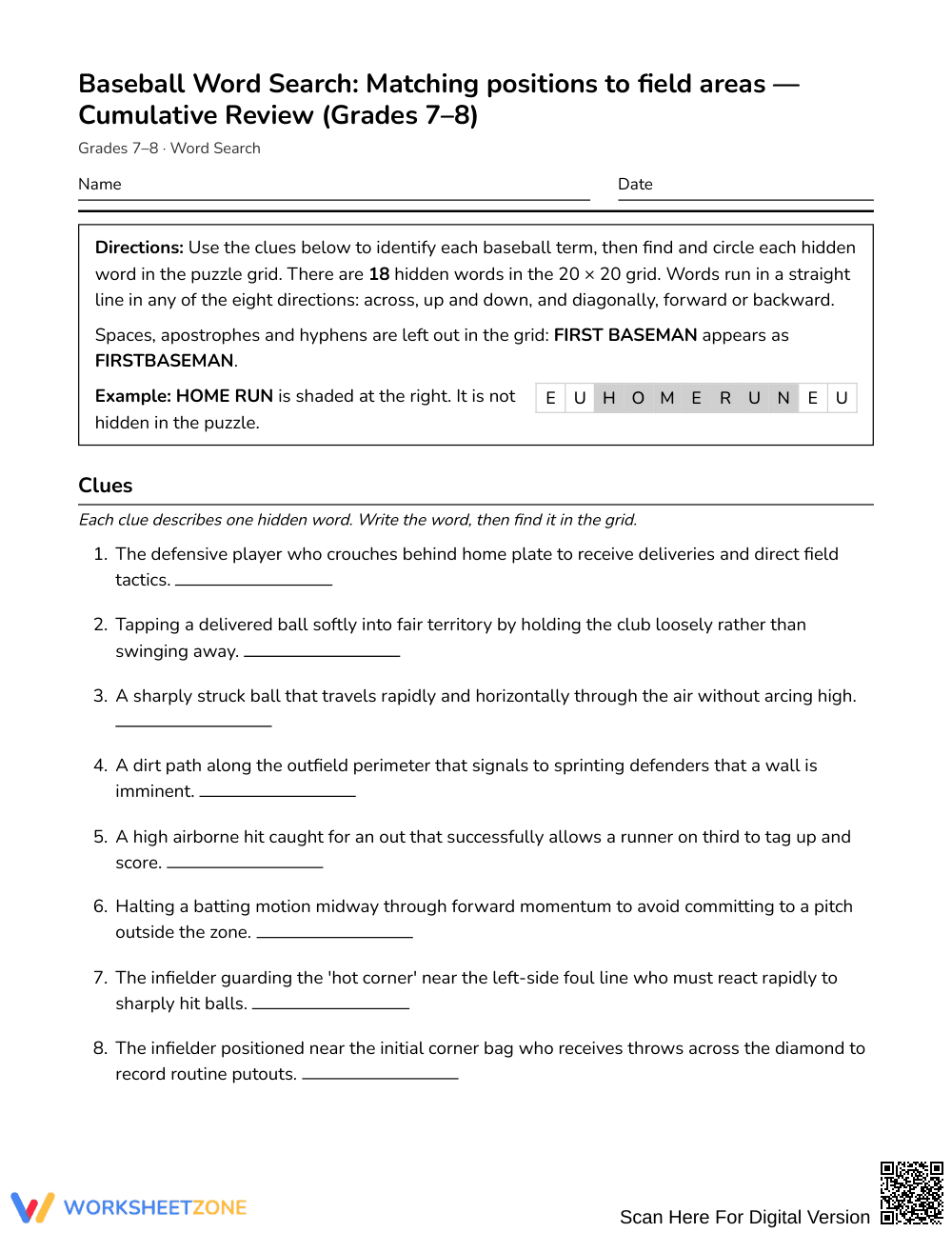
This baseball vocabulary word search challenges Grades 7–8 students to connect athletic positions with their physical locations on the playing field. By solving descriptive text clues and scanning a dense letter grid, learners reinforce domain-specific sports terminology and spatial vocabulary during independent reading and language arts coursework.
At a Glance
- Grade: Grades 7–8 · Subject: English Language Arts (ELA)
- Standard: Not standards-assessed — vocabulary enrichment and informational text term reinforcement
- Skill Focus: Matching defensive baseball positions to specific playing field areas
- Format: 3 student pages · 18 hidden words · Full answer key included · Printable PDF
- Best For: Independent vocabulary review, early finisher enrichment, or emergency sub plans
- Time: 20–35 minutes total completion time
What's Inside
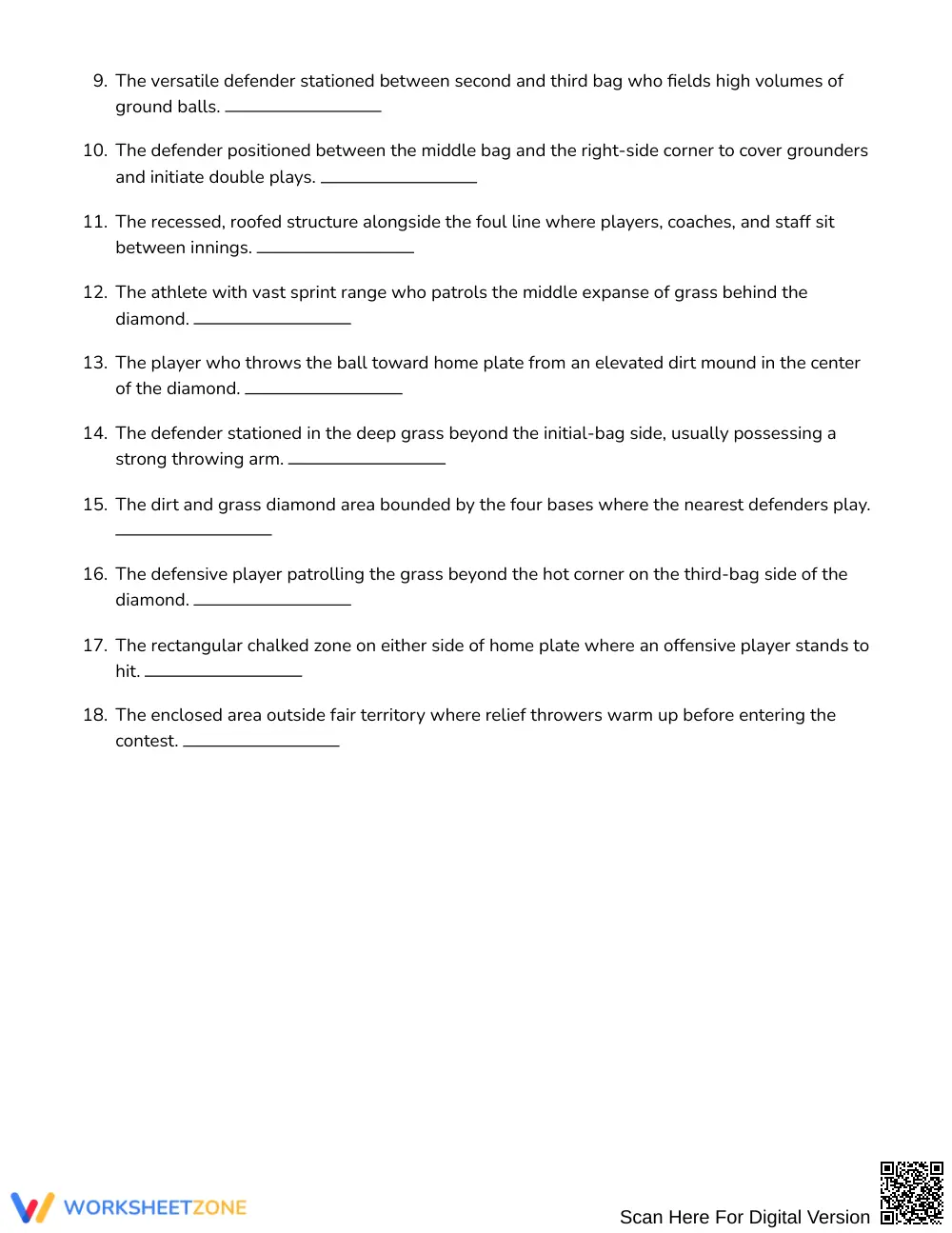
The 3-page printable activity packet features 18 hidden vocabulary terms distributed across an extensive puzzle grid accompanied by complete contextual definitions. Rather than presenting a simple checklist, each term is paired with an informational clue detailing player responsibilities and field geometry. A comprehensive 4-page answer key displays exact coordinate paths for quick verification.
How the Puzzle Works
Students navigate a 20 by 20 character grid where 18 vocabulary words are placed in eight possible directions: North, Northeast, East, Southeast, South, Southwest, West, and Northwest. Learners read definitions from a shuffled clue bank—such as identifying the player guarding the 'hot corner'—deduce the corresponding target term, and locate the sequence within the letter matrix.
Standards Alignment
This activity provides dedicated vocabulary enrichment and is not aligned to a formal state standard. It focuses on strengthening technical sports vocabulary, spelling patterns, and deductive reasoning skills to support informational text comprehension across secondary language arts classrooms.
How to Use It
Deploy this word search directly after an informational sports reading unit to consolidate thematic vocabulary, or assign it as an independent station task while conducting small-group literacy conferences. For formative observation, monitor whether students solve the structural clues before searching or rely solely on letter scanning. Most middle school learners finish within 20 to 35 minutes.
Who It's For
This puzzle is designed for Grades 7–8 ELA students exploring athletic nonfiction, technical texts, or descriptive terminology. For struggling readers, highlight key nouns within the clues beforehand to prompt recognition. Pair this resource naturally with an informational article analyzing baseball history or ballpark dimensions.
According to research synthesized by Fisher & Frey (2014) on secondary literacy development, structured vocabulary reinforcement that pairs explicit definition analysis with visual word retrieval significantly improves long-term semantic retention. Although this activity serves as non-standards-assessed vocabulary enrichment rather than a formal benchmark, engaging students in identifying domain-specific athletic terms—such as pitcher, shortstop, and warning track—strengthens both orthographic awareness and background knowledge. The 18 targeted terms require adolescents to evaluate descriptive positional clues and recognize multisyllabic vocabulary across an 8-directional 20 by 20 grid. Classroom data reviewed in literacy research indicates that contextual word puzzles serve as effective low-stakes reinforcement tools, fostering independent word consciousness and aiding informational reading comprehension. Educators can utilize these focused enrichment exercises to solidify specialized terminology without requiring extended teacher intervention or grading overhead during busy instructional rotations.


