




























Views
Downloads

Complete Atomic Structure Worksheet | Grade 9 Science

Paste this activity's link or code into your existing LMS (Google Classroom, Canvas, Teams, Schoology, Moodle, etc.).
Students can open and work on the activity right away, with no student login required.
You'll still be able to track student progress and results from your teacher account.
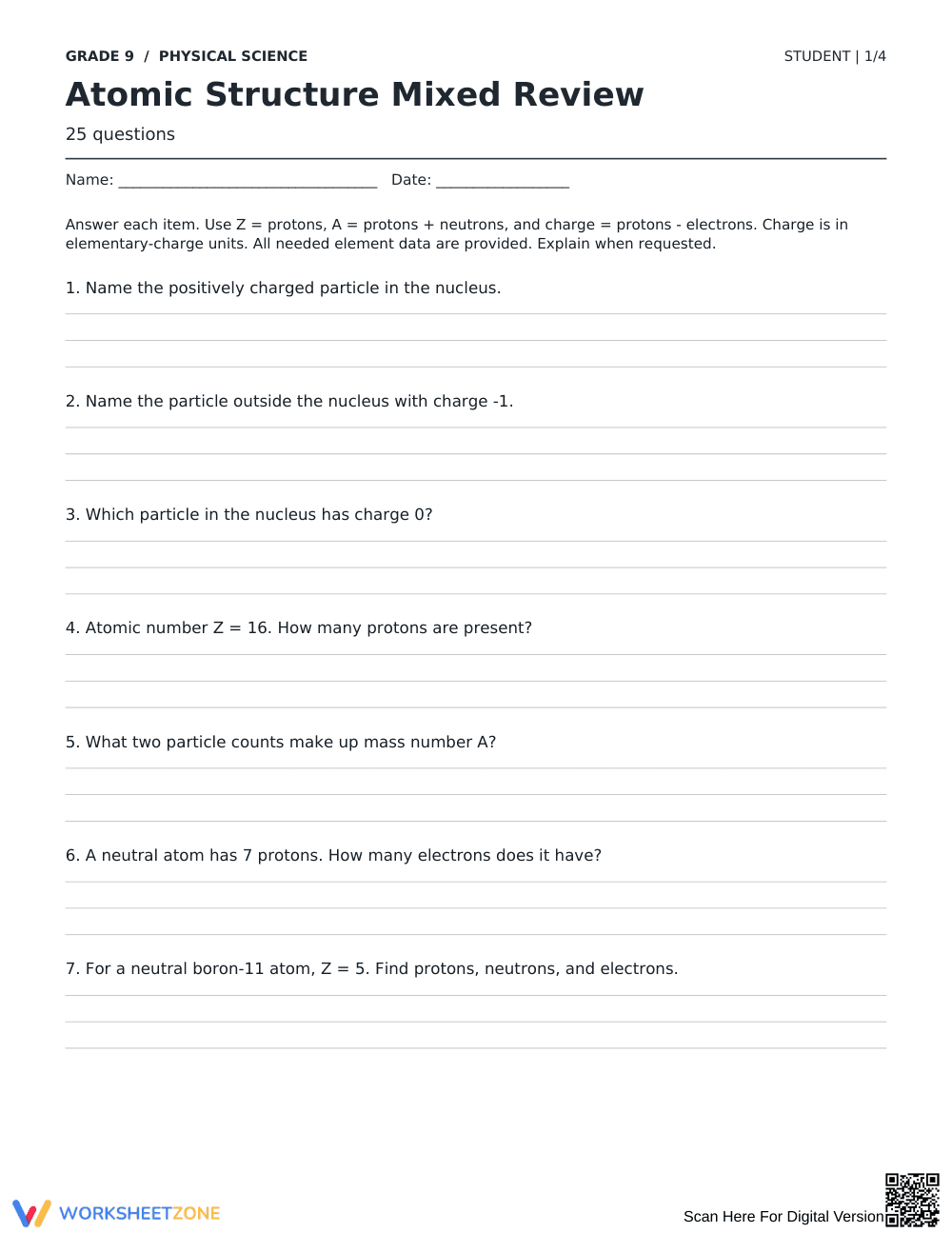
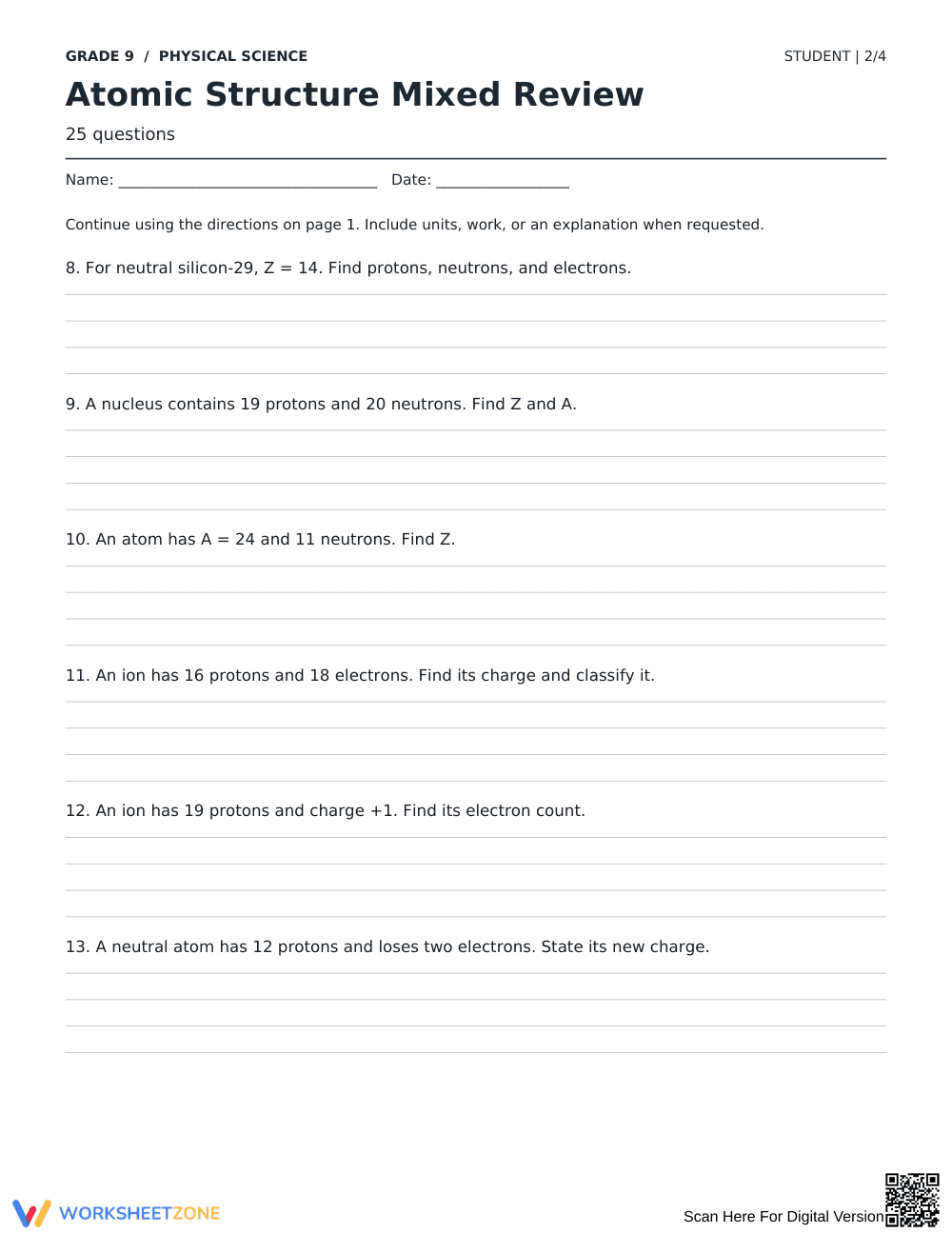
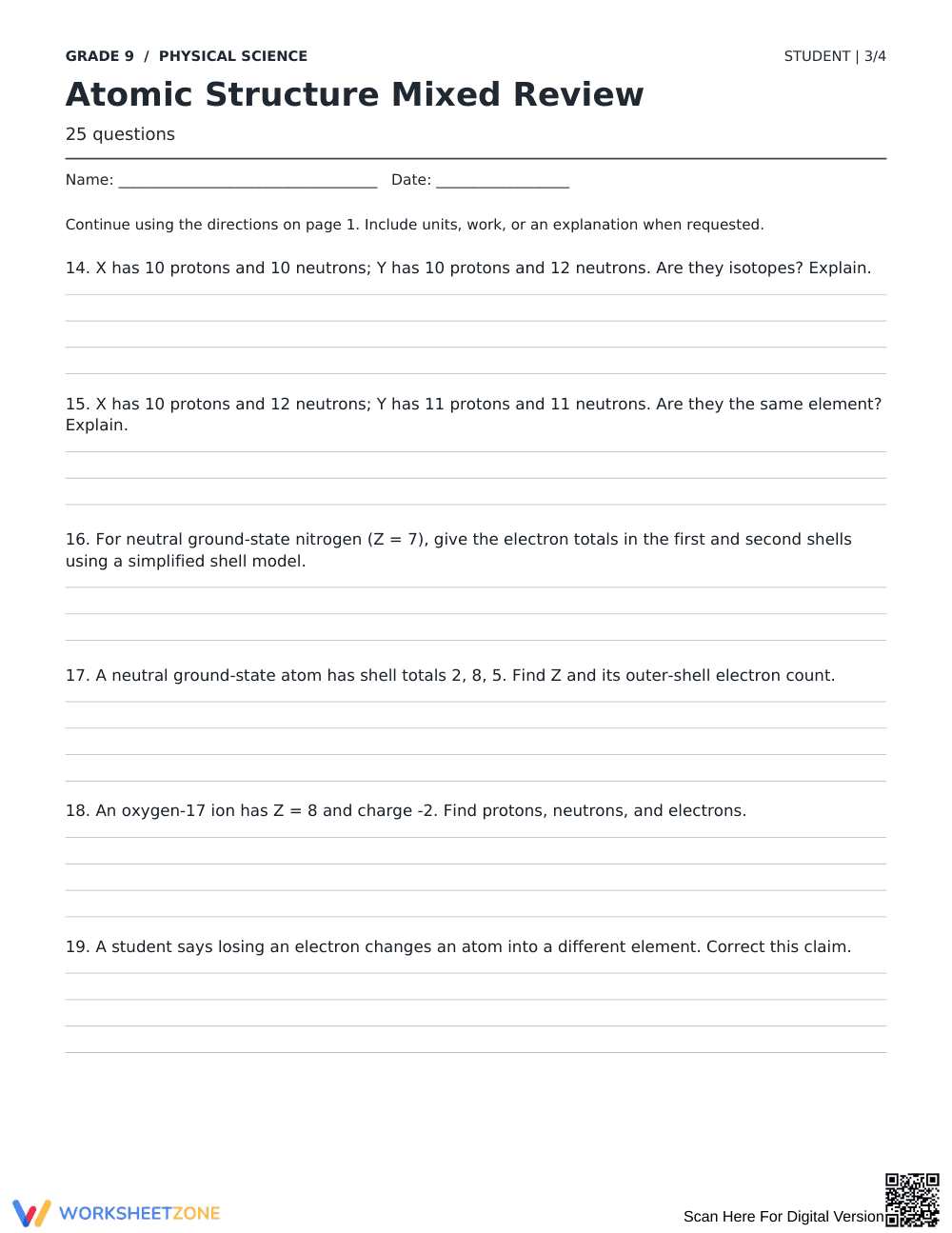
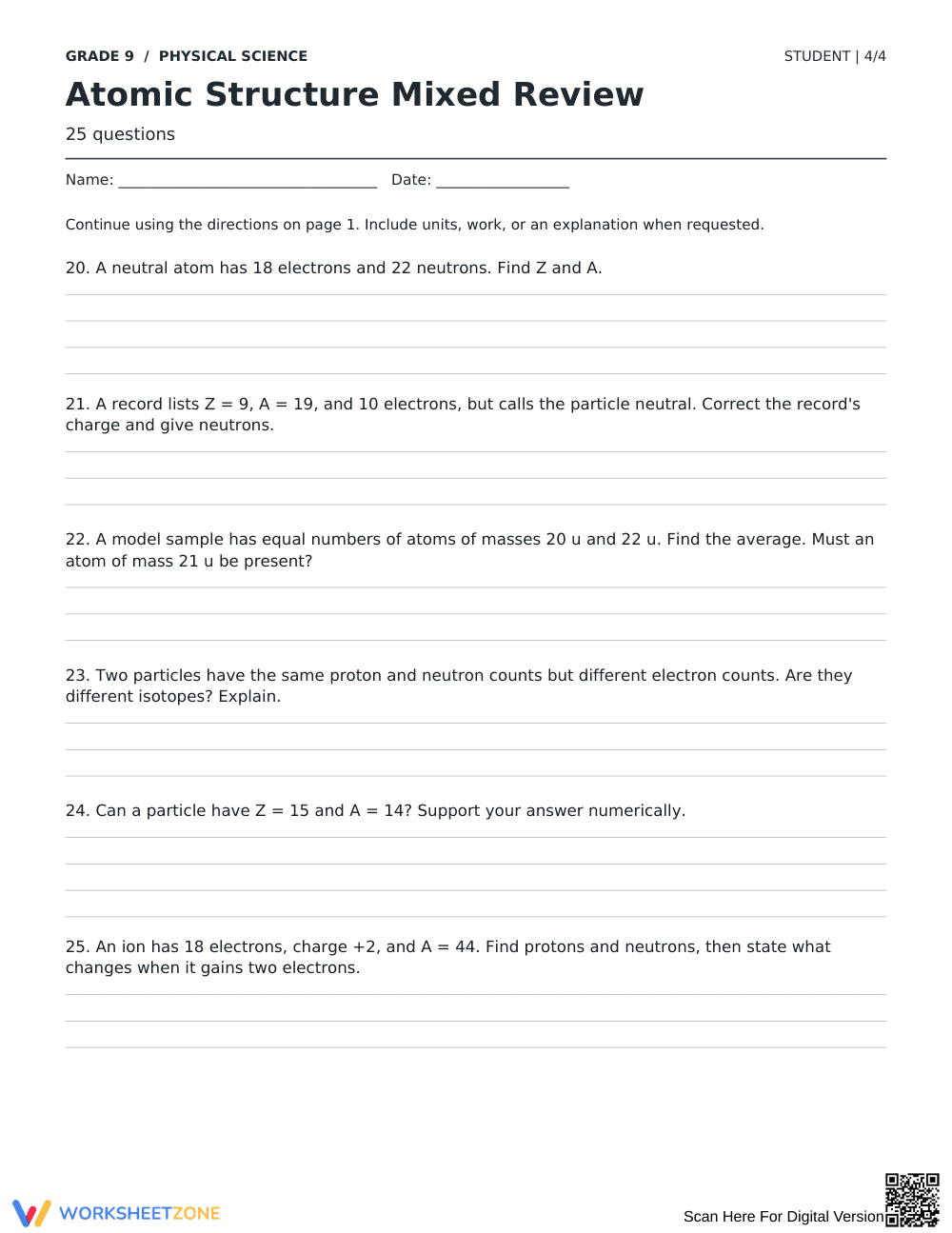
This atomic structure worksheet helps Grade 9 physical science students master subatomic calculations, isotopic notation, and electron shell configurations. Learners determine protons, neutrons, and electrons from atomic numbers, mass numbers, and ionic charges. Through 25 focused questions, students build conceptual clarity and quantitative precision across core physical science principles.
At a Glance
- Grade: 9 · Subject: Science
- Standard:
HS-PS1-1— Model atomic substructure and determine subatomic particle arrangements in neutral atoms and ions- Skill Focus: Atomic structure, subatomic counts, isotopes, and ions
- Format: 4 pages · 25 problems · Answer key included · PDF
- Best For: Independent practice, unit review, or homework
- Time: 25–40 minutes
What's Inside
This 4-page student worksheet includes 25 structured questions spanning particle identification, arithmetic calculations with atomic formulas (atomic number, mass number, and net charge), isotope evaluation, and electron energy level diagrams. A comprehensive 2-page model answer key provides complete numerical solutions, step-by-step subtraction formulas, conceptual explanations, and a clear 2-point scoring guide.
Skill Progression
- Guided Practice (Questions 1–6): Foundational recall identifying particle charges, locations within or outside the nucleus, and direct application of atomic number and neutral electron counts.
- Supported Practice (Questions 7–15): Multi-step calculations finding proton, neutron, and electron counts from given notation, finding mass numbers, calculating net charge, and identifying isotope pairs.
- Independent Practice (Questions 16–25): Advanced problem-solving involving Bohr shell models, average atomic mass concepts, impossible atomic configurations, and multi-variable ion transformations.
This sequence follows a gradual-release instructional model that transitions students from fundamental vocabulary recall to independent scientific reasoning and error analysis.
Standards Alignment
Primary Standard: HS-PS1-1 — Use the periodic table as a model to predict the relative properties of elements based on the patterns of electrons in the outermost energy level of atoms. Supporting Standard: MS-PS1-1 covers developing models to describe the atomic composition of simple molecules and extended structures. Both standard codes can be copied directly into lesson plans, IEP goals, or district curriculum mapping tools.
How to Use It
Deploy this review worksheet after direct instruction on subatomic structure and isotopic symbols. Use questions 1 to 10 as an in-class mid-lesson check, monitoring whether students correctly subtract atomic number from mass number when finding neutrons. Assign the remaining items for 25 to 40 minutes of paired practice or independent summative review before unit exams.
Who It's For
Designed for Grade 9 physical science and introductory high school chemistry students. The clearly defined formulas provided at the top of page 1 support developing learners, while analytical reasoning questions challenge advanced students. Pair this activity directly with a reference periodic table chart and an interactive atom-building simulation.
According to research by Fisher & Frey (2014) on guided instruction, learning outcomes improve significantly when students progress systematically from core factual recall to complex, multi-step problem solving. This 25-item Grade 9 science worksheet operationalizes that pedagogical framework for standard HS-PS1-1 by guiding learners through subatomic particle calculations, isotope identification, and ionic charge determinations. High school students often conflate mass number with atomic number or miscalculate net ionic charges during early chemistry instruction. By structuring atomic calculations around explicit mathematical relationships, this resource reinforces foundational chemical principles before students encounter periodic trends. Teachers can utilize the detailed 2-page answer key for accurate formative evaluation, ensuring that every learner achieves mastery in modeling atomic substructure and electron configurations across introductory physical science and chemistry units.


