































Complete Atomic Foundations Worksheet | Grades 9-12 Science

Paste this activity's link or code into your existing LMS (Google Classroom, Canvas, Teams, Schoology, Moodle, etc.).
Students can open and work on the activity right away, with no student login required.
You'll still be able to track student progress and results from your teacher account.
This comprehensive science worksheet builds foundational chemistry knowledge by introducing core atomic structure and periodic table vocabulary across 37 targeted questions. Students define key terms, analyze simplified Bohr models, interpret isotope data, and address common misconceptions about physical versus chemical changes. It delivers clear practice to prepare high school learners for chemistry units or introductory video investigations.
At a Glance
- Grade: Grades 9–12 · Subject: Science
- Standard: Core Physical Science — Describe atomic structure, periodic trends, and chemical versus physical properties
- Skill Focus: Foundational atomic vocabulary, Bohr models, and isotopes
- Format: 4 pages · 37 problems · Answer key included · PDF
- Best For: Video introduction, pre-assessment, or review
- Time: 40–50 minutes
What's Inside
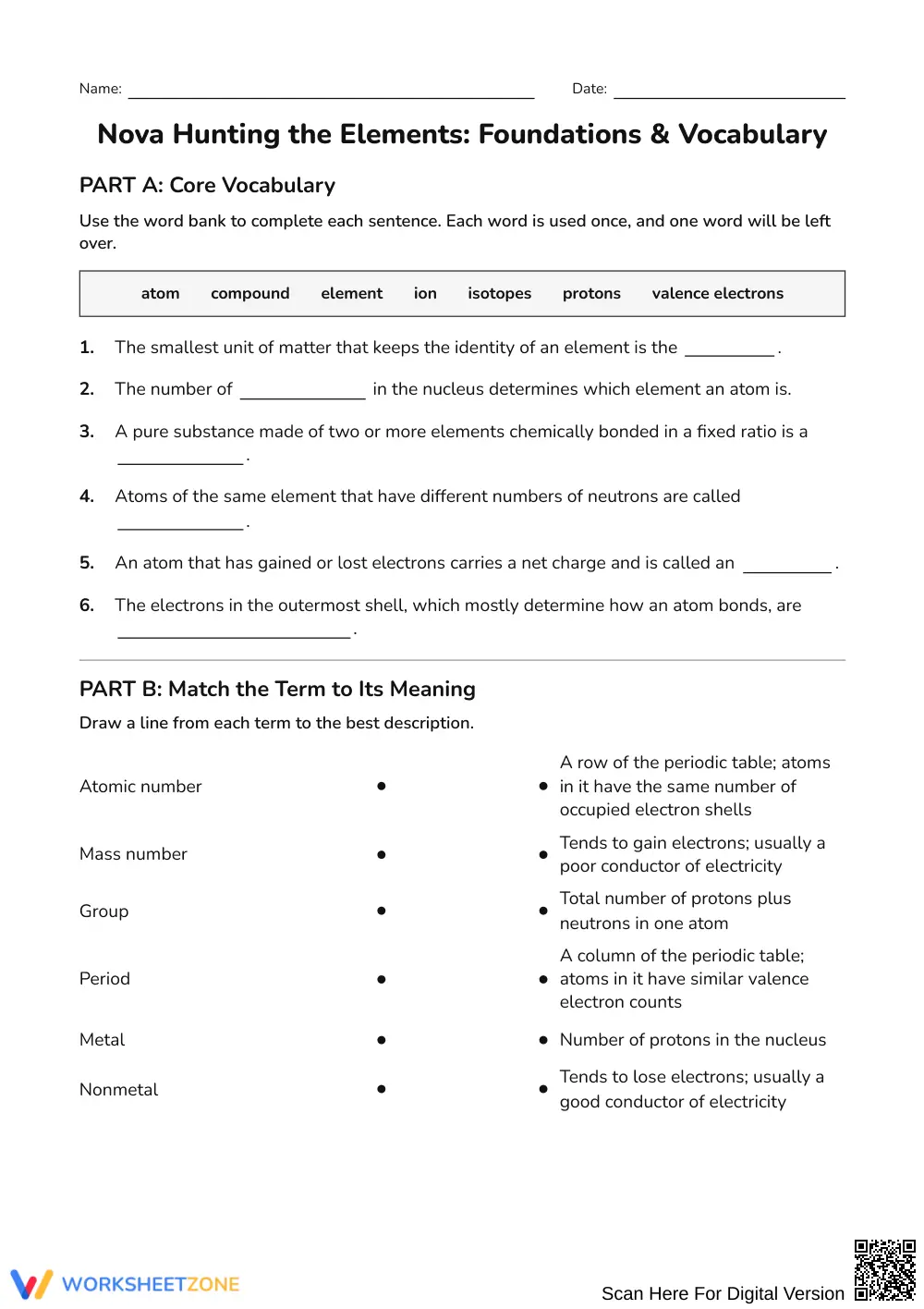
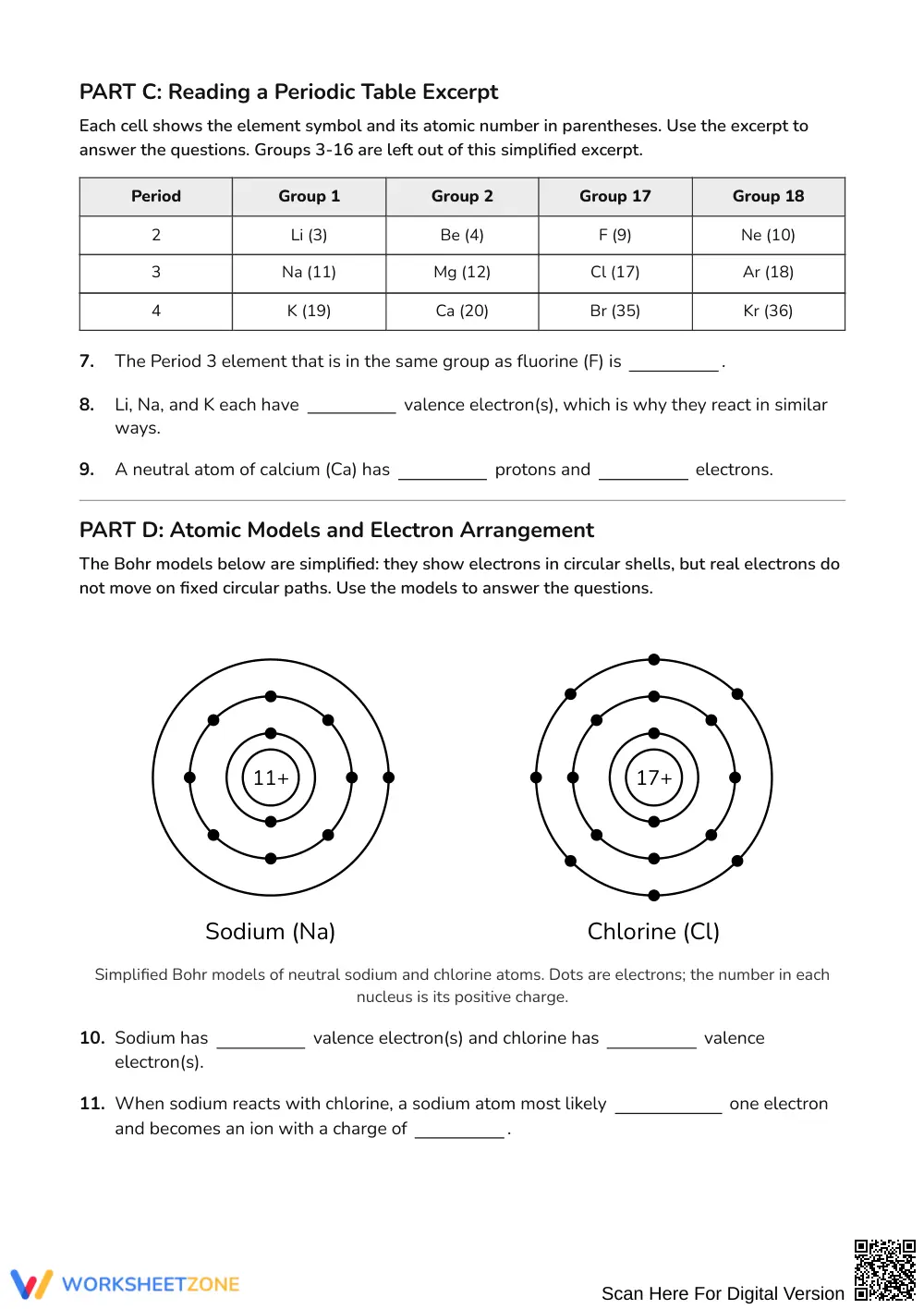
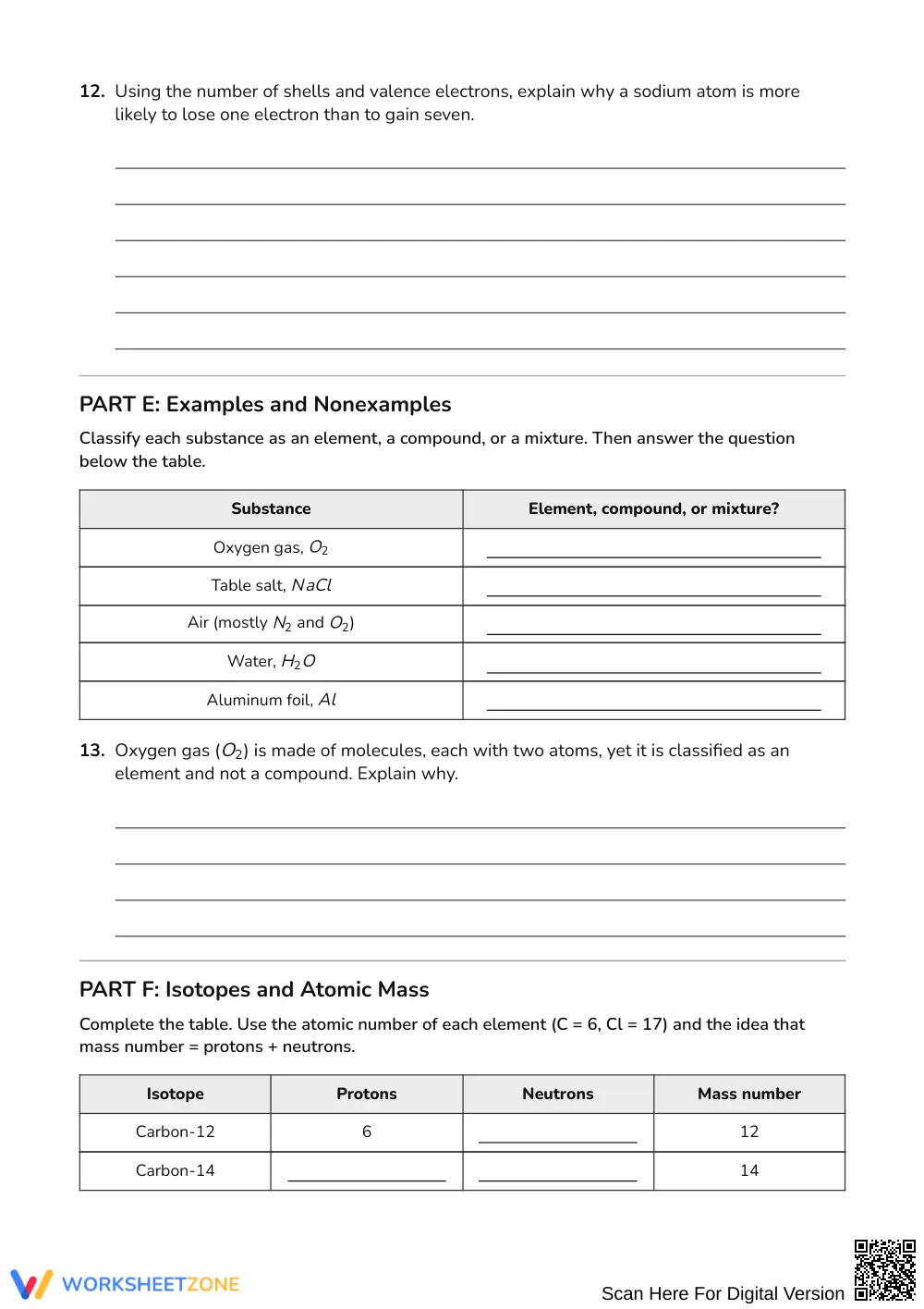
The 4-page student activity features seven distinct sections: word bank sentence completion, terminology matching, periodic table excerpt interpretation, simplified Bohr model analysis, matter classification (element, compound, or mixture), isotope calculations, and an error-analysis misconception check. A complete 4-page answer key provides full explanations and sample student responses.
Skill Progression
- Guided practice (Parts A–B, 13 tasks): Students identify baseline definitions using a structured word bank and match foundational vocabulary terms with low cognitive load.
- Supported practice (Parts C–E, 14 tasks): Students apply definitions to periodic trends, calculate subatomic particles, analyze electron arrangements, and classify chemical formulas.
- Independent practice (Parts F–G, 10 tasks): Students compute isotope mass numbers and resolve a nuanced misconception regarding molecular bonds during phase changes.
This deliberate sequence mirrors the gradual release of responsibility model, guiding students from direct recall to rigorous conceptual explanation.
Standards Alignment
This resource aligns with high school physical science performance expectations for structure and properties of matter. Students use the periodic table as a model to predict the relative properties of elements based on the patterns of valence electrons in outermost energy levels. This alignment can be documented directly in lesson plans and curriculum maps.
How to Use It
Deploy this worksheet prior to viewing NOVA’s Hunting the Elements documentary to activate prior knowledge, or use it during an introductory chemistry unit following direct instruction on atomic theory. During classwork, circulate to monitor Part D; observe whether students correctly identify that sodium loses one electron rather than gaining seven. Students typically complete the 37 tasks within 40 to 50 minutes.
Who It's For
Designed for introductory chemistry and physical science students in grades 9 through 12, this resource accommodates diverse readiness levels through defined word banks and clear diagrams. Pair this activity naturally with periodic table reference sheets or an introductory multimedia presentation on atomic structure.
According to Fisher & Frey (2014), structured vocabulary acquisition and guided error analysis are pivotal in helping secondary students bridge the gap between conversational vocabulary and discipline-specific scientific discourse. This 4-page foundational science worksheet directly activates conceptual understanding of atomic composition, valence electrons, periodic trends, and isotope notation across 37 tiered tasks. When secondary science students interact with recurring chemical terms through matching, diagram interpretation, and real-world classification, they build durable cognitive schemas essential for higher-level chemistry concepts. Furthermore, requiring students to critique and rewrite a prevalent physical science misconception—specifically, distinguishing between intermolecular spacing and intramolecular bond cleavage during phase changes—solidifies empirical reasoning. Teachers can rely on this systematic progression to diagnose knowledge gaps, reinforce essential terminology, and cultivate academic literacy across all high school science classrooms prior to complex lab investigations.


