

































Complete Argument-Reasoning Worksheet | Grade 12 English IV

Paste this activity's link or code into your existing LMS (Google Classroom, Canvas, Teams, Schoology, Moodle, etc.).
Students can open and work on the activity right away, with no student login required.
You'll still be able to track student progress and results from your teacher account.
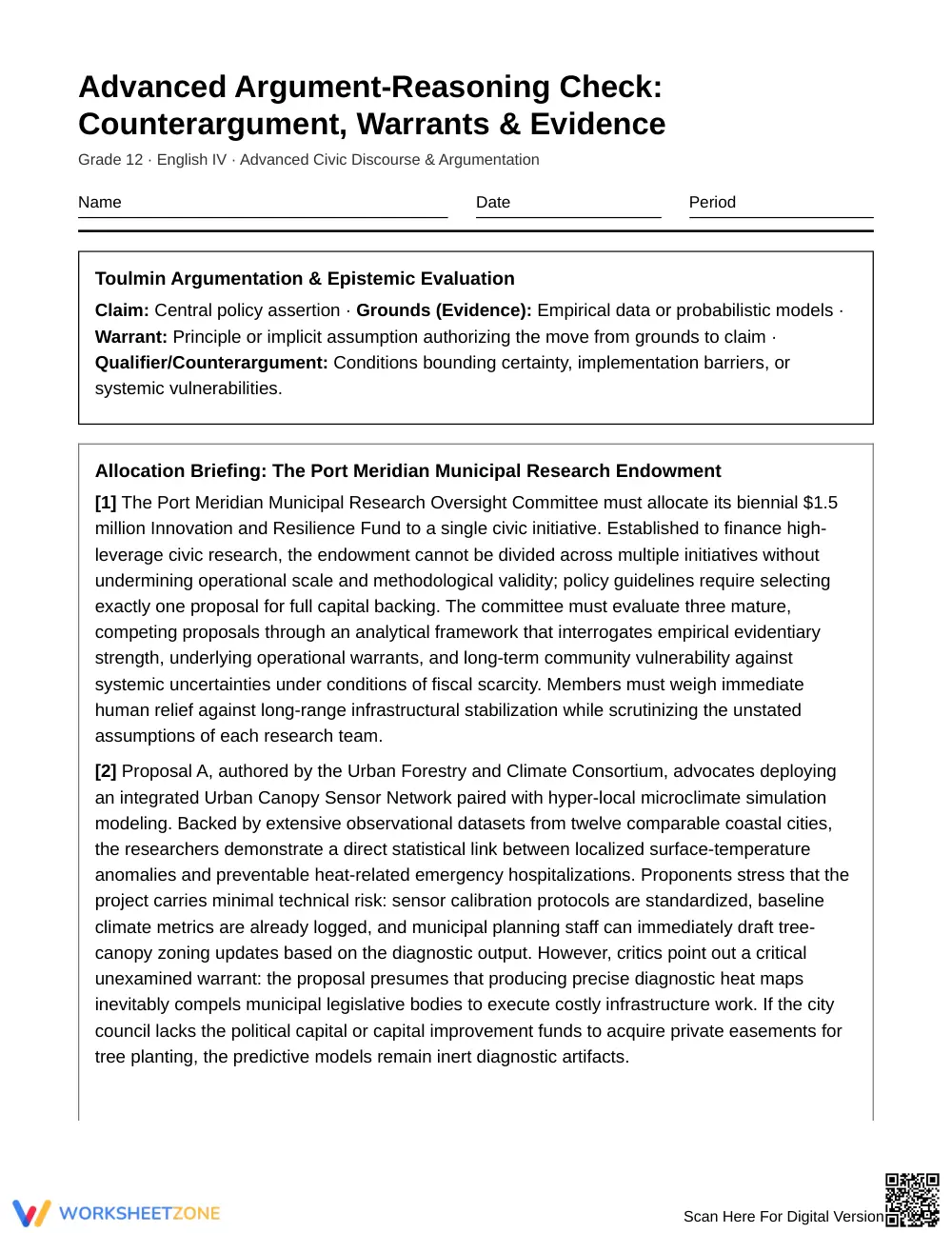
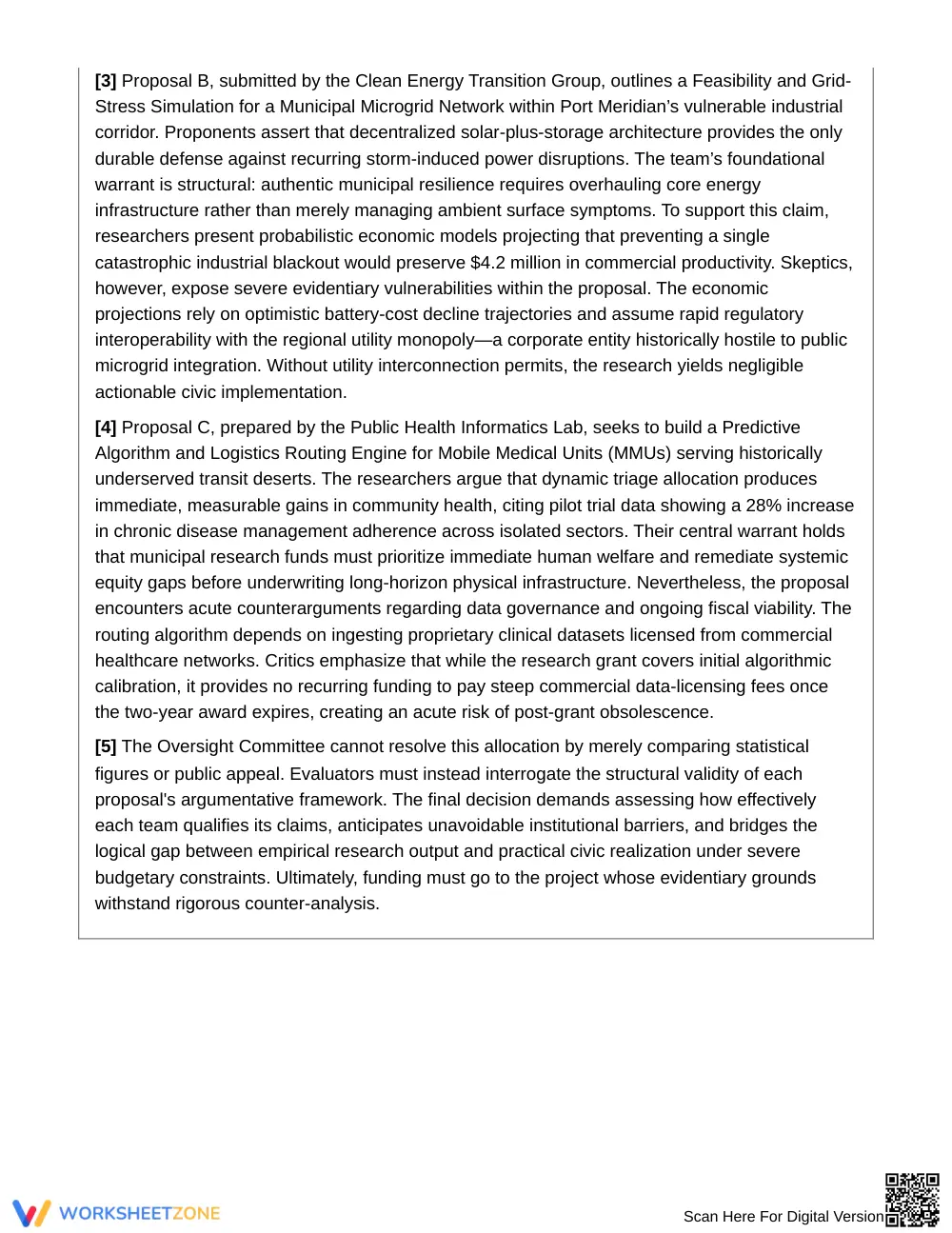
This Grade 12 English IV worksheet trains students to critically evaluate warrants, empirical grounds, and counterarguments within civic policy discourse. Learners dissect three competing municipal endowment proposals, expose unstated assumptions, and construct bounded revisions. The tasks prepare students for advanced rhetorical evaluation and collegiate academic writing.
At a Glance
- Grade: 12 · Subject: English IV (Advanced Civic Discourse)
- Standard: Rhetorical Analysis — Evaluate evidentiary sufficiency, implicit warrants, and structural counterarguments in complex civic policy texts
- Skill Focus: Advanced Argument-Reasoning Check
- Format: 6 student pages · 12 analytical problems · 3-page answer key included · PDF
- Best For: Post-instruction critical rhetoric and argumentation evaluation
- Time: 45–60 minutes total
What's Inside
This 6-page printable resource includes a municipal research briefing, 12 analytical tasks, and a 3-page explanatory answer key. Featuring a Toulmin argumentation model reference header, the worksheet provides multiple-choice identification items, assumption analysis prompts, bounded sentence revisions, and an evaluative written defense paragraph.
Skill Progression
- Guided practice (Tasks 1–3): Students identify explicit claims, empirical grounds, and counterarguments within the briefing using targeted prompts.
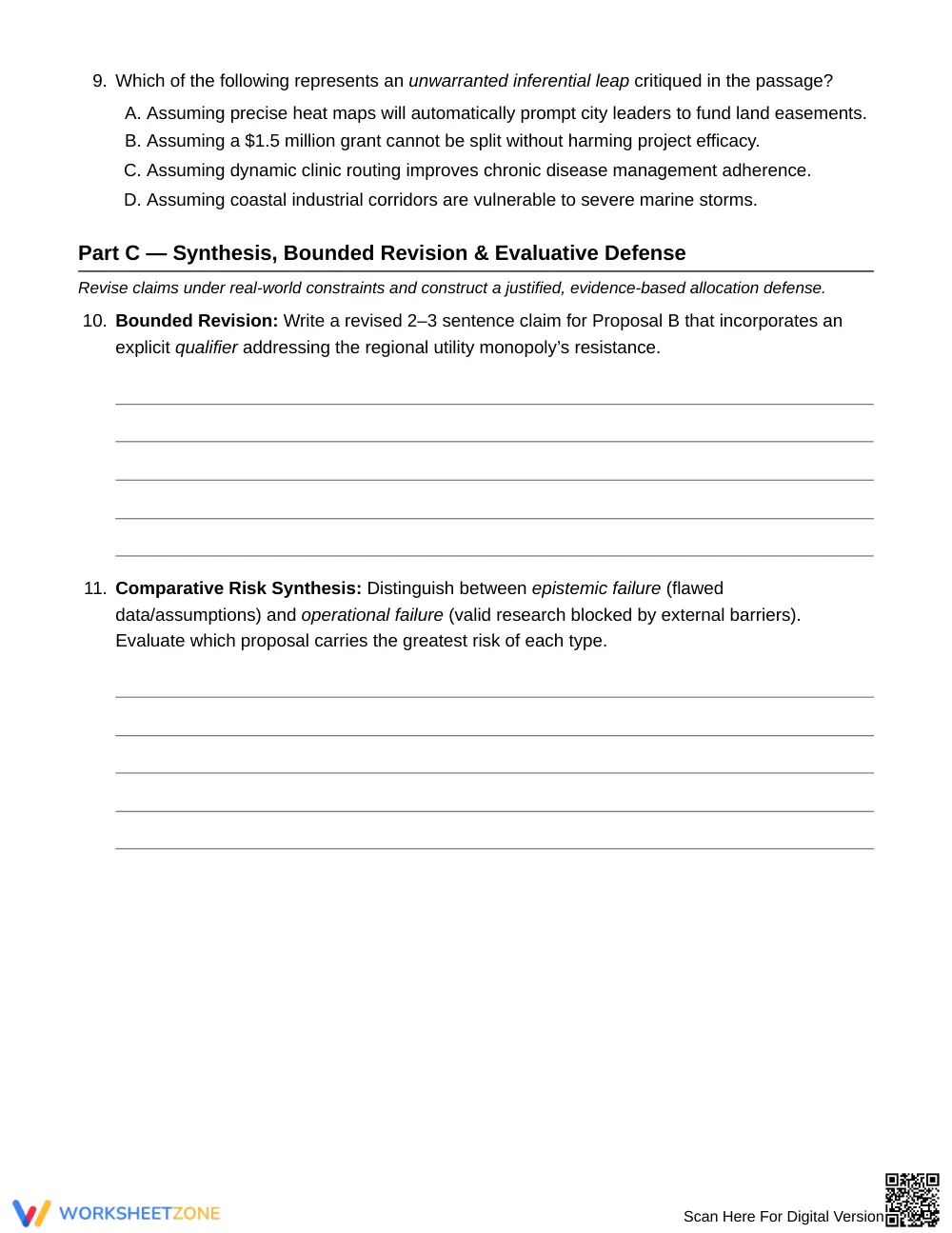
- Supported practice (Tasks 4–9): Learners analyze unverified assumptions, evaluate competing warrants, and propose operational modifications for data vulnerabilities.
- Independent practice (Tasks 10–12): Students revise policy claims with qualifiers, distinguish failure modes, and compose an evaluative allocation defense.
This sequence follows the gradual-release framework, moving learners from basic structural identification to independent rhetorical defense.
Standards Alignment
This worksheet aligns with advanced high school English language arts benchmarks for delineating and evaluating reasoning in civic texts. Students assess empirical sufficiency, detect unexamined warrants, and construct qualified claims under resource constraints. Both standard codes can be copied directly into lesson plans, IEP goals, or district curriculum mapping tools.
How to Use It
Administer this worksheet after direct instruction on Toulmin argumentation. Use Parts A and B for collaborative partner analysis of civic proposals, and reserve Part C as an independent formative assessment. Monitor whether students distinguish operational barriers from flawed reasoning in Task 11. Completion takes approximately 45 to 60 minutes.
Who It's For
This resource serves Grade 12 English IV students, AP English Language learners, and advanced civic discourse classes. Teachers can provide sentence frames for struggling writers tackling bounded revisions. It pairs naturally with an instructional unit on public policy rhetoric or an anchor chart detailing Toulmin argumentation elements.
Rigorous rhetorical evaluation in Grade 12 English language arts requires students to systematically interrogate warrants, empirical grounds, and counterarguments within complex civic texts. According to research documented in Fisher & Frey (2014), instructional frameworks that scaffold argumentation through gradual release significantly strengthen high school seniors' ability to distinguish between evidentiary validity and operational implementation hurdles. When students dissect competing civic proposals and actively identify implicit assumptions, they move beyond surface-level comprehension toward sophisticated epistemic evaluation. This advanced argument-reasoning check reinforces critical literacy by compelling students to formulate qualified claims and defend policy allocations under authentic institutional constraints. Grounded in robust secondary argumentation benchmarks, this six-page practice sequence bridges diagnostic reading and evaluative writing. By engaging with complex policy trade-offs, learners master the analytical skills essential for college-level civic discourse, rhetorical deconstruction, and evidence-based decision-making across multidisciplinary academic settings.


