





























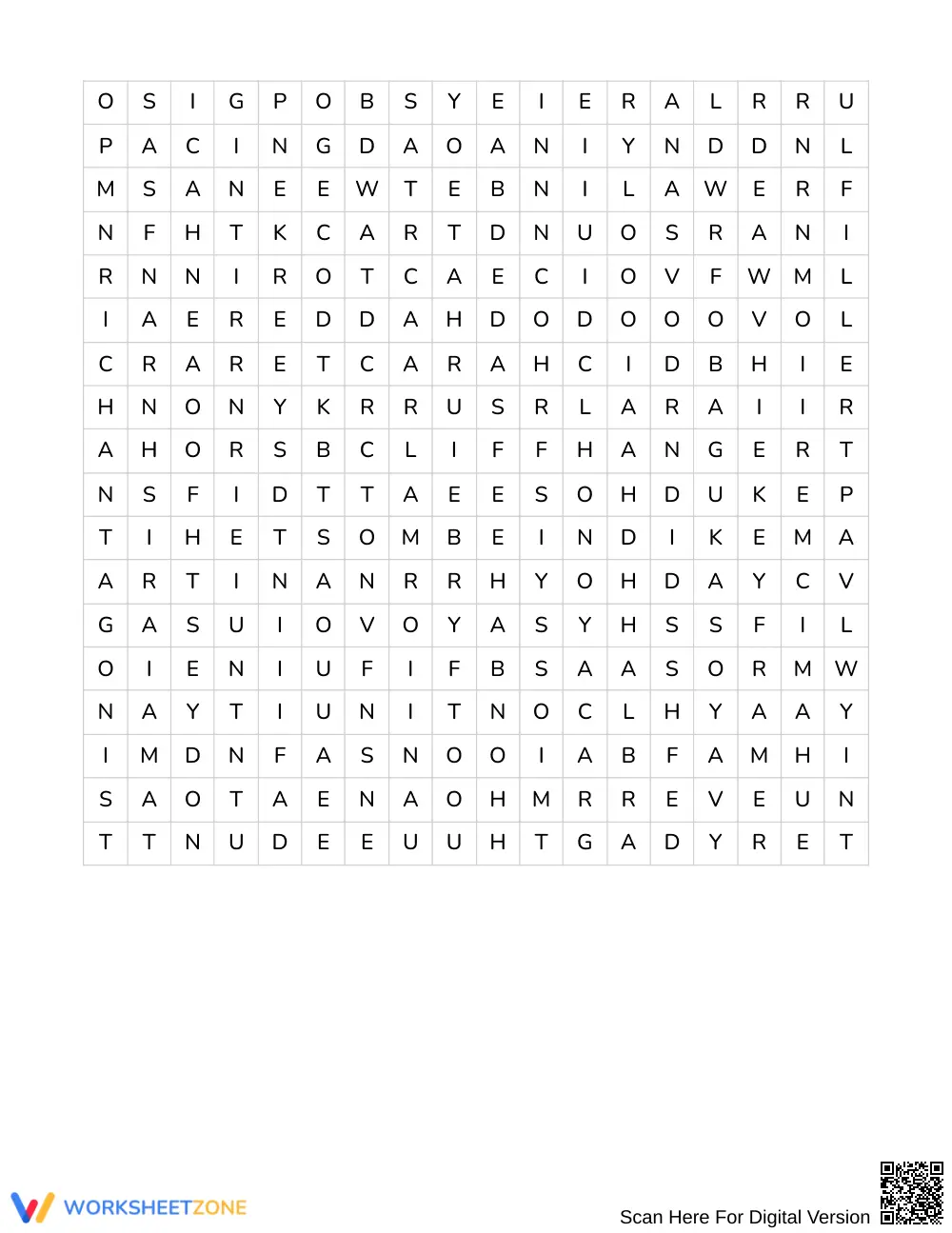


Complete Animation Vocabulary Word Search | Grades 7–8 ELA

Paste this activity's link or code into your existing LMS (Google Classroom, Canvas, Teams, Schoology, Moodle, etc.).
Students can open and work on the activity right away, with no student login required.
You'll still be able to track student progress and results from your teacher account.
This Grades 7–8 vocabulary word search builds understanding of 16 essential animation and storytelling terms through clue-based retrieval. Students decipher concise technical definitions before locating each hidden term within a dense grid, reinforcing academic language connected to narrative pacing, character development, and cinematic production techniques.
At a Glance
- Grade: Grades 7–8 · Subject: English Language Arts (ELA)
- Standard: Not standards-assessed — vocabulary enrichment
- Skill Focus: Animation and storytelling vocabulary
- Format: 3 pages · 16 words · Answer key included · PDF
- Best For: Vocabulary enrichment and early finishers
- Time: 20–35 minutes
This 3-page printable PDF provides an engaging challenge centered on narrative craft. Rather than simply scanning for pre-listed terms, students read 16 contextual clues defining concepts like character arcs, storyboards, and foreshadowing. The resource includes a full 4-page answer key showing completed word placements, allowing teachers or students to verify solutions immediately without additional setup.
Puzzle Mechanics and Structure
The activity challenges students with an 18 x 18 letter grid containing 16 hidden terms. Words run in all 8 cardinal and diagonal directions: north, northeast, east, southeast, south, southwest, west, and northwest. Because the puzzle omits a traditional word bank, learners must solve each clue first, transforming casual visual scanning into active semantic retrieval and deliberate literary analysis.
Standards Alignment
This resource serves as targeted vocabulary enrichment and is not aligned to a formal state or national content standard. It reinforces domain-specific terminology across narrative writing, media studies, and literary analysis units, helping students connect foundational storytelling mechanics to popular contemporary visual media.
How to Use It
Deploy this activity after direct instruction on literary devices or during an interdisciplinary unit examining visual media adaptations. It functions effectively as a collaborative partner challenge or an independent early-finisher task. While students work, circulate to observe whether they correctly match clues like pacing and continuity before searching the grid. Most middle school learners will complete the challenge within 20 to 35 minutes.
Who It's For
Designed specifically for Grades 7–8 ELA classrooms, creative writing electives, and middle school anime or film clubs. The clue-driven format supports differentiated vocabulary acquisition for visual learners and graphic novel fans. Pair this puzzle with an excerpted screenplay, storyboarding project, or narrative arc anchor chart to extend student discussion.
Contextualized vocabulary acquisition relies on authentic engagement and generative cognitive retrieval rather than rote memorization. According to research synthesized by Fisher & Frey (2014), middle school students develop deeper word consciousness and retain domain-specific terminology more effectively when vocabulary instruction integrates expressive, high-interest media contexts with active definition matching. This 16-word enrichment resource targets animation and storytelling vocabulary across an 18 x 18 puzzle matrix without relying on passive word banks. By requiring learners in Grades 7–8 to analyze narrative definitions—such as character motivation, narrative pacing, and thematic foils—before locating terms across eight directional orientations, the exercise bridges popular visual culture and academic literacy. The resulting instructional interaction promotes active recall, strengthens conceptual associations, and reinforces literary craft terminology in a motivating format suitable for independent review, collaborative stations, or targeted vocabulary enrichment.


