




























Views
Downloads


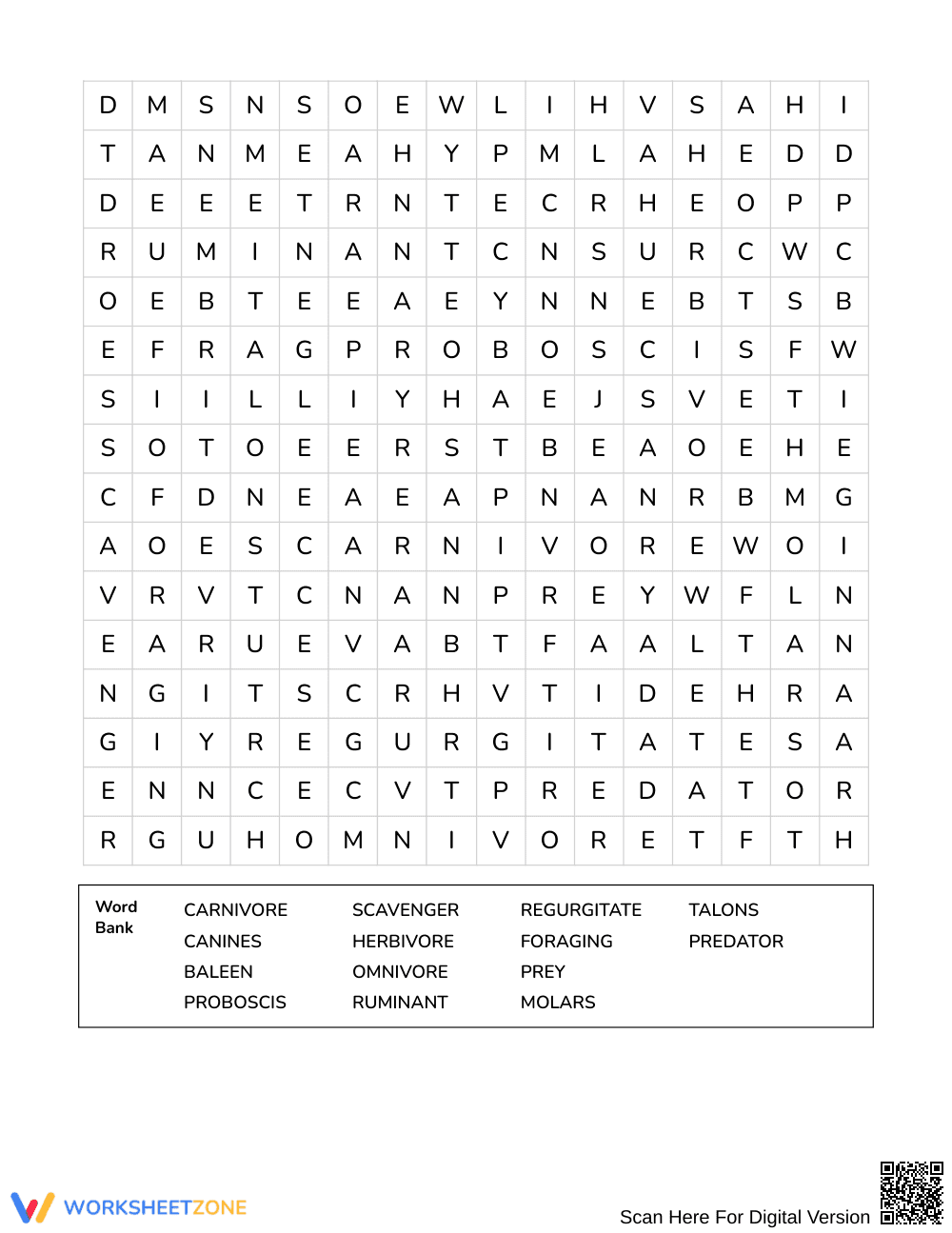

Complete Animal Diets Word Search | Grades 4–5 Science

Paste this activity's link or code into your existing LMS (Google Classroom, Canvas, Teams, Schoology, Moodle, etc.).
Students can open and work on the activity right away, with no student login required.
You'll still be able to track student progress and results from your teacher account.
This science word search helps upper elementary learners master specialized biology terminology by connecting structural feeding adaptations to core dietary classifications. Students read descriptive clues to identify 14 key vocabulary words, reinforcing conceptual understanding of how animal mouthparts, digestive systems, and foraging behaviors support survival in diverse natural habitats.
At a Glance
- Grade: Grades 4–5 · Subject: Science
- Standard: Not standards-assessed — vocabulary enrichment
- Skill Focus: Animal diets and feeding adaptations
- Format: 3 pages · 14 words · Answer key included · PDF
- Best For: Science unit vocabulary reinforcement
- Time: 20–30 minutes
What's Inside
The activity spans 3 print-ready pages featuring a Clue Detective format that challenges learners to solve definition-based prompts before searching the grid. Each clue targets a specialized adaptation term, including dentition types, anatomical structures, and feeding strategies. A complete 3-page answer key provides clear grid overlays showing exact letter placements for swift checking.
Puzzle Structure and Mechanics
The activity centers on a 16 × 16 letter grid containing 14 hidden science terms arranged across four distinct orientations: northeast, east, southeast, and south. Rather than relying on a simple word list, students read context-rich clue sentences to determine target words such as herbivore, baleen, and ruminant, actively applying science knowledge before searching the letter matrix.
Standards Alignment
This word search serves as science vocabulary enrichment and is not aligned to a specific state or national standard. It supports cross-curricular literacy by pairing domain-specific biological terminology with active reading comprehension, making it an effective supplemental resource during life science and organism adaptation studies.
How to Use It
Incorporate this activity after direct instruction on animal adaptations to consolidate key terms, or use it as an engaging mid-unit review station. Teachers can conduct a quick formative assessment by circulating while students solve the clue prompts to check for accurate identification of anatomical structures like molars and canines. Expected completion time is 20 to 30 minutes.
Who It's For
This puzzle is designed for learners in Grades 4–5 studying food chains, physical traits, or ecological niches. It offers accessible language reinforcement for English language learners and visual thinkers needing varied exposure to complex scientific terms. Pair this activity with an animal adaptation informational text or hands-on skull investigation lesson.
Domain-specific vocabulary acquisition forms a critical foundation for conceptual comprehension in elementary science education. As highlighted by Fisher & Frey (2014), intentional exposure to disciplinary words through interactive, context-based tasks strengthens long-term retention and reading comprehension across informational texts. By engaging with 14 foundational life science terms—ranging from broad nutritional roles like predator, prey, and scavenger to specialized physical traits like proboscis, talons, and baleen—learners establish meaningful mental models of ecological relationships. Rather than engaging in passive rote memorization, students analyze biological definitions before hunting through the letter grid, reinforcing both orthographic awareness and scientific reasoning. This multi-step process bridges vocabulary acquisition with science inquiry, equipping young biologists to accurately describe animal survival mechanisms and dietary structures during collaborative classroom discourse, written ecosystem explanations, and upper elementary assessments.


