






























Complete Algebraic Limits Worksheet | Grade 12 Calculus
Paste this activity's link or code into your existing LMS (Google Classroom, Canvas, Teams, Schoology, Moodle, etc.).
Students can open and work on the activity right away, with no student login required.
You'll still be able to track student progress and results from your teacher account.
This Grade 12 Calculus worksheet develops student mastery in resolving 0/0 indeterminate limits through algebraic simplification. Students factor polynomials, rationalize radicals, simplify compound fractions, and analyze piecewise functions. Designed to eliminate algebraic misconceptions, this resource ensures learners move confidently from procedural computation to rigorous analytical justification.
At a Glance
- Grade: 12 · Subject: Calculus
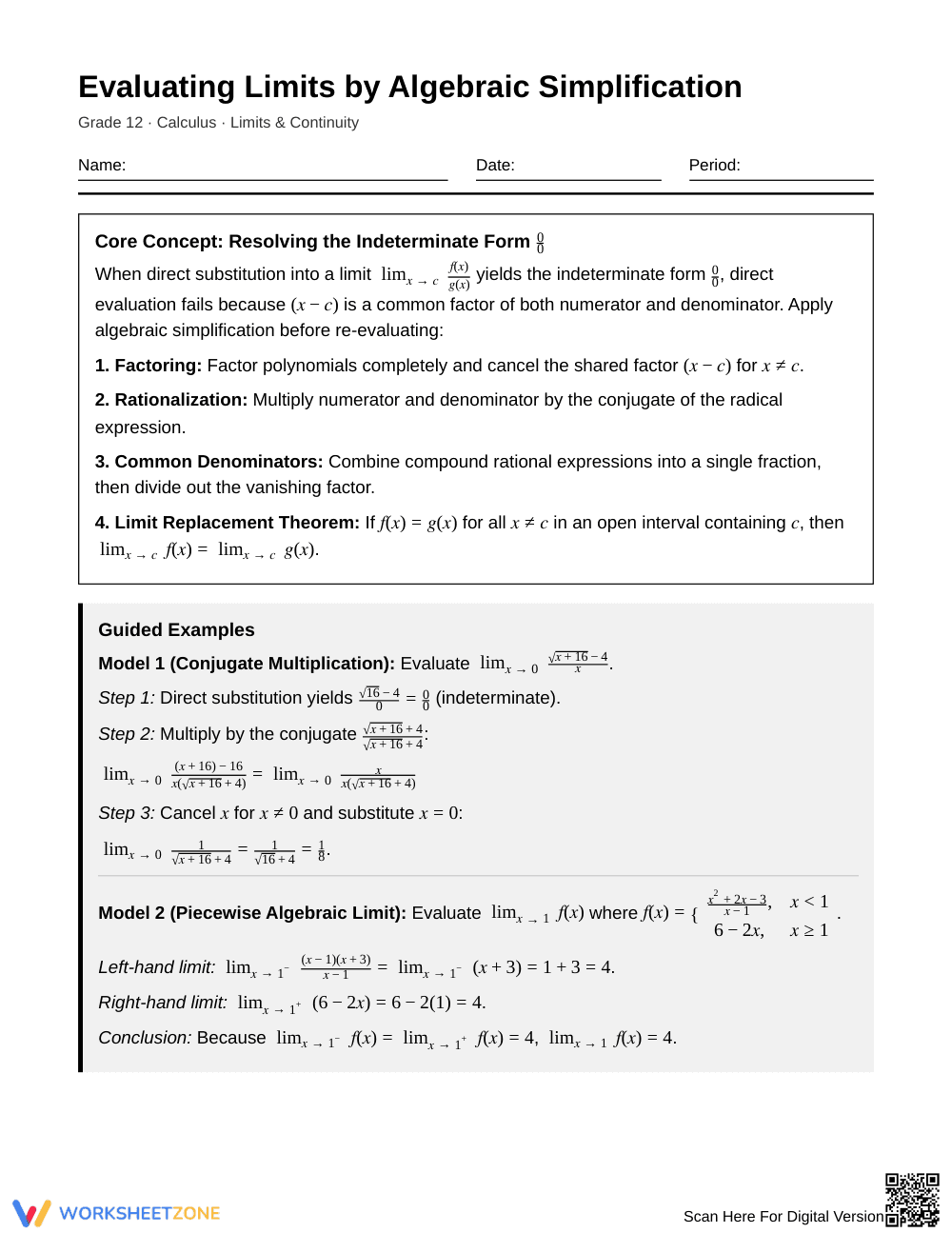
- Standard: Evaluate limits algebraically by factoring polynomials, rationalizing radicals, and simplifying compound fractions
- Skill Focus: Evaluate a Limit by Algebraic Simplification
- Format: 5 pages · 12 multi-step problems · Answer key included · PDF
- Best For: Calculus direct instruction follow-up and exam preparation
- Time: 45–60 minutes
What's Inside
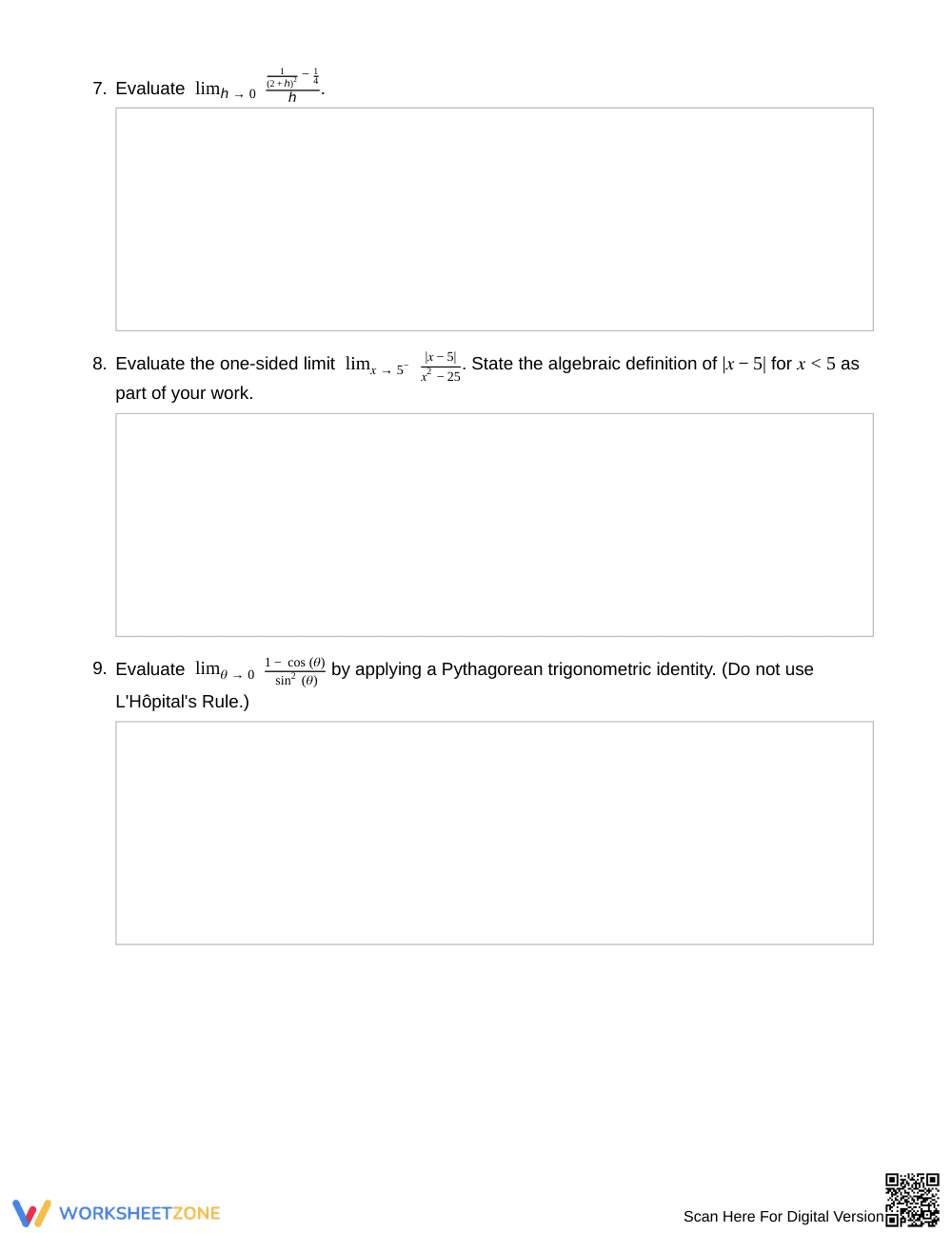
This 5-page worksheet begins with a reference box outlining four algebraic limit techniques and two worked models for conjugate multiplication and piecewise limits. Part A features 4 guided missing-step problems with structured fill-in blanks. Part B provides 6 independent evaluation tasks covering cubic factoring, conjugates, complex fractions, absolute values, and continuity constants. Part C contains 2 written conceptual checks on domain restrictions and indeterminate forms, supported by a 3-page answer key.
Skill Progression
- Guided practice (Part A, 4 problems): Scaffolds reasoning with missing-step frames where students supply specific factors, simplified rational expressions, and terminal evaluations.
- Supported practice (Part B, 6 problems): Fosters procedural fluency through unassisted evaluations spanning cubic expressions, radical conjugates, and piecewise constants.
- Independent practice (Part C, 2 problems): Solidifies conceptual depth through written explanations distinguishing indeterminate forms from undefined values and evaluating domain restrictions.
This sequence implements the gradual release of responsibility, moving students from guided completion to autonomous mathematical reasoning.
Standards Alignment
This worksheet aligns with introductory differential calculus standards covering limits and continuity. Students evaluate limits of rational, radical, and piecewise functions algebraically by rewriting expressions to eliminate 0/0 indeterminate forms before substitution. Supporting goals include analyzing continuity and removable discontinuities at specified points. Both standard codes can be copied directly into lesson plans, IEP goals, or district curriculum mapping tools.
How to Use It
Assign this resource following direct instruction on limit techniques as collaborative partner practice or independent homework. During work time, observe whether students check for indeterminate forms before applying algebraic techniques, using Part A as a formative check. Twelfth-grade calculus students typically finish all 12 tasks within 45 to 60 minutes.
Who It's For
This printable worksheet serves Grade 12 Calculus, AP Calculus AB, and dual-enrollment mathematics courses. Differentiate instruction by directing students who need algebraic scaffolding to Part A before advancing to Part B. Pair this document with an introductory lesson on the Limit Replacement Theorem and rational function graphs.
Evaluating limits by algebraic simplification requires secondary mathematics students to coordinate algebraic factoring, conjugate multiplication, and formal limit theorems to resolve 0/0 indeterminate forms. In their foundational research on instructional scaffolding, Fisher & Frey (2014) demonstrated that structured gradual-release frameworks significantly improve student retention of complex multi-step procedures by transitioning learners from structured completion tasks to autonomous problem solving. This calculus worksheet operationalizes that pedagogical principle by coupling guided missing-step evaluations with unassisted algebraic derivations and conceptual justification prompts. By systematically requiring students to factor polynomials, rationalize radical terms, and explain the mathematical distinction between indeterminate forms and undefined expressions, the resource reinforces conceptual continuity alongside procedural fluency. Consequently, secondary educators can effectively diagnose algebraic misconceptions surrounding removable discontinuities while preparing students for advanced calculus coursework and collegiate mathematics expectations through targeted analytical practice.


