




























Views
Downloads



Complete Agriculture Word Search | Grades 7–8 ELA

Paste this activity's link or code into your existing LMS (Google Classroom, Canvas, Teams, Schoology, Moodle, etc.).
Students can open and work on the activity right away, with no student login required.
You'll still be able to track student progress and results from your teacher account.
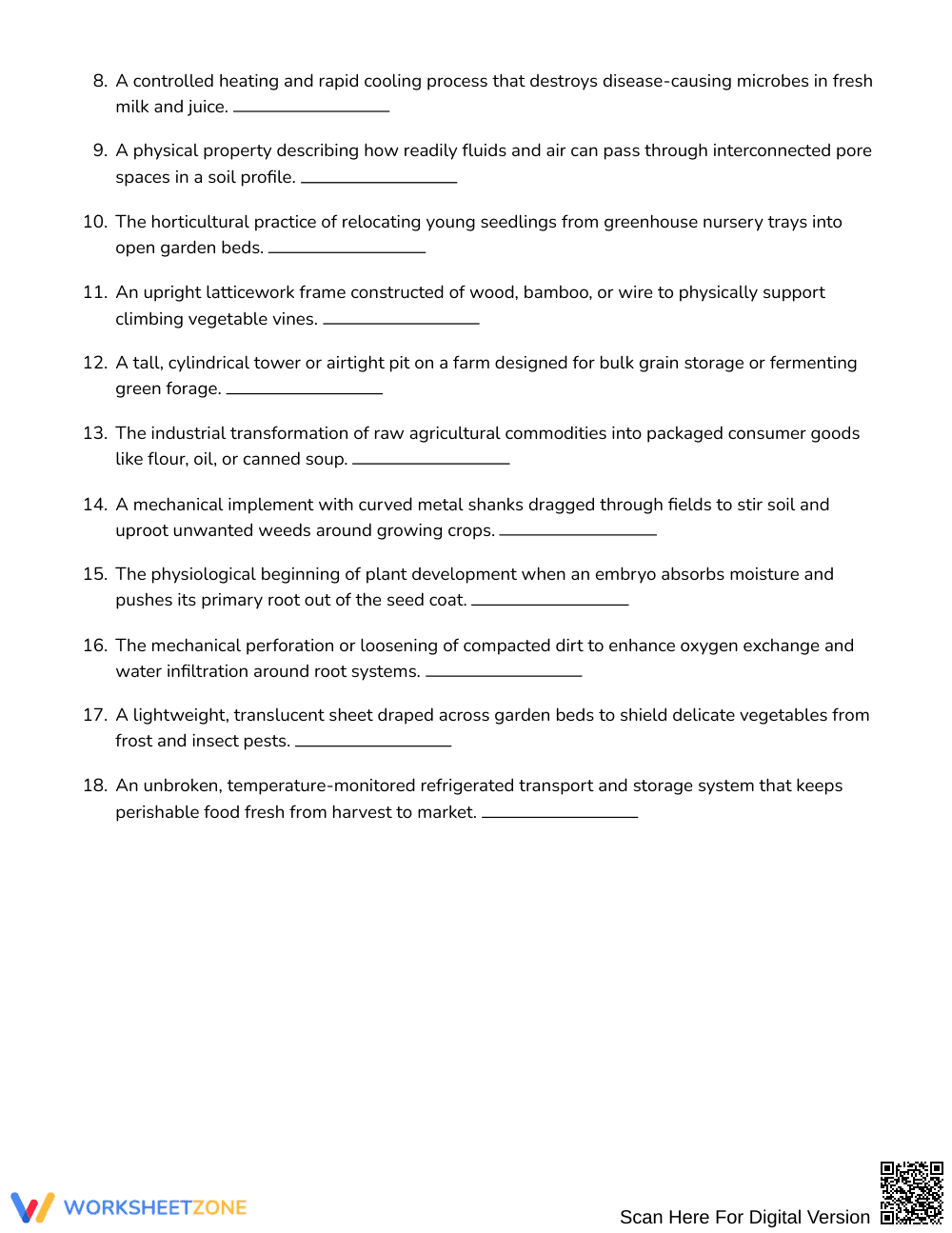
This agricultural vocabulary word search strengthens middle school language acquisition by connecting technical farming terminology to context clues. Designed for Grades 7–8 learners, students read comprehensive definitions of agricultural tools, soil mechanics, and distribution networks, identify each target term, and locate it within the letter grid.
At a Glance
- Grade: Grades 7–8 · Subject: English Language Arts (ELA)
- Standard: Not standards-assessed — vocabulary enrichment
- Skill Focus: Tools, processes, and food systems vocabulary
- Format: 3 pages · 18 words · Answer key included · PDF
- Best For: Vocabulary review or early finisher work
- Time: 25–35 minutes
What's Inside
The activity spans 3 student pages accompanied by a full answer key. The opening section presents a shuffled word bank alongside 18 detailed clues covering machinery, post-harvest logistics, and soil science. Students read clues for concepts such as pasteurization, permeability, and crop rotation before finding each term hidden in the dense letter puzzle.
Puzzle Structure and Search Mechanics
The puzzle features an expansive 20x20 grid designed to challenge middle school visual tracking skills. Target terms run across 8 possible compass headings: North, Northeast, East, Southeast, South, Southwest, West, and Northwest. Forward, backward, and diagonal placements ensure students attend closely to orthographic patterns, spelling accuracy, and word structure rather than scanning solely along horizontal lines.
Standards Alignment
This resource is designed strictly for vocabulary enrichment and is not aligned to a formal academic standard. It reinforces domain-specific terminology across interdisciplinary agricultural and science topics.
How to Use It
Introduce this puzzle as a cumulative review after completing a unit on food systems or agricultural geography, giving students a low-stakes opportunity to recall technical vocabulary. Alternatively, assign it as an engaging independent task for early finishers or sub plans. During class completion, observe whether students identify terms directly from memory using the clues or rely primarily on letter matching, noting which definitions require post-activity group review. Expected student completion time is 25 to 35 minutes.
Who It's For
This activity is created for general education students in Grades 7–8 seeking domain-specific literacy practice. For learners needing additional support, teachers can highlight starting letters directly on the grid; for advanced learners, have students write an original application sentence for 5 selected terms. It pairs naturally with informational reading passages detailing modern food supply chains or sustainable farming technology.
Systematic exposure to domain-specific vocabulary improves cross-curricular reading comprehension by establishing robust semantic networks. According to Fisher & Frey (2014), purposeful vocabulary tasks that require learners to connect precise conceptual definitions with orthographic recognition strengthen lexical retention far more effectively than rote memorization. This word search engages Grades 7–8 learners in retrieving 18 specialized agricultural concepts, including irrigation, aeration, and cold chain distribution, before locating them across 8 directional orientations within a 20x20 grid. By embedding content clues alongside spatial word recognition, the activity bridges content-area literacy with active problem-solving. Learners repeatedly analyze root words and affixes as they search forward, backward, and diagonally through the letter matrix, cementing correct spelling and conceptual understanding simultaneously. The accompanying answer key provides an immediate feedback loop for classrooms, reinforcing accurate term identification and supporting independent learning across diverse middle school instructional environments.


