





























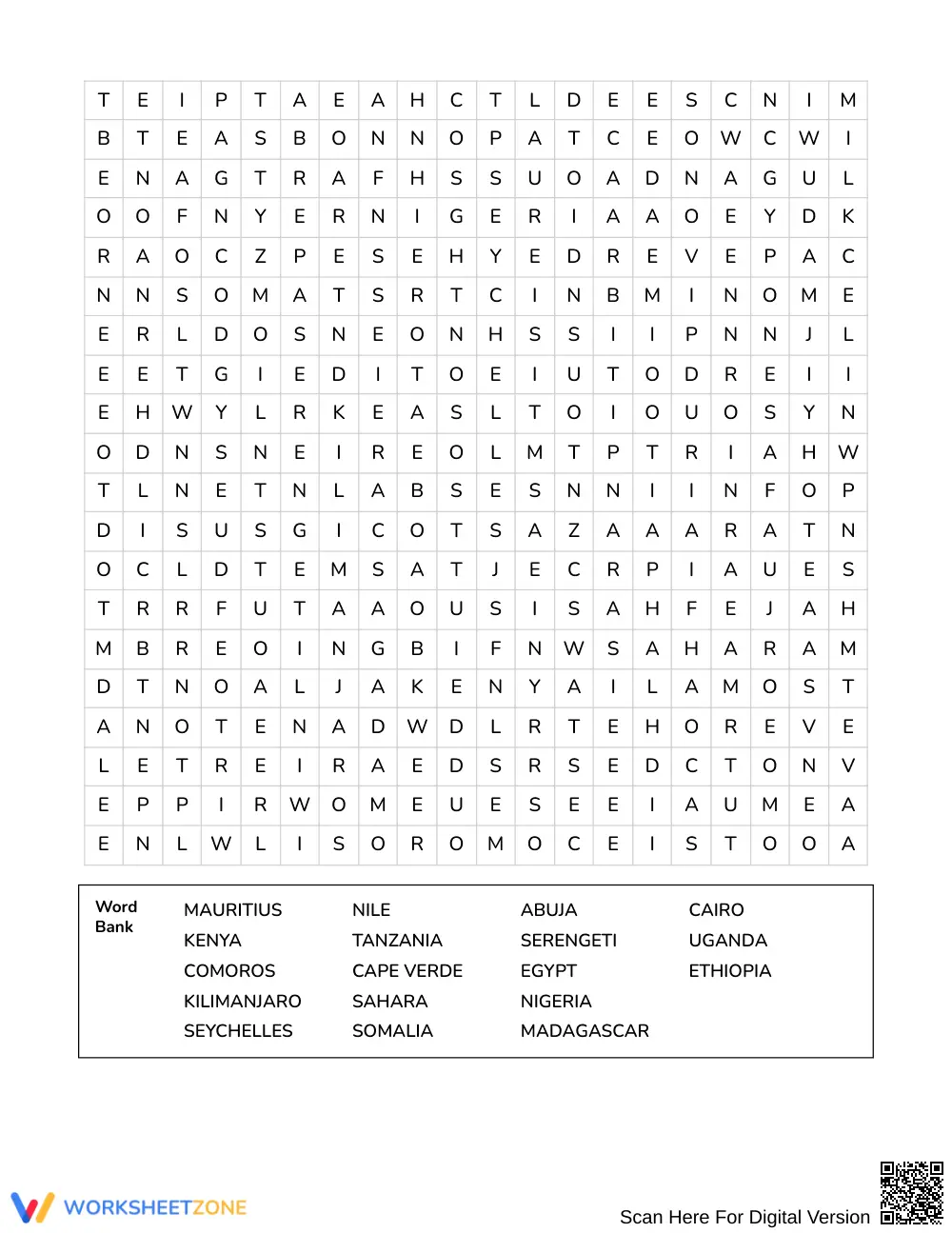


Complete Africa Word Search | Grades 7–8 Social Studies

Paste this activity's link or code into your existing LMS (Google Classroom, Canvas, Teams, Schoology, Moodle, etc.).
Students can open and work on the activity right away, with no student login required.
You'll still be able to track student progress and results from your teacher account.
This African geography word search reinforces regional vocabulary and spatial knowledge for middle school learners. Students review key countries, major capital cities, and prominent physical landmarks by matching descriptive geographical clues to hidden terms across a cumulative puzzle grid. The activity strengthens terminology retention and geographic literacy across North, West, East, and Southern Africa.
At a Glance
- Grade: Grades 7–8 · Subject: Social Studies
- Standard: Not standards-assessed — vocabulary enrichment and regional terminology reinforcement
- Skill Focus: African country geography review and landmark recognition
- Format: 3 pages · 18 words · Full-page answer key included · Printable PDF
- Best For: Unit wrap-up, cumulative geography review, or engaging sub plans
- Time: 20–30 minutes of independent or partner work
What's Inside
The activity spans 3 printable pages designed for quick classroom deployment. It features a shuffled word bank of 18 geographic terms paired with concise informational clues highlighting key facts about African nations, capitals, and natural features. Students use the clues to identify nations like Nigeria and Kenya, physical landmarks such as the Sahara and Mount Kilimanjaro, and major urban centers like Cairo and Abuja. A complete 3-page answer key provides circled solutions for rapid self-assessment.
Puzzle Mechanics and Structure
This puzzle challenges students to search within a dense 20 x 20 letter grid. Hidden words run in all eight possible directions: North, Northeast, East, Southeast, South, Southwest, West, and Northwest. The scrambled word bank encourages students to read each clue carefully, reinforcing factual associations between country names, geographical landmarks, and regional definitions before locating each target entry in the grid.
Standards Alignment
This resource serves as targeted vocabulary enrichment rather than direct standards-based assessment. While not formally tied to a specific state or national code, the activity reinforces essential middle school social studies competencies by building location familiarity, spatial awareness, and regional literacy across the African continent.
How to Use It
Introduce this word search after direct instruction on African regional geography to synthesize learning at the end of a unit. Alternatively, assign it as a collaborative warm-up during an introductory geography module where student pairs discuss clues before hunting for locations. During the 20 to 30 minute completion window, circulate to check whether learners can define clues without consulting an atlas, noting which regional terms require remediation.
Who It's For
This activity is designed for general education, inclusive, and remedial Grades 7–8 Social Studies classrooms. For striving readers or English language learners, provide a labeled political map of Africa alongside the puzzle to support spatial connections. Pair this printable directly with a comprehensive physical geography slide presentation or regional mapping unit for maximum instructional impact.
Content-area vocabulary acquisition serves as the bedrock of spatial reasoning and geographic literacy in middle school social studies. According to Fisher & Frey (2014), structured word exposure coupled with contextual definitions significantly enhances long-term retention of specialized academic terminology. By engaging middle school learners in identifying 18 essential African geographic terms alongside factual clue prompts, this word search operationalizes intentional vocabulary review within an accessible format. Students reinforce mental associations between nations, biomes, and landmark capitals, transforming passive word recognition into active geographical conceptualization. Research indicates that gamified lexical puzzles paired with informative context clues reduce cognitive anxiety while consolidating foundational subject knowledge. Teachers can effectively deploy this resource to evaluate learner familiarity with African geography, identify conceptual gaps across regional units, and ensure students maintain the academic lexicon required for advanced global studies curricula.


