































Complete Accumulation Functions Worksheet – Grade 12

Paste this activity's link or code into your existing LMS (Google Classroom, Canvas, Teams, Schoology, Moodle, etc.).
Students can open and work on the activity right away, with no student login required.
You'll still be able to track student progress and results from your teacher account.
Master accumulation functions and the Fundamental Theorem of Calculus through graphical, analytical, and tabular practice. This 5-page worksheet equips Grade 12 Calculus students with tools to differentiate integral functions, interpret rates of change, apply net change, and evaluate complex accumulation across 18 multi-step problems.
At a Glance
- Grade: 12 · Subject: Calculus
- Standard: Apply the Fundamental Theorem of Calculus to analyze and differentiate accumulation functions
- Skill Focus: Accumulation Functions and the Fundamental Theorem
- Format: 5 pages · 18 problems · Answer key included · PDF
- Best For: Calculus review and AP exam practice
- Time: 60–75 minutes
This comprehensive resource spans 5 pages and features 18 structured problems categorized into foundational skills, core graphical applications, and rigorous analytical challenges. Students work with Riemann sum approximations from tabular data, piecewise linear graphs of accumulated area, chain-rule differentiation of variable limits, and L'Hôpital's Rule limits. A 2-page detailed answer key provides complete step-by-step solutions and justifications for every item.
Skill Progression
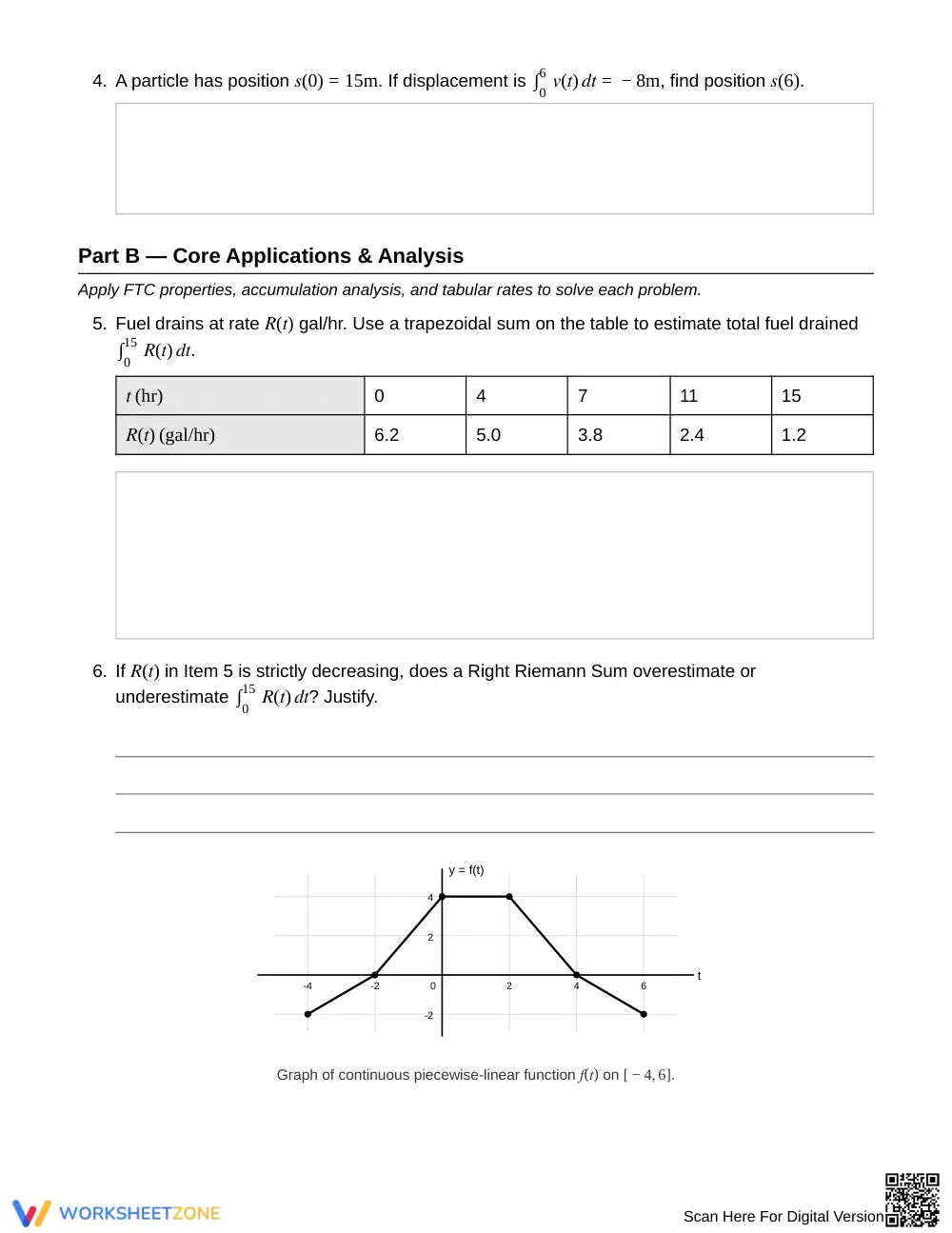
- Guided Practice (Part A, Problems 1–4): Direct application of Fundamental Theorem Part 1 differentiation, tabular Left Riemann Sum approximations, and net change position calculations with formula scaffolds.
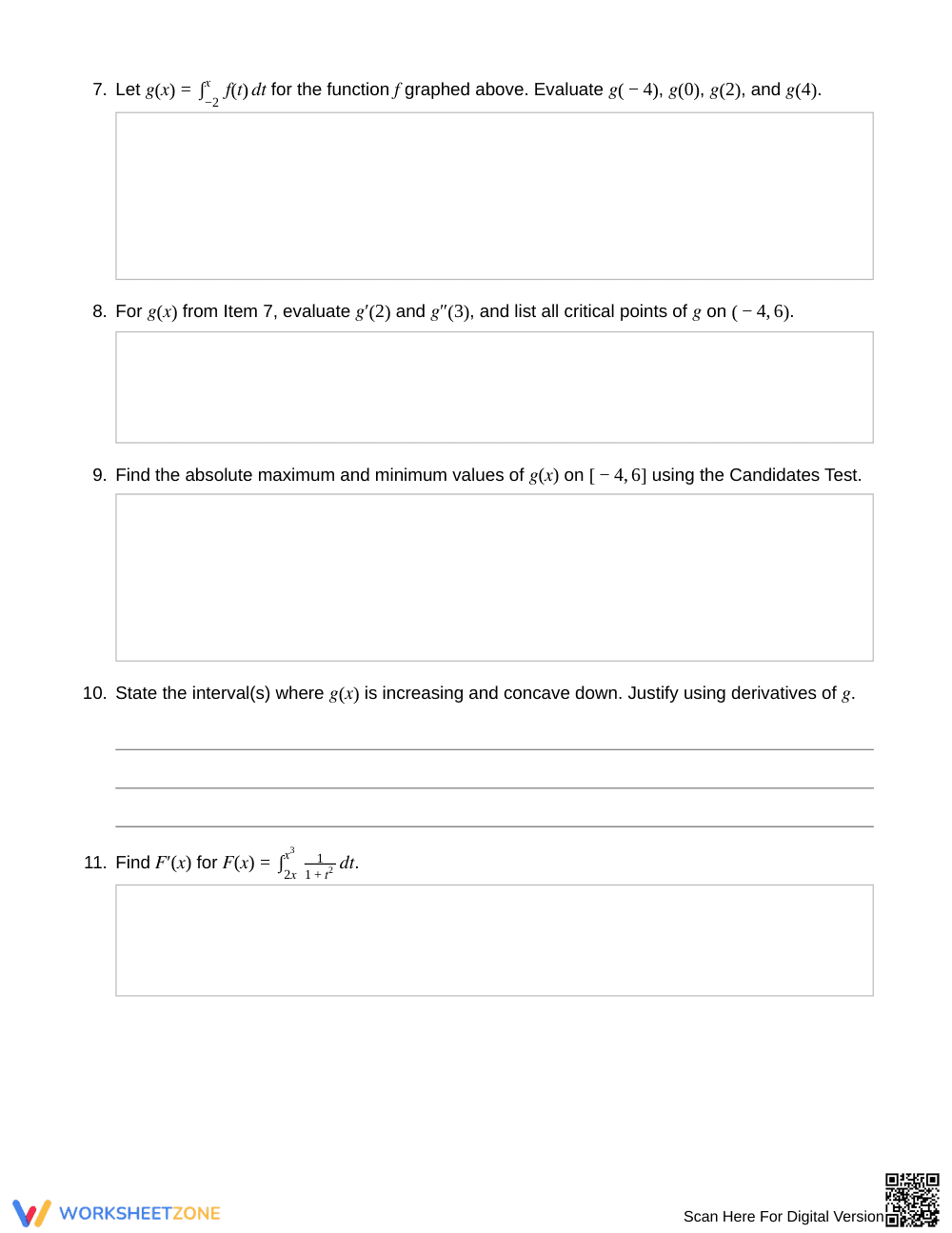
- Supported Practice (Part B, Problems 5–14): Intermediate graphical analysis of piecewise functions, Candidates Test extreme value determinations, trapezoidal sums, tangent lines, and rate modeling with contextual prompts.
- Independent Practice (Part C, Problems 15–18): Unscaffolded advanced challenges requiring composite second derivatives, Riemann limit-to-integral conversions, implicit differentiation, and formal Mean Value Theorem proofs.
This structured sequence follows the gradual release of responsibility model, guiding learners from mechanical derivative rules to high-level theoretical synthesis.
Curriculum and Standards Alignment
This resource aligns with high school and AP Calculus curricula covering Riemann sums, accumulation functions, and the Fundamental Theorem of Calculus. Students demonstrate conceptual mastery by connecting rate graphs to area accumulation and applying differentiation rules to variable integral bounds. These learning objectives can be copied directly into lesson plans, IEP goals, or district curriculum mapping tools.
How to Use It
Deploy this worksheet after direct instruction on the Fundamental Theorem of Calculus. Use Part A and Part B for an in-class workshop (40–45 minutes), where students discuss concavity and critical points in pairs. Assign Part C as an independent challenge. For formative assessment, inspect student work on Item 9 (Candidates Test) to confirm they test both interior critical points and domain endpoints. Completion time spans 60 to 75 minutes.
Who It's For
Designed for Grade 12 Calculus students, including AP Calculus AB and BC cohorts preparing for free-response accumulation tasks. It provides targeted practice for students analyzing accumulation integrals, with high-ceiling extension problems for advanced learners. Pair this worksheet with an accumulation anchor chart or a dynamic geometry demonstration illustrating accumulated signed area under a curve.
Mastering accumulation functions and the Fundamental Theorem of Calculus requires students to bridge graphical, numerical, and algebraic representations of rates of change. According to Fisher & Frey (2014), structured instructional progressions that transition students systematically from scaffolded foundational tasks to complex, non-routine problem solving significantly enhance mathematical reasoning and long-term conceptual retention. This 18-problem Calculus resource directly implements this evidence-based instructional design across 5 structured pages. Students begin by differentiating basic integral expressions, progress through multi-representational piecewise graph analysis and Riemann sum tables, and conclude with formal Mean Value Theorem proofs and implicit differentiation. By integrating continuous graphical analysis with rigorous algebraic justification, this worksheet reinforces core calculus competencies and prepares Grade 12 students to interpret dynamic accumulation models effectively across advanced STEM coursework, AP exam evaluations, and standard district assessments.


