


























Views
Plays
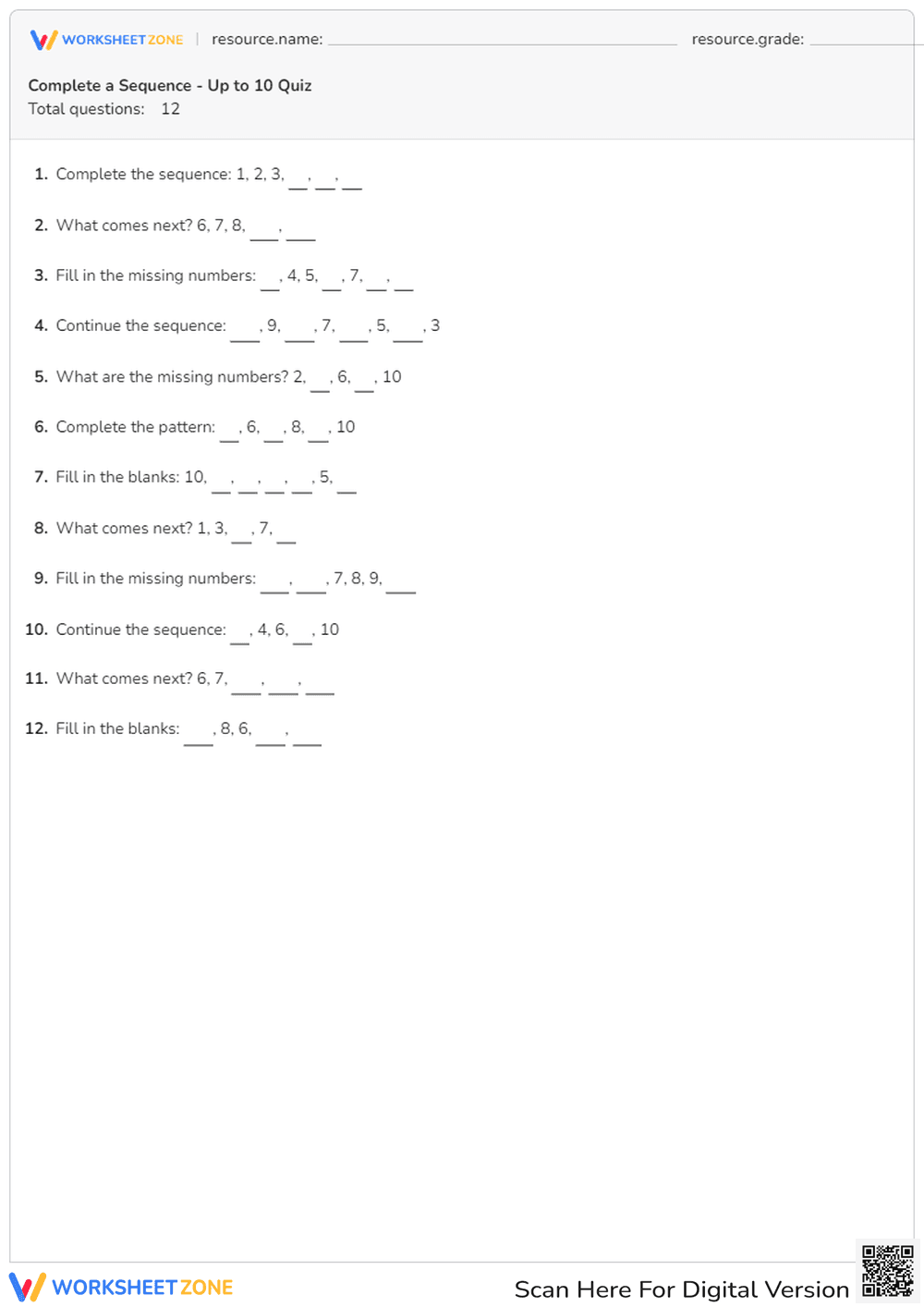

Printable Number Sequence Worksheet | Grade 1 Math
Paste this activity's link or code into your existing LMS (Google Classroom, Canvas, Teams, Schoology, Moodle, etc.).
Students can open and work on the activity right away, with no student login required.
You'll still be able to track student progress and results from your teacher account.
This ready-to-use math worksheet helps early learners master number sequences up to 10 by filling in missing digits. Students build foundational number sense and counting fluency as they complete forward, backward, and skip-counting patterns, ensuring they confidently recognize numerical order and relationships.
At a Glance
- Grade: K-1 · Subject: Math
- Standard:
CCSS.MATH.CONTENT.K.CC.A.2— Count forward from a given number- Skill Focus: Completing number sequences up to 10
- Format: 1 page · 12 problems · Answer key included · PDF
- Best For: Independent practice and quick assessment
- Time: 10–15 minutes
This single-page resource features 12 distinct sequence problems designed to test numerical fluency. Students will encounter a mix of counting forward, counting backward, and basic skip-counting patterns within the 0-10 range. The clean layout minimizes visual distractions, allowing young learners to focus entirely on the math. A complete answer key is provided to make grading fast and accurate.
Zero-Prep Workflow
This worksheet is designed for maximum efficiency in busy classrooms. Follow these simple steps:
- Print (1 minute): Generate the PDF and print a class set directly from your computer.
- Distribute (1 minute): Hand out the single-page assignment to students during math centers or morning work.
- Review (3 minutes): Use the included answer key to quickly check student responses or conduct a whole-class review.
With a total teacher prep time of under two minutes, this resource is an excellent addition to any emergency sub plan or last-minute instructional block.
Standards Alignment
This activity is directly aligned to CCSS.MATH.CONTENT.K.CC.A.2: Count forward beginning from a given number within the known sequence. It also supports early first-grade operations by reinforcing number relationships and sequence predictability. Both standard codes can be copied directly into lesson plans, IEP goals, or district curriculum mapping tools.
How to Use It
Deploy this worksheet during independent math centers after direct instruction on counting principles. It also serves as an effective morning work activity to activate prior knowledge before a new math lesson begins. As a formative assessment observation tip, watch how students approach the backward counting sequences (like question 4); hesitation here often indicates a need for more concrete number line practice. Expect students to complete the 12 problems in approximately 10 to 15 minutes.
Who It's For
This resource is ideal for Kindergarten and early Grade 1 students developing basic number sense. For students requiring differentiation, provide a physical number line or counting blocks to support visual and tactile learning. Advanced learners can be challenged to write the next three numbers beyond the provided blanks. Pair this worksheet with a whole-group counting song or a large classroom anchor chart displaying numbers 1 through 10.
Developing early numerical fluency requires consistent, targeted practice with number sequences. According to a 2024 report by EdReports, foundational math skills such as counting forward from a given number are critical predictors of later algebraic success. When students engage with CCSS.MATH.CONTENT.K.CC.A.2, they do more than just memorize digits; they build a mental number line that supports addition and subtraction. This worksheet provides the exact repetition needed to solidify these concepts. By asking students to complete sequences up to 10, educators can quickly identify gaps in basic number sense. Regular exposure to varied sequence patterns ensures that young learners develop the cognitive flexibility required for advanced mathematical reasoning. Integrating this evidence-based practice into daily routines builds lasting confidence.


