




























Comparing Ordering Fractions: Essential Check
Paste this activity's link or code into your existing LMS (Google Classroom, Canvas, Teams, Schoology, Moodle, etc.).
Students can open and work on the activity right away, with no student login required.
You'll still be able to track student progress and results from your teacher account.
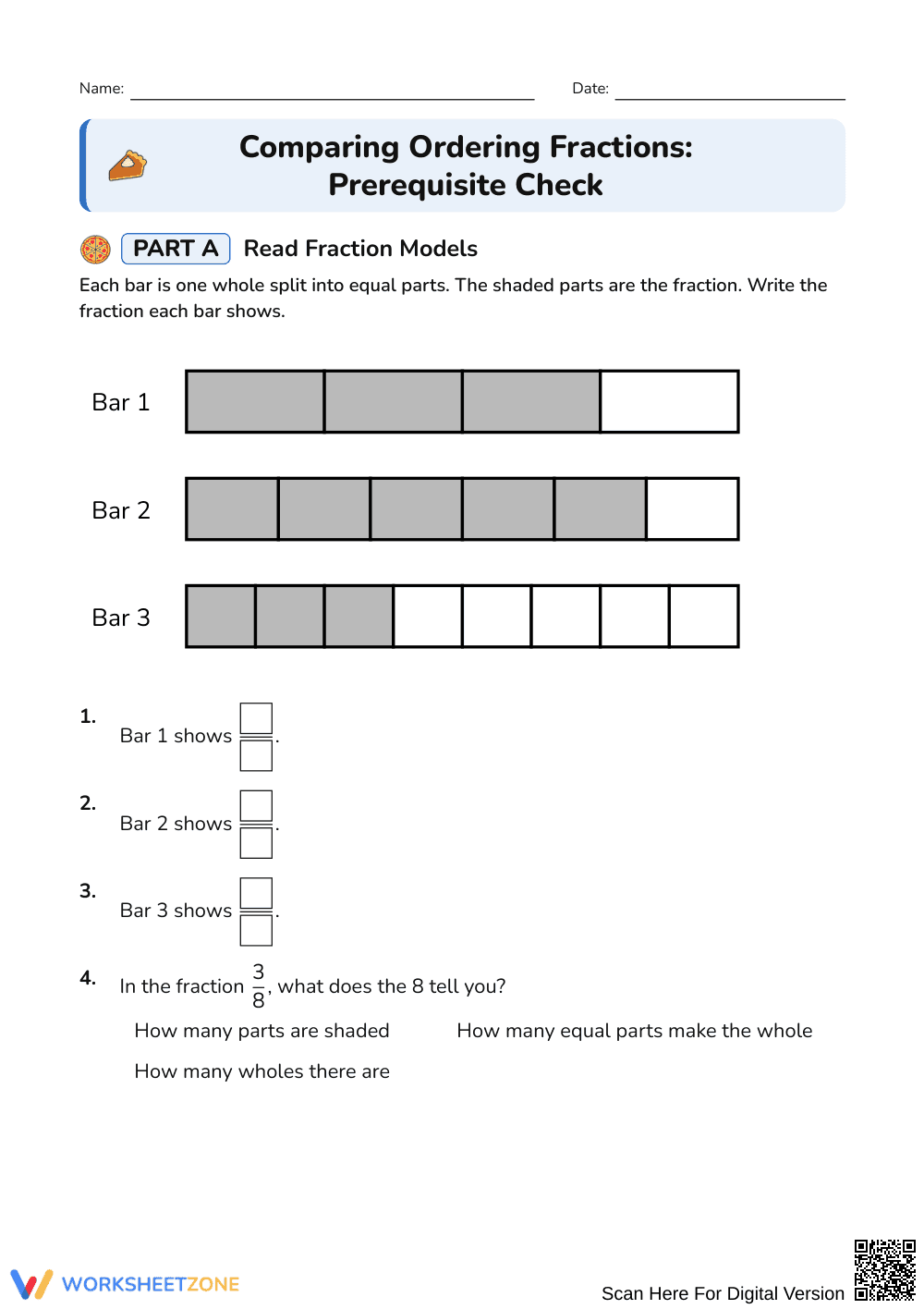
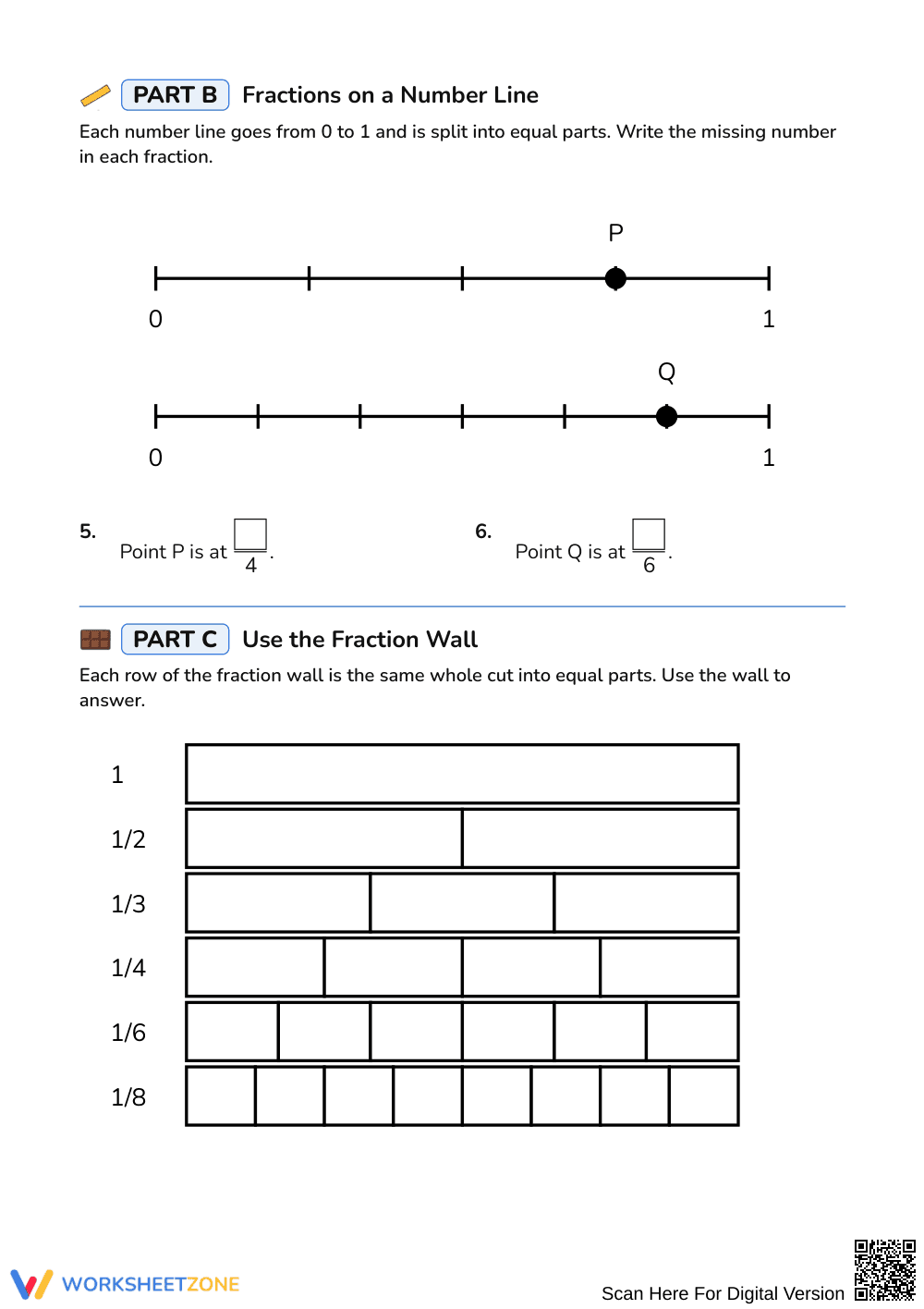
This Grade 3 math worksheet prepares students to compare fractions by reviewing essential prerequisite concepts. Learners read equal-part bar models, locate fractions on number lines, examine fraction walls, and practice comparison notation. These 16 targeted diagnostic tasks establish the foundation needed to compare fractions with like numerators or denominators.
At a Glance
- Grade: 3 · Subject: Math
- Standard:
3.NF.A.3— Compare two fractions with the same numerator or denominator using visual models- Skill Focus: Prerequisite fraction models and comparison notation
- Format: 3 pages · 16 problems · Answer key included · PDF
- Best For: Pre-unit diagnostic assessment and prerequisite review
- Time: 20–30 minutes
What's Inside
The 3-page student worksheet provides 16 diagnostic tasks divided across four parts. Exercises feature shaded bar models, fractional number lines, and an aligned fraction wall. A complete 3-page teacher answer key provides full solutions and written explanations for swift grading.
Skill Progression
- Guided practice (Part A & Part B, 6 problems): Students identify fractions from shaded bars and number lines, reviewing core notation with visual scaffolds.
- Supported practice (Part C, 4 problems): Students reference a fraction wall to identify equivalencies and compare unit sizes using visual lengths.
- Independent practice (Part D, 6 problems): Students apply comparison symbols and explain why smaller denominators represent larger equal parts.
This sequence mirrors the gradual-release framework, moving learners from guided visual interpretation to independent conceptual reasoning.
Standards Alignment
This worksheet aligns directly with primary standard 3.NF.A.3, which requires students to explain fraction equivalence and compare fractions by reasoning about their size. It also reinforces supporting standard 3.NF.A.2 by having students locate fractions on number line diagrams. Both standard codes can be copied directly into lesson plans, IEP goals, or district curriculum mapping tools.
How to Use It
Administer this worksheet before introducing fraction comparison lessons to identify prerequisite learning gaps. During completion, observe whether students confuse denominator values with piece size on the fraction wall. The activity also serves as focused post-instruction review. Students typically finish all 16 tasks within 20 to 30 minutes.
Who It's For
Designed for Grade 3 math classrooms, this resource also supports Grade 4 students who need targeted intervention with fraction basics. Teachers can supply physical fraction tiles for students who need extra concrete scaffolding. Pair this worksheet with an interactive anchor chart illustrating fraction strip comparisons.
Mastering standard 3.NF.A.3 requires Grade 3 students to compare fractions by reasoning about their size rather than relying on rote algorithmic rules. According to research from Fisher & Frey (2014), purposeful prerequisite checks and guided instructional sequences substantially reduce cognitive overload when elementary students encounter unfamiliar mathematical representations. When young learners examine equal-part bar models and number lines before making formal inequality statements, they develop essential spatial intuition regarding unit size. This 16-task diagnostic worksheet operationalizes gradual release by anchoring relational symbols in concrete visual representations, directly addressing persistent student misconceptions about larger denominators indicating larger parts. By verifying that third graders understand fundamental partition notation prior to comparing fractions with unlike numerators and denominators, educators ensure that students establish durable conceptual schema. The structured progression provides actionable diagnostic data that enables targeted small-group intervention during foundational fraction units.


