




























Comparing Ordering Fractions: Complete Worked Examples
Paste this activity's link or code into your existing LMS (Google Classroom, Canvas, Teams, Schoology, Moodle, etc.).
Students can open and work on the activity right away, with no student login required.
You'll still be able to track student progress and results from your teacher account.
This Grade 4 fraction worksheet builds comparison skills through structured, incomplete worked examples. Students analyze fraction models, plot values on number lines, and use benchmark reasoning before solving problems independently. Completing the missing explanatory steps enables fourth graders to justify fraction size using mathematical logic rather than rote procedures.
At a Glance
- Grade: 4 · Subject: Math
- Standard:
4.NF.A.2— Compare two fractions with different numerators and different denominators using visual models and benchmarks.- Skill Focus: Comparing fractions using incomplete worked examples
- Format: 3 student pages · 20 structured problems · Full answer key included · PDF document
- Best For: Tier-2 math intervention and guided fraction practice
- Time: 30–45 minutes
What's Inside
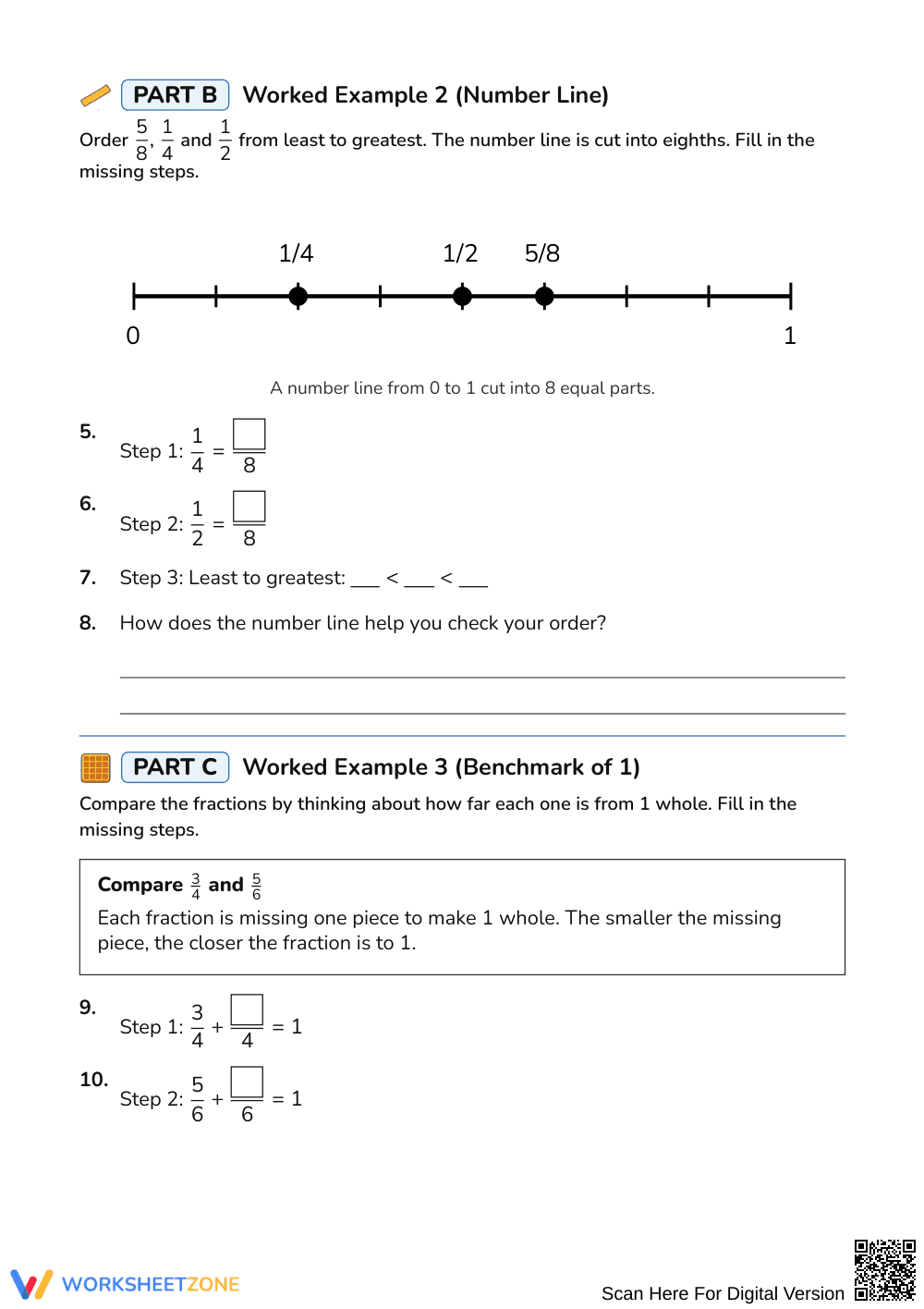
This 3-page printable contains 20 tasks arranged across four structured sections. Students explore three detailed worked examples featuring fraction strips, an eighths number line, and benchmark distances to 1 whole. The final section provides independent inequality comparisons, ordering problems, and a word problem, paired with a complete 3-page answer key.
Skill Progression
- Guided practice (Parts A & B, 6 tasks): Students complete missing reasoning steps on fraction bars and number lines, justifying size when numerators match.
- Supported practice (Part C, 4 tasks): Learners evaluate distance from benchmark 1, explaining why smaller missing pieces create greater fractions.
- Independent practice (Part D, 10 tasks): Fourth graders apply their strategies to compare fractions, order values, and solve a word problem.
This progression reflects the gradual-release framework, guiding students from modeling (I Do, We Do) to autonomous reasoning (You Do).
Standards Alignment
This worksheet aligns directly to 4.NF.A.2: Compare two fractions with different numerators and denominators by creating common denominators or comparing to benchmarks. It also reinforces supporting standard 4.NF.A.1 by applying visual fraction equivalence. Both standard codes can be copied directly into lesson plans, IEP goals, or district curriculum mapping tools.
How to Use It
Use this worksheet during small-group intervention following direct instruction on fraction magnitude, or assign Parts A through C for partner work while reserving Part D for exit tickets. During classwork, observe whether students connect smaller missing unit fractions to values closer to one whole in Part C. Expected completion time is 30 to 45 minutes.
Who It's For
This resource supports fourth-grade students developing fraction number sense, including English learners benefiting from explicit explanation prompts and special education students needing scaffolded steps. Pair this worksheet with fraction tile manipulatives or a classroom anchor chart illustrating unit fraction sizes.
Mastering fraction comparison under standard 4.NF.A.2 requires students to evaluate relative sizes of fractions with unlike numerators and denominators using benchmarks and visual representations. Research synthesized by Fisher & Frey (2014) on the gradual release of responsibility demonstrates that structured worked examples with faded solution steps reduce extraneous cognitive load, enabling novice learners to internalize underlying mathematical principles before transitioning to independent problem-solving. By prompting fourth-grade students to complete intermediate reasoning stages and compose verbal explanations, this resource directly addresses common misconceptions regarding denominator magnitude. Rigorous curricular evaluations, such as those published in EdReports 2024, affirm that integrating visual fraction models alongside explanatory writing tasks fosters deeper conceptual transfer than rote procedural algorithms. Consequently, educators using this 20-problem sequence provide students with the cognitive scaffolding required to build durable, standards-aligned fraction number sense across diverse elementary classroom environments.


