



























Comparing Ordering Fractions: Complete Representations
Paste this activity's link or code into your existing LMS (Google Classroom, Canvas, Teams, Schoology, Moodle, etc.).
Students can open and work on the activity right away, with no student login required.
You'll still be able to track student progress and results from your teacher account.
This Grade 4 math worksheet builds conceptual understanding of fraction comparisons through five distinct representations. Students examine fraction bars, number lines, fraction walls, benchmark reasoning, and comparative word problems to evaluate fractions with unlike denominators.
At a Glance
- Grade: 4 · Subject: Math
- Standard:
4.NF.A.2— Compare two fractions with different numerators and different denominators using visual models- Skill Focus: Multiple Representations
- Format: 3 student pages · 17 total problems · Full answer key included · Printable PDF
- Best For: Small group visual fraction intervention and skill practice
- Time: 30–45 minutes
What's Inside
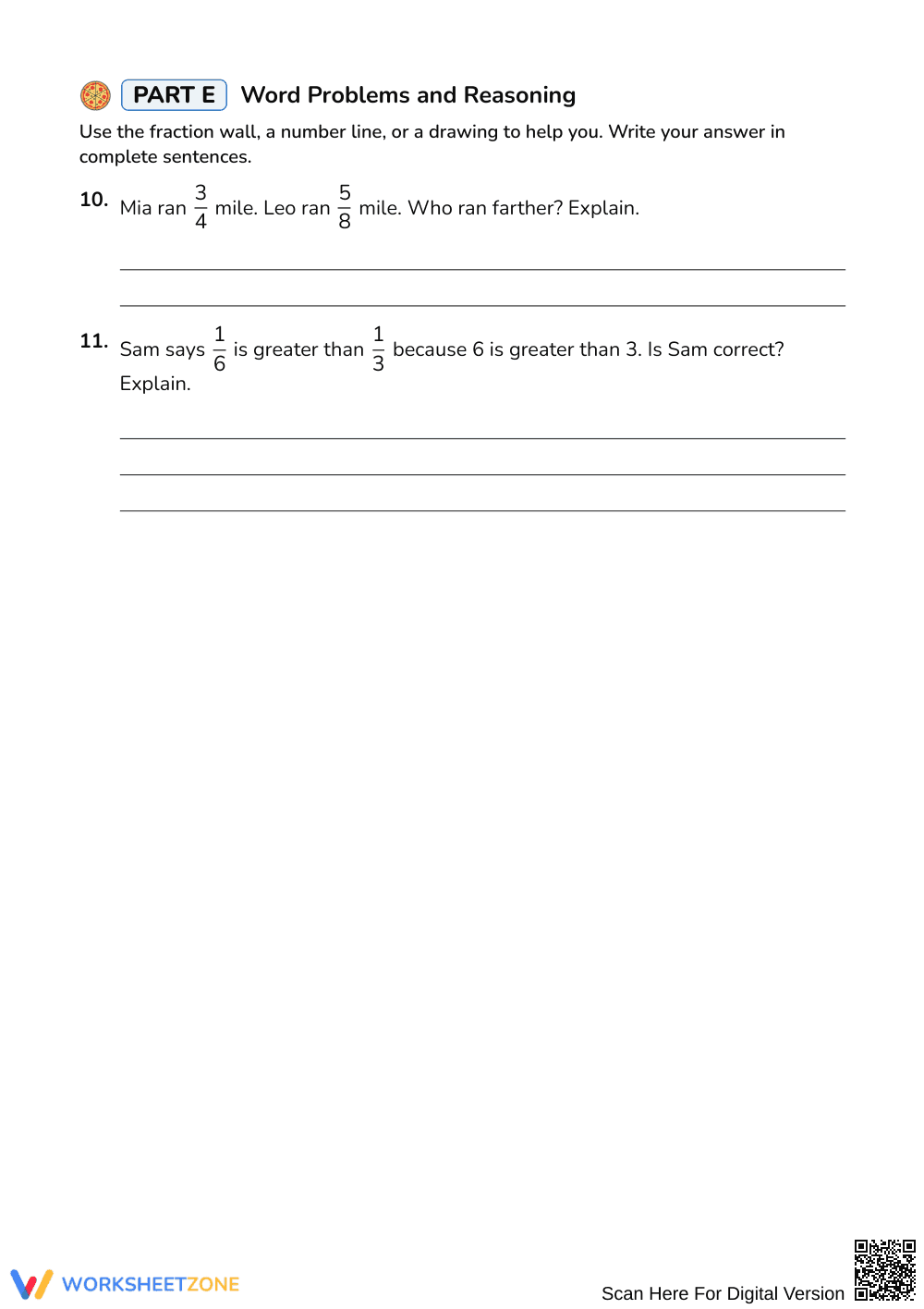
The 3-page student packet contains 17 problems across five visual formats: fraction bars (Part A), number line ordering (Part B), fraction wall comparisons (Part C), benchmark sorting tables (Part D), and written reasoning word problems (Part E). A matching 3-page answer key provides complete solutions and written explanations.
Skill Progression
- Guided practice (Parts A & B, 5 problems): Students inspect shaded fraction bars and a marked eighths number line with explicit visual scaffolds.
- Supported practice (Parts C & D, 7 problems): Students examine fraction wall segments and classify fractions against benchmark values of 0, 1/2, and 1.
- Independent practice (Part E, 5 problems): Students solve word problems and write justifications evaluating common fraction misconceptions without visual supports.
This structure follows a gradual-release model, moving learners from concrete visual analysis to abstract reasoning.
Standards Alignment
This resource aligns with `4.NF.A.2`: Compare two fractions with different numerators and different denominators by creating common denominators or comparing to a benchmark fraction like 1/2. It also reinforces supporting standard `4.NF.A.1` through visual equivalence on fraction walls. Both standard codes can be copied directly into lesson plans, IEP goals, or district curriculum mapping tools.
How to Use It
Use this worksheet after direct instruction on benchmark fractions. In small groups, assign Parts A through C to assess whether students understand that smaller denominators mean larger unit pieces. In Part D, monitor how students place 3/8 relative to 1/2. Completion takes 30 to 45 minutes.
Who It's For
This activity supports fourth-grade students, fifth-grade intervention groups, and learners with IEP goals targeting visual fractions. Provide fraction tiles for students needing tactile support on Part C. Pair this resource with a direct instruction lesson on benchmark reasoning or an equivalent fractions anchor chart.
Mastering fraction comparison requires students to connect visual area models, linear number lines, and benchmark reasoning before executing abstract computation. According to Fisher & Frey (2014), structured gradual-release frameworks ensure that intermediate elementary students build conceptual schema by moving systematically from teacher-guided visual analysis to autonomous written justification. This instructional packet targets standard 4.NF.A.2 by prompting learners to compare fractions with unlike denominators through fraction bars, number lines, fraction walls, and benchmarks. By demanding complete sentence explanations for mathematical misconceptions—such as addressing why one-sixth is smaller than one-third despite the larger denominator—the 17 tasks cultivate relational understanding over rote procedural memory. Independent completion of these visual representations provides educators with verifiable diagnostic evidence regarding student mastery of fractional size relationships, enabling timely intervention before learners advance to mixed numbers and unlike-denominator fraction addition.


