


























0
Views
0
Downloads

0.0
0
Save
0 Likes
Share
Compare and Contrast Vertebrates and Invertebrates
0 Views
0 Downloads
Paste this activity's link or code into your existing LMS (Google Classroom, Canvas, Teams, Schoology, Moodle, etc.).
Students can open and work on the activity right away, with no student login required.
You'll still be able to track student progress and results from your teacher account.
Information
Description
What It Is:
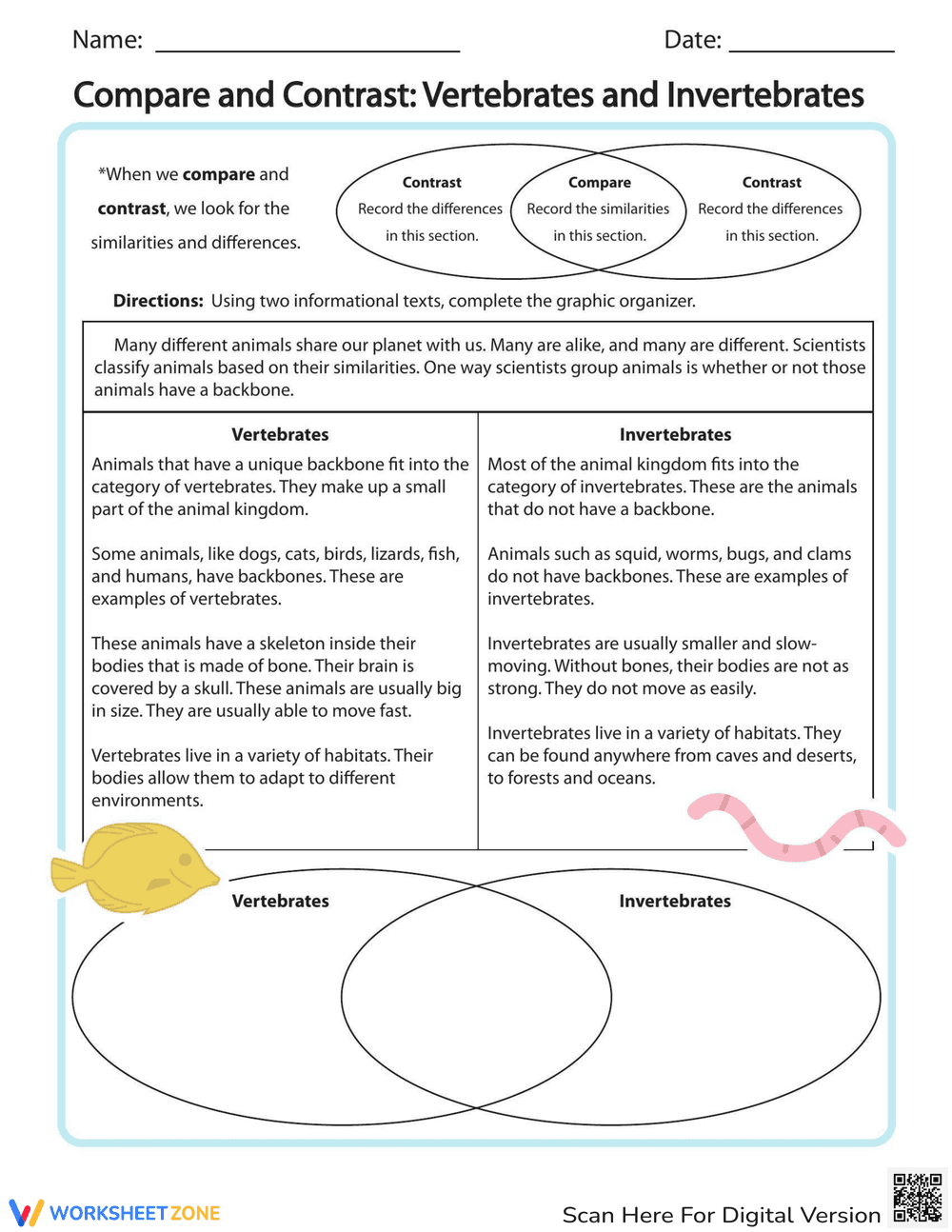
This is an educational worksheet designed to help students compare and contrast vertebrates and invertebrates. It includes informational text describing the characteristics of each group of animals, as well as a Venn diagram for students to record the similarities and differences between them. There are labelled sections for 'Contrast' (differences) and 'Compare' (similarities) to guide students. The worksheet includes a picture of a fish representing vertebrates and a worm representing invertebrates.
Grade Level Suitability:
This worksheet is suitable for grades 3-5. The reading level of the informational text is appropriate for this age group, and the Venn diagram is a common tool used to teach comparison and contrast skills at this level. The topic of vertebrates and invertebrates is a standard science topic for elementary school.
Why Use It:
This worksheet helps students develop critical thinking skills by analyzing and comparing information. It reinforces understanding of the key characteristics that differentiate vertebrates and invertebrates. Using the Venn diagram promotes organization of information and visual learning. It also helps students practice reading comprehension skills.
How to Use It:
Students should read the informational text about vertebrates and invertebrates. Then, they should use the Venn diagram to record the similarities and differences between the two groups. In the sections labeled 'Contrast,' they should write the characteristics that are unique to each group. In the overlapping section labeled 'Compare,' they should write the characteristics that both groups share.
Target Users:
This worksheet is intended for elementary school students in grades 3-5 who are learning about animal classification and the differences between vertebrates and invertebrates. It can be used in a science class or as a homework assignment.
This is an educational worksheet designed to help students compare and contrast vertebrates and invertebrates. It includes informational text describing the characteristics of each group of animals, as well as a Venn diagram for students to record the similarities and differences between them. There are labelled sections for 'Contrast' (differences) and 'Compare' (similarities) to guide students. The worksheet includes a picture of a fish representing vertebrates and a worm representing invertebrates.
Grade Level Suitability:
This worksheet is suitable for grades 3-5. The reading level of the informational text is appropriate for this age group, and the Venn diagram is a common tool used to teach comparison and contrast skills at this level. The topic of vertebrates and invertebrates is a standard science topic for elementary school.
Why Use It:
This worksheet helps students develop critical thinking skills by analyzing and comparing information. It reinforces understanding of the key characteristics that differentiate vertebrates and invertebrates. Using the Venn diagram promotes organization of information and visual learning. It also helps students practice reading comprehension skills.
How to Use It:
Students should read the informational text about vertebrates and invertebrates. Then, they should use the Venn diagram to record the similarities and differences between the two groups. In the sections labeled 'Contrast,' they should write the characteristics that are unique to each group. In the overlapping section labeled 'Compare,' they should write the characteristics that both groups share.
Target Users:
This worksheet is intended for elementary school students in grades 3-5 who are learning about animal classification and the differences between vertebrates and invertebrates. It can be used in a science class or as a homework assignment.


