


























Views
Downloads


Grade 3 Adjectives — Printable No-Prep Worksheet
Paste this activity's link or code into your existing LMS (Google Classroom, Canvas, Teams, Schoology, Moodle, etc.).
Students can open and work on the activity right away, with no student login required.
You'll still be able to track student progress and results from your teacher account.
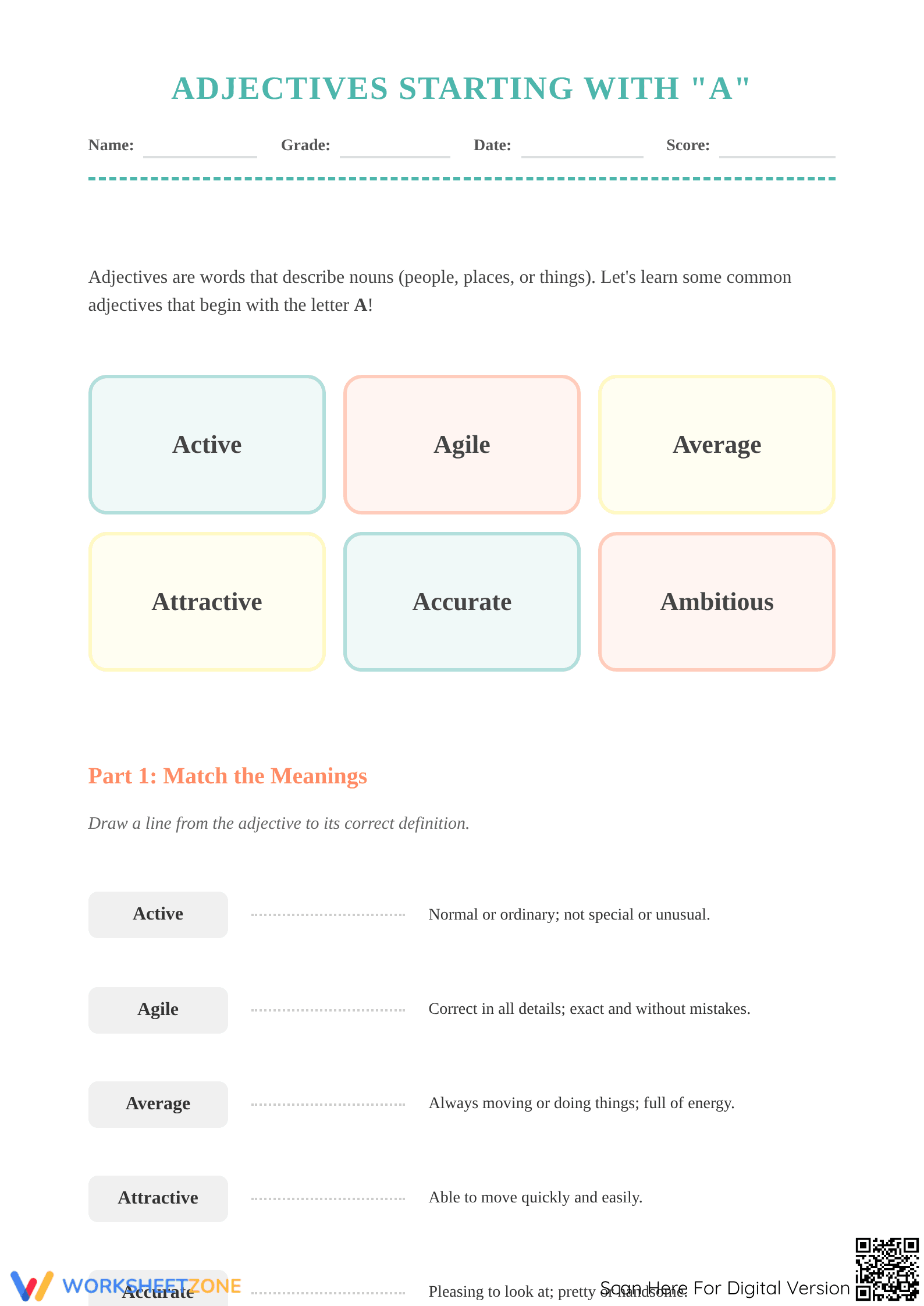
This Grade 3 vocabulary worksheet helps students acquire and accurately use new descriptive words. By focusing on common adjectives starting with the letter A, learners expand their everyday language skills and improve their reading comprehension. Students will connect words to their definitions and apply them in context.
At a Glance
- Grade: 3 · Subject: ELA
- Standard:
CCSS.ELA-LITERACY.L.3.6— Acquire and use grade-appropriate vocabulary accurately.- Skill Focus: Adjectives and Vocabulary Context
- Format: 2 pages · 14 problems · Answer key included · PDF
- Best For: Independent practice and vocabulary building
- Time: 15–20 minutes
This two-page resource introduces six specific adjectives: active, agile, average, attractive, accurate, and ambitious. The worksheet features a clear reference section at the top, followed by three distinct task types. Students begin with a matching activity to solidify definitions, move on to a fill-in-the-blank section to practice contextual usage, and finish with a creative writing prompt requiring them to generate their own sentences. A complete answer key is provided for quick grading.
Zero-Prep Workflow
- Print (1 minute): Simply print the two-page PDF double-sided. No special materials or prior setup are required.
- Distribute (1 minute): Hand out the worksheet as a morning work assignment, literacy center activity, or independent practice task.
- Review (3 minutes): Use the included answer key to quickly check student comprehension or project it on the board for self-correction. Total teacher prep time is under two minutes, making this an excellent option for emergency sub plans.
Standards Alignment
Aligned to CCSS.ELA-LITERACY.L.3.6, this resource ensures students acquire and use accurately grade-appropriate conversational, general academic, and domain-specific words and phrases. It also supports reading comprehension by helping students determine the meaning of words in context. Both standard codes can be copied directly into lesson plans, IEP goals, or district curriculum mapping tools.
How to Use It
This worksheet is highly effective as a follow-up activity after direct instruction on parts of speech. Teachers can assign it during literacy centers to reinforce vocabulary acquisition independently. As a formative assessment tip, observe how students tackle the creative writing section; this will reveal whether they truly grasp the nuance of the adjectives beyond simple memorization. Expected completion time is 15 to 20 minutes.
Who It's For
Designed primarily for third-grade students, this resource is also appropriate for second graders needing an extra challenge or fourth graders requiring vocabulary review. The clear layout and structured progression provide built-in scaffolding for English Language Learners. Pair this worksheet with a descriptive writing anchor chart to help students immediately apply their new vocabulary to longer writing assignments.
Explicit vocabulary instruction is a critical component of reading comprehension and effective communication. By targeting specific descriptive words, this resource aligns with CCSS.ELA-LITERACY.L.3.6 to help students acquire and use grade-appropriate vocabulary accurately. According to a recent EdReports 2024 analysis, instructional materials that provide multiple exposures to new words across different contexts—such as matching definitions, completing sentences, and generating original text—significantly increase long-term retention. This worksheet utilizes that exact multi-modal approach, moving learners from basic recognition to active application. Providing structured opportunities to practice new adjectives ensures students can transition these words from their receptive vocabulary into their expressive vocabulary, ultimately strengthening both their reading fluency and their independent writing capabilities.


