


























Views
Downloads

Universe Coloring Page | Essential Grade K-5 Printable
Paste this activity's link or code into your existing LMS (Google Classroom, Canvas, Teams, Schoology, Moodle, etc.).
Students can open and work on the activity right away, with no student login required.
You'll still be able to track student progress and results from your teacher account.
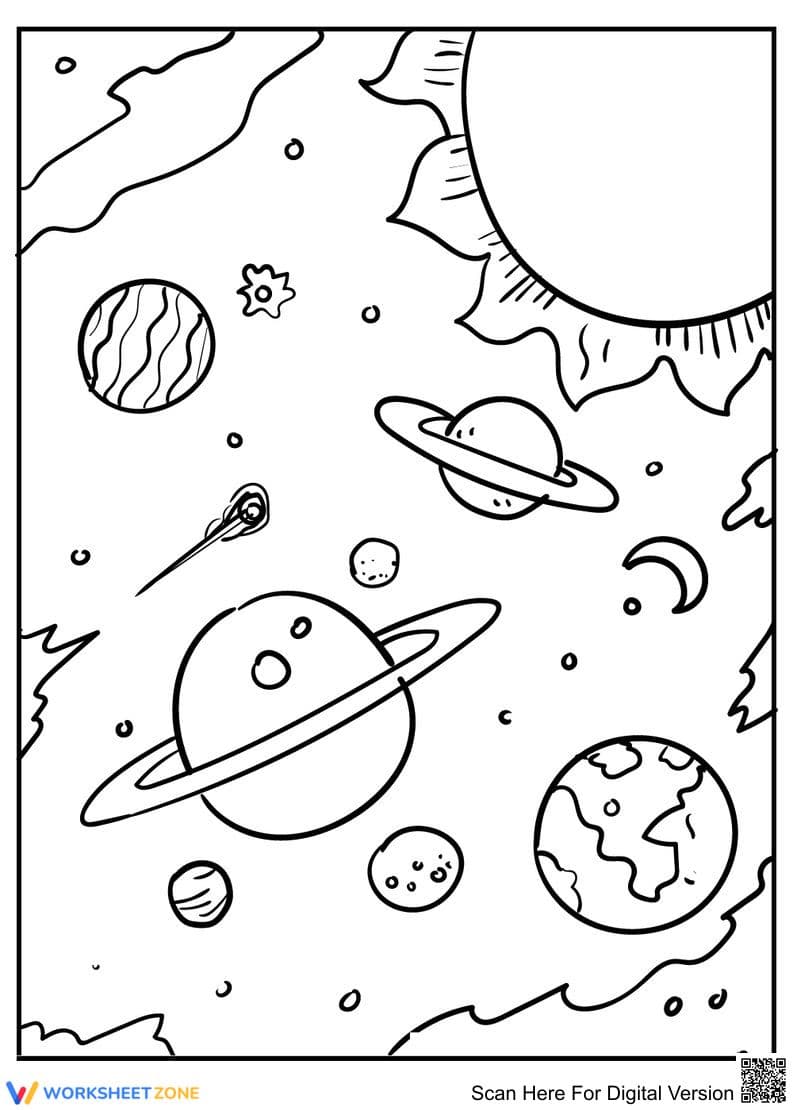
This printable universe coloring worksheet provides students with a detailed celestial scene to explore through art. By engaging with illustrations of the sun, planets, and stars, learners develop fine motor control and spatial awareness. It serves as an excellent supplemental activity for early elementary science units or creative writing prompts about outer space.
At a Glance
- Grade: K-5 · Subject: Arts & Science
- Standard:
K-ESS1-1— Use observations of the sun, moon, and stars to describe patterns- Skill Focus: Fine Motor & Space Vocabulary
- Format: 1 page · 1 complex scene · No answer key · PDF
- Best For: Early finishers and science centers
- Time: 15–30 minutes
This single-page PDF features a high-quality line-art illustration of the solar system. The composition includes a large sun, multiple ringed planets, the Earth, a crescent moon, a comet, and various stars. The varied sizes of the objects allow for different levels of coloring precision, making it suitable for a wide age range from Kindergarten through 5th grade.
Zero-Prep Workflow
- Print: Select the single-page PDF and print enough copies for your group (30 seconds).
- Distribute: Provide the sheets to students along with crayons, markers, or colored pencils (1 minute).
- Review: Have students name the celestial bodies they have colored to reinforce vocabulary (2 minutes).
Total teacher preparation time is under two minutes, making this an ideal sub-plan or transition activity.
Standards Alignment
This resource aligns with `K-ESS1-1`, which requires students to use observations of the sun, moon, and stars to describe predictable patterns. While primarily an artistic tool, it supports visual identification of these astronomical objects. Both standard codes can be copied directly into lesson plans, IEP goals, or district curriculum mapping tools.
How to Use It
Use this worksheet during a science unit on the solar system to reinforce the visual characteristics of different planets. It is also effective as a formative assessment tool; observe if students can distinguish between the sun and the planets based on their coloring choices. Completion typically takes 15 to 30 minutes depending on the medium used.
Who It's For
This worksheet is designed for early elementary students, particularly those in Kindergarten through 2nd grade, though older students will enjoy the detailed linework. It is a natural pairing for a read-aloud about space or an anchor chart displaying the order of the planets from the sun.
Integrating visual arts into science instruction, such as this K-ESS1-1 aligned coloring activity, supports cognitive development and retention of scientific vocabulary. According to the RAND AIRS 2024 report, multi-modal learning experiences that combine tactile engagement with thematic content improve student interest in STEM subjects. By identifying and coloring the sun, moon, and stars, students build a foundational mental model of the universe. This resource provides a low-stakes environment for students to practice fine motor skills while internalizing the relative scales and features of celestial bodies. Research indicates that such creative activities can reduce academic anxiety and provide a necessary sensory break during rigorous instructional blocks. This standalone summary confirms the worksheet's utility as a bridge between creative expression and standards-based observational science in the early childhood classroom.


