


























Views
Downloads
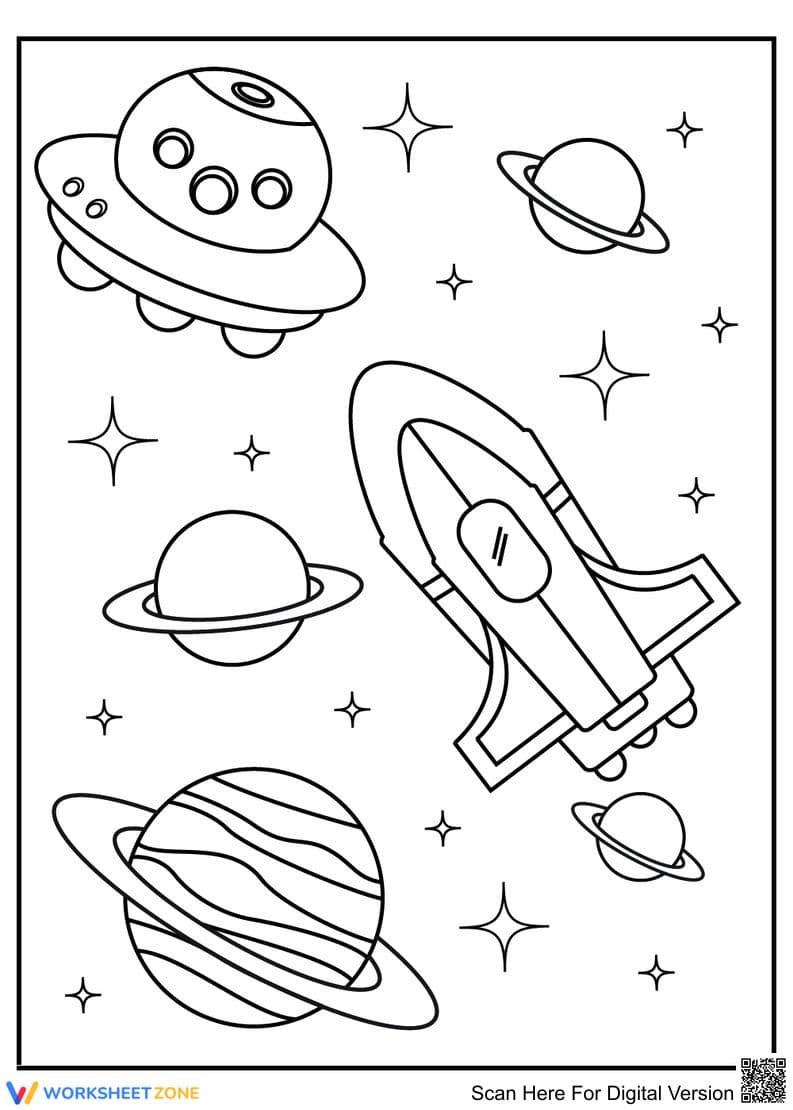

Outer Space Coloring Worksheet | Grade K-2 Essential
Paste this activity's link or code into your existing LMS (Google Classroom, Canvas, Teams, Schoology, Moodle, etc.).
Students can open and work on the activity right away, with no student login required.
You'll still be able to track student progress and results from your teacher account.
This Outer Space coloring worksheet provides young learners with a creative outlet to explore astronomical themes while developing essential fine motor control. By engaging with detailed illustrations of spacecraft and celestial bodies, students improve their hand-eye coordination and grip strength, which are foundational for early writing success and artistic expression in the primary classroom.
At a Glance
- Grade: K-2 · Subject: Arts & Science
- Standard:
K-ESS1-1— Use observations of the sun, moon, and stars to describe patterns- Skill Focus: Fine motor development and space vocabulary
- Format: 1 page · 1 task · No answer key required · PDF
- Best For: Early finishers and morning work
- Time: 15–20 minutes
What's Inside
Inside this printable PDF, you will find a single-page high-quality illustration featuring a classic rocket ship, a stylized UFO, multiple ringed planets, and a field of stars. The clean line art is designed specifically for crayons, colored pencils, or markers, ensuring that even the youngest students can stay within the lines while expressing their unique vision of the galaxy.
Zero-Prep Workflow
The zero-prep workflow for this resource is designed for maximum efficiency in busy classrooms. First, print the single-page PDF in seconds. Second, distribute the sheets to students during transition periods or as a reward for completing core tasks. Third, review the completed artwork to assess student grip and color choice. Total teacher preparation time is under 2 minutes, making it an ideal sub plan addition.
Standards Alignment
This resource aligns with `K-ESS1-1`, which encourages students to observe and describe patterns in the natural world, including the stars and planets. While primarily an artistic activity, it serves as a visual anchor for discussions about Earth's place in the solar system. This standard code can be copied directly into lesson plans, IEP goals, or district curriculum mapping tools.
How to Use It
Use this worksheet as a quiet-time activity following a read-aloud about the solar system. It is also an excellent formative assessment tool; observe how students hold their coloring utensils to identify those who may need additional occupational therapy support or pencil-grip intervention. Expect students to spend approximately 15 to 20 minutes completing the scene during morning work or centers.
Who It's For
This worksheet is ideal for Kindergarten through 2nd-grade students, though older children may enjoy it as a stress-relief activity. It is particularly effective for English Language Learners (ELLs) when paired with a space-themed word bank or an anchor chart identifying the rocket, planets, and stars to build domain-specific vocabulary during science blocks.
Research by Fisher & Frey (2014) emphasizes the importance of visual literacy and fine motor practice in the early childhood curriculum as a precursor to formal writing and complex cognitive processing. This Outer Space worksheet supports these developmental milestones by providing a structured yet creative environment for students to practice precision and spatial awareness. Aligned with the K-ESS1-1 standard, the activity bridges the gap between artistic expression and scientific observation, allowing students to internalize astronomical concepts through tactile engagement. According to the NAEP, students who engage in regular fine motor activities show higher readiness for literacy tasks in later primary grades. By integrating this 1-page resource into daily routines, educators provide a low-stakes opportunity for students to master the gradual release model of independent task completion. This standalone summary confirms the worksheet's utility as a research-backed tool for early elementary development.


