


























Views
Downloads

Living and Non-living Things Worksheet | Grade K Ready
Paste this activity's link or code into your existing LMS (Google Classroom, Canvas, Teams, Schoology, Moodle, etc.).
Students can open and work on the activity right away, with no student login required.
You'll still be able to track student progress and results from your teacher account.
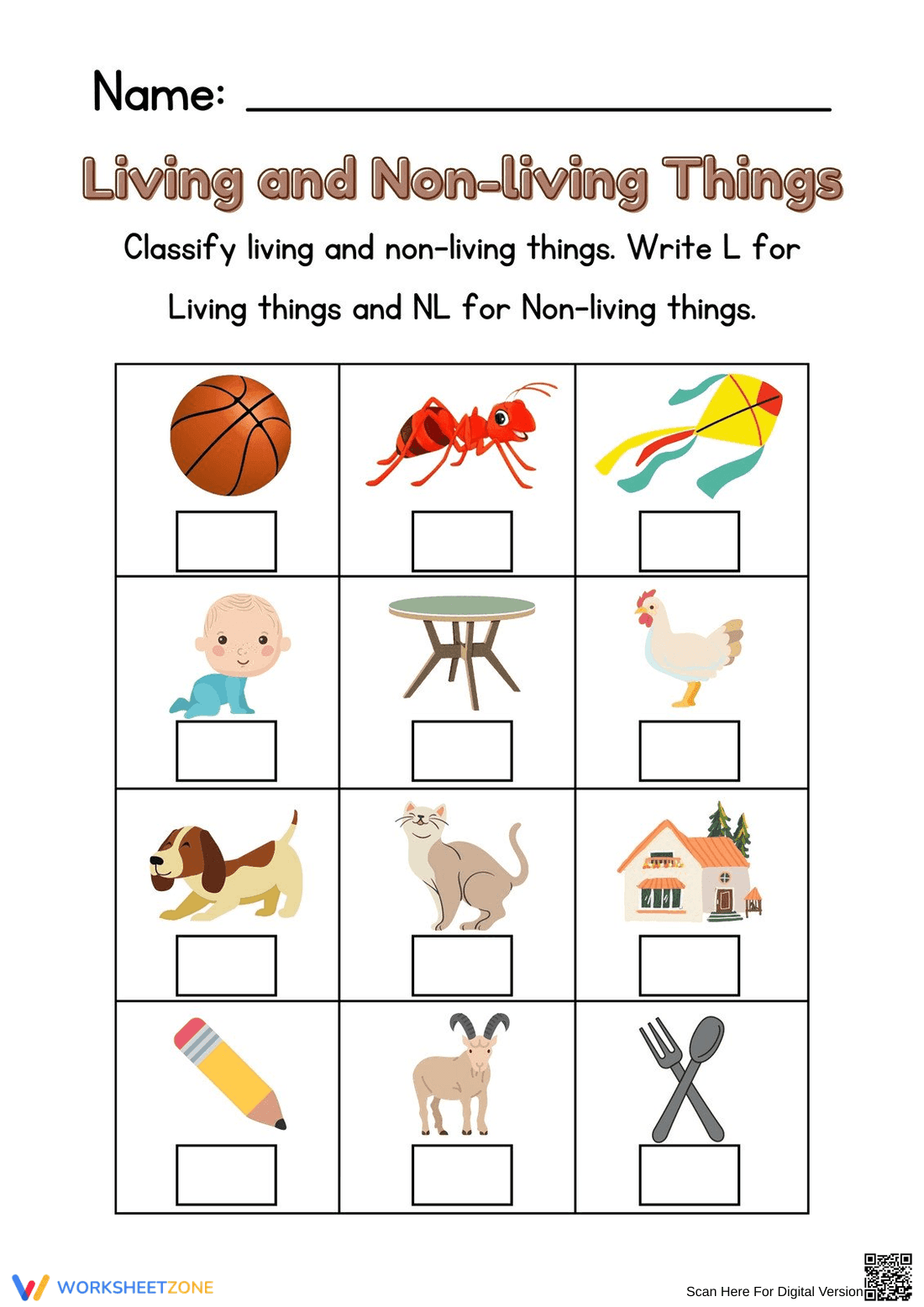
This Grade K science worksheet helps students distinguish between living and non-living things through visual classification. By identifying 12 distinct objects, learners develop foundational biological observation skills. This resource provides a clear, structured way for young scientists to apply their knowledge of life characteristics to real-world items like animals, people, and inanimate objects.
At a Glance
- Grade: Kindergarten · Subject: Science
- Standard:
K-LS1-1— Use observations to describe patterns of what plants and animals need to survive- Skill Focus: Living vs. Non-living Classification
- Format: 1 page · 12 problems · Answer key included · PDF
- Best For: Independent practice or quick formative assessment
- Time: 10–15 minutes
Inside this single-page PDF, you will find a 3x4 grid featuring high-quality, colorful illustrations. Students are prompted to write "L" for living things and "NL" for non-living things in the provided boxes below each image. The worksheet includes a mix of animals, humans, and common household objects to ensure a comprehensive check for understanding. A full answer key is provided for rapid grading.
This resource is designed for a zero-prep workflow. First, print the single-page PDF (30 seconds). Next, distribute the sheets to your students and explain the "L" and "NL" coding system (1 minute). Finally, review the answers as a whole group or collect them for a quick check (under 1 minute). Total teacher preparation time is less than two minutes, making it an ideal sub plan.
This worksheet aligns with K-LS1-1, focusing on the observation of patterns in living organisms. By identifying living things, students begin to recognize the shared traits of organisms that require energy and growth. It also supports supporting standards by helping students understand the relationship between living things and their environment. Both standard codes can be copied directly into lesson plans, IEP goals, or district curriculum mapping tools.
Use this worksheet during the "elaborate" phase of a 5E science lesson. After discussing the traits of living things (breathing, eating, growing), assign this as independent practice to verify comprehension. It also serves as an excellent formative assessment observation tool; watch for students who struggle with the "baby" versus "doll-like" illustrations to address misconceptions about life cycles. Completion typically takes 10 to 15 minutes.
This resource is tailored for Kindergarten and early 1st-grade students. It is particularly effective for English Language Learners (ELLs) because the heavy reliance on visual cues reduces the linguistic load while maintaining cognitive rigor. Pair this worksheet with a living/non-living anchor chart or a short nature walk around the school grounds for a complete instructional experience.
The classification of living and non-living entities is a fundamental milestone in early childhood science education, serving as the gateway to more complex biological concepts. According to the RAND AIRS 2024 report on early science literacy, structured visual sorting tasks significantly improve a child's ability to categorize natural phenomena and develop scientific vocabulary. This worksheet utilizes 12 specific prompts to reinforce the K-LS1-1 standard, ensuring students can differentiate between biological organisms and inanimate objects with high accuracy. By engaging with colorful, recognizable illustrations, learners build the observational stamina required for higher-level inquiry. Research suggests that early exposure to these classification patterns predicts later success in life science modules. This printable resource provides the necessary scaffolding for students to move from simple identification to explaining the logic behind their choices, fostering a deeper connection to the natural world and scientific methodology.


