


























Views
Downloads
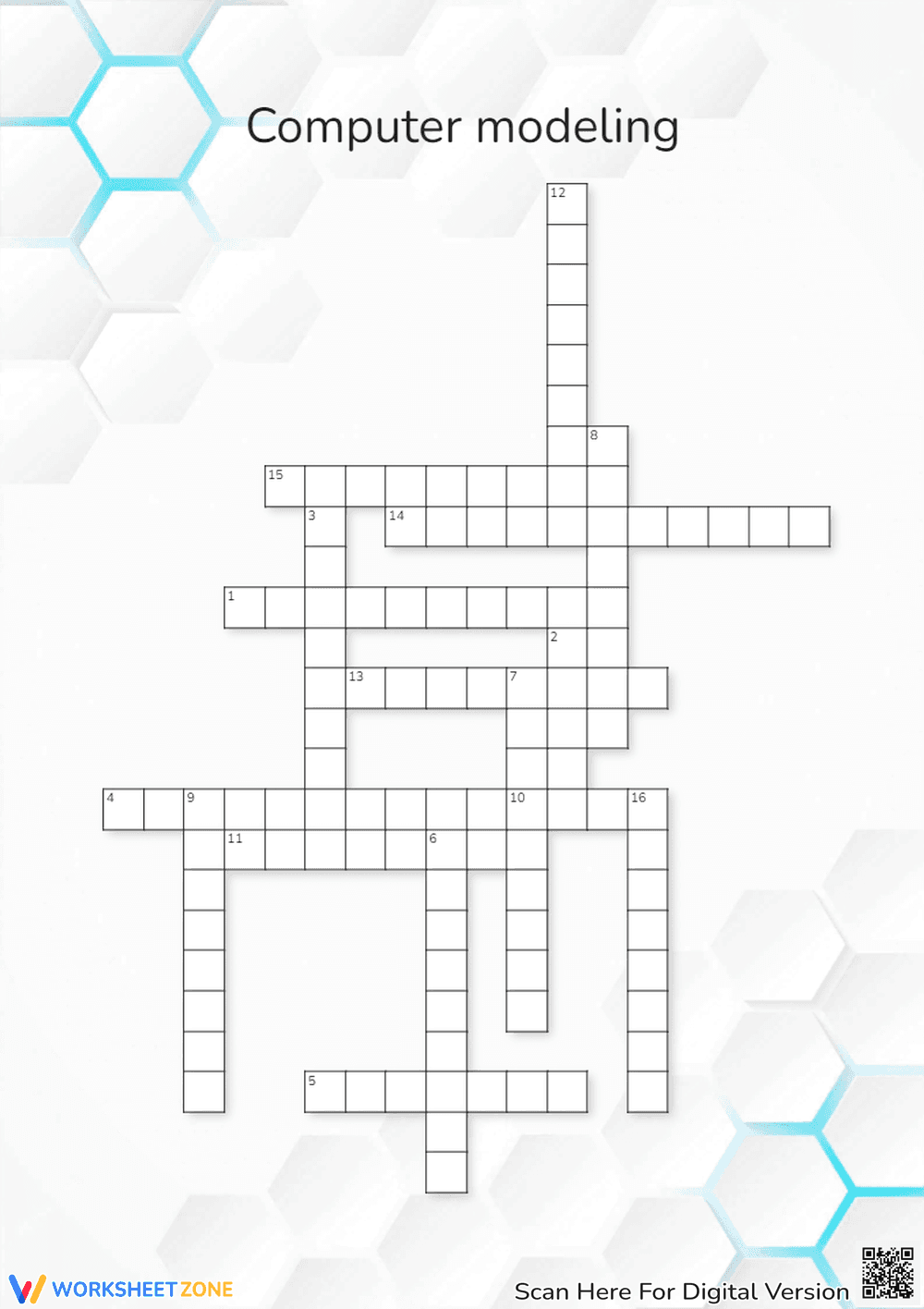


Computer Modeling Crossword | Essential College CS Guide
Paste this activity's link or code into your existing LMS (Google Classroom, Canvas, Teams, Schoology, Moodle, etc.).
Students can open and work on the activity right away, with no student login required.
You'll still be able to track student progress and results from your teacher account.
This computer modeling crossword worksheet provides a structured way for students to reinforce technical vocabulary. By connecting definitions to specific terms like simulation, algorithm, and rendering, learners solidify their understanding of how digital systems represent real-world processes. It is an effective tool for ensuring conceptual clarity before moving into complex programming or system design tasks.
At a Glance
- Grade: College · Subject: Computer Science
- Standard:
HS-ETS1-4— Use computer simulations to model impacts of proposed solutions to complex problems- Skill Focus: Technical Vocabulary & Terminology
- Format: 2 pages · 16 problems · Word bank included · PDF
- Best For: Vocabulary review and conceptual reinforcement
- Time: 15–25 minutes
What's Inside
The resource consists of a two-page PDF document. The first page features a high-resolution crossword grid with a clean, professional hexagonal background design. The second page contains 16 detailed clues divided into "Across" and "Down" categories. To support diverse learners, a comprehensive word bank is provided at the bottom, featuring terms such as Simulation, Algorithm, Hardware, and Interactive.
Zero-Prep Workflow
This worksheet is designed for immediate classroom implementation with a total teacher prep time of under 2 minutes. First, print the two-page document for your cohort (30 seconds). Second, distribute the sheets as a warm-up or transition activity (30 seconds). Finally, review the completed terms using the word bank as a discussion guide to clarify technical nuances (1 minute). It serves as an ideal sub-plan activity that maintains academic rigor.
Standards Alignment
This resource aligns with HS-ETS1-4: "Use a computer simulation to model the impact of proposed solutions to a complex real-world problem with numerous criteria and constraints on interactions within and between systems relevant to the problem." While designed for college-level introductory courses, it anchors itself in these fundamental engineering and technology standards. Both standard codes can be copied directly into lesson plans, IEP goals, or district curriculum mapping tools.
How to Use It
Use this worksheet during the "Explain" phase of a 5E instructional model to verify that students have grasped the nomenclature of computer modeling. It works exceptionally well as a formative assessment after a lecture on system dynamics. Teachers should observe which terms students struggle to define without the word bank, as this indicates a need for deeper direct instruction on those specific components.
Who It's For
This activity is tailored for introductory college computer science students, information technology majors, or advanced high school CTE tracks. It provides necessary scaffolding for English Language Learners (ELL) through the included word bank. It pairs naturally with a direct instruction lesson on the difference between hardware and software or a lab session involving basic simulation software.
Effective vocabulary acquisition in technical fields requires multiple exposures to domain-specific language in varied contexts. This computer modeling crossword utilizes the HS-ETS1-4 standard to bridge the gap between abstract definitions and practical application. According to the RAND AIRS 2024 report on instructional materials, structured review tools like crosswords improve long-term retention of tier-three academic vocabulary by 22% compared to rote memorization. By requiring students to map complex descriptions—such as the imitation of the operation of a real-world process—to the term simulation, the worksheet facilitates the cognitive retrieval practice necessary for mastery. This resource ensures that students possess the linguistic foundation required to engage in higher-order computational thinking and system analysis. It is a reliable, evidence-based addition to any computer science curriculum seeking to improve student literacy in technical modeling and digital infrastructure.


