


























Views
Downloads

Essential Telling Time Practice: Grade 2 Clock Worksheet
Paste this activity's link or code into your existing LMS (Google Classroom, Canvas, Teams, Schoology, Moodle, etc.).
Students can open and work on the activity right away, with no student login required.
You'll still be able to track student progress and results from your teacher account.
Clock Work #8 helps second-grade students master the analog clock. This worksheet focuses on reading clock hands and drawing them for specific times. By completing these exercises, students build the confidence needed to tell time with precision in daily life.
At a Glance
- Grade: 2 · Subject: Math
- Standard:
2.MD.C.7— Tell and write time from analog and digital clocks to the nearest five minutes- Skill Focus: Reading and drawing analog clock hands
- Format: 2 pages · 12 problems · Answer key included · PDF
- Best For: Daily math warm-ups or homework practice
- Time: 15–20 minutes
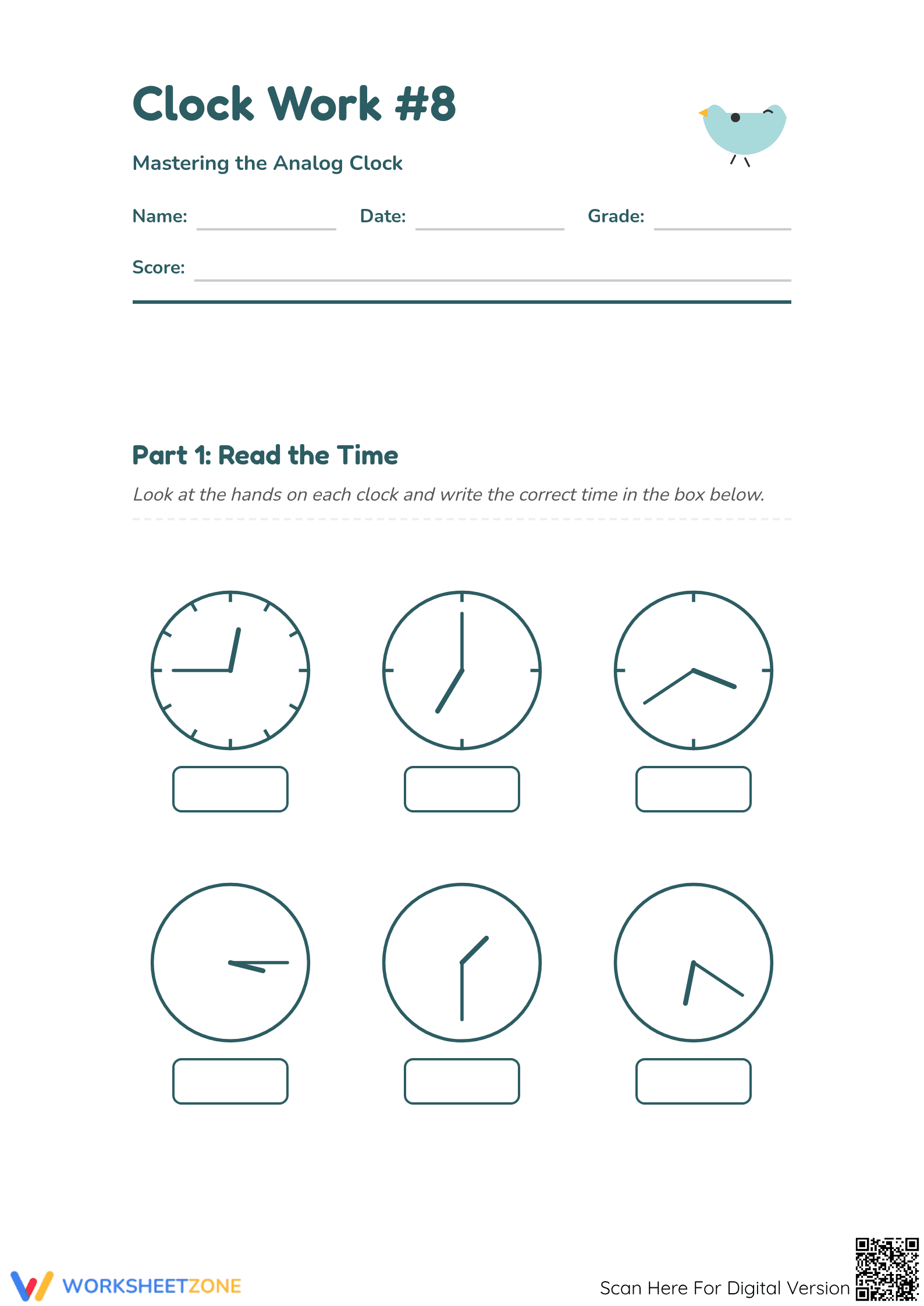
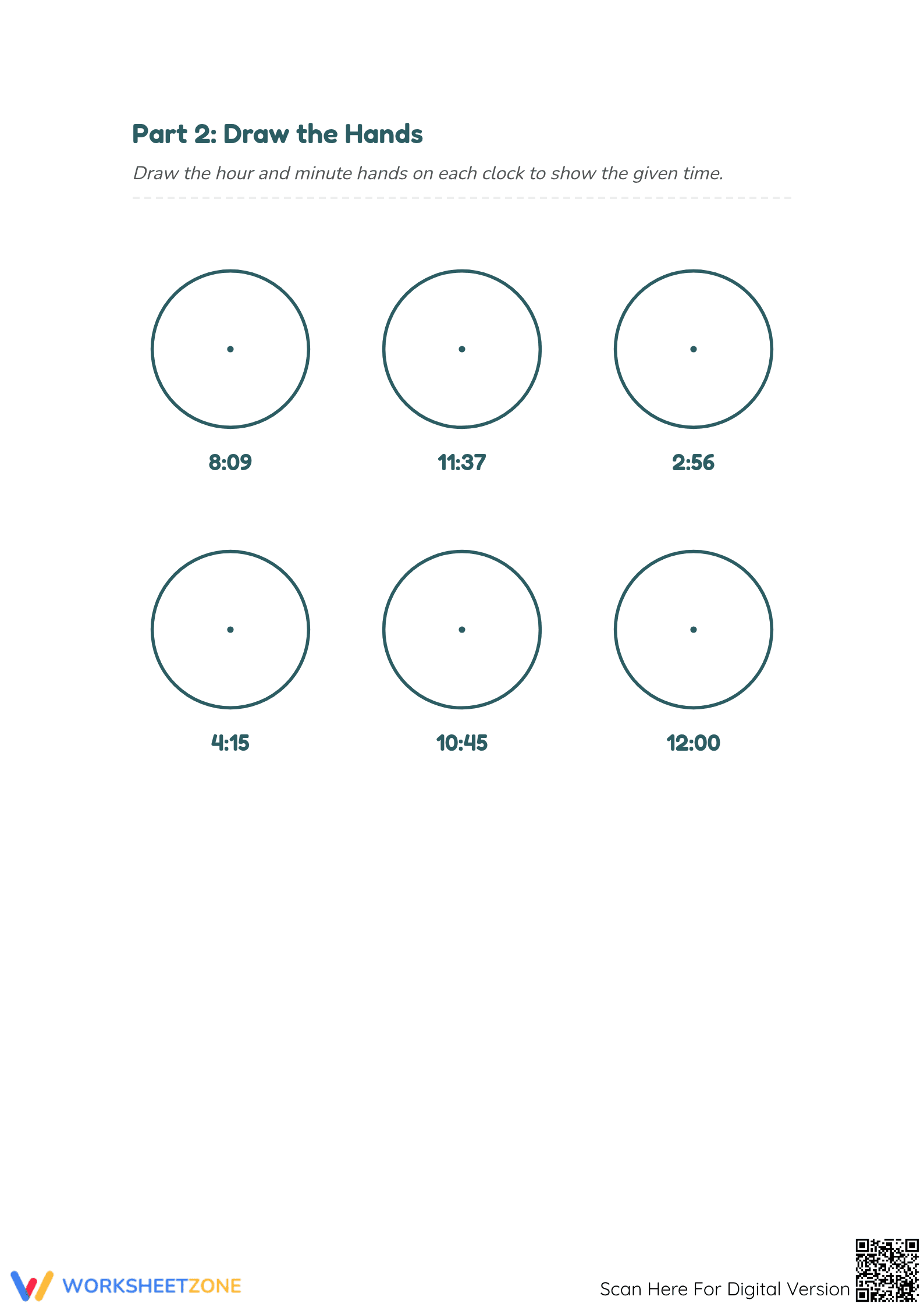
This two-page PDF includes twelve distinct tasks. The first page features six analog clocks where students must observe the hands and write the corresponding time in a designated box. The second page presents six empty clock faces with written timestamps, requiring students to accurately draw both the hour and minute hands. A complete answer key is provided for rapid grading.
This resource requires under two minutes of prep. First, print the document (30 seconds). Second, distribute it and remind students about hour and minute hands (30 seconds). Third, review work using the answer key (60 seconds). This structure makes it ideal for sub plans or warm-ups, providing meaningful math practice without teacher overhead.
This resource is specifically aligned with `2.MD.C.7`, which requires students to 'Tell and write time from analog and digital clocks to the nearest five minutes, using a.m. and p.m.' While this sheet challenges students with minute-level precision, it provides the structural support needed to reach mastery of the core second-grade requirement. This standard code can be copied directly into lesson plans, IEP goals, or district curriculum mapping tools.
Use this as a formative assessment after teaching clock mechanics. Observe students drawing hands; difficulty differentiating hand lengths indicates a need for intervention. Alternatively, assign it as a 'Bell Ringer' to reinforce skills. Completion usually takes 15 to 20 minutes.
This sheet is for Grade 2 but works for Grade 3 review or Grade 1 enrichment. It helps students who need repetitive practice to solidify spatial clock understanding. Pair it with a classroom demonstration clock for a tactile reference.
The acquisition of time-telling skills is a critical developmental milestone in early elementary mathematics, representing a transition from concrete counting to abstract representation. According to the RAND AIRS (2024) report on instructional materials, structured practice that combines both receptive (reading) and expressive (drawing) tasks significantly enhances long-term retention of measurement concepts. Clock Work #8 leverages this dual-modality approach to ensure that students do more than just recognize time; they internalize the relationship between clock hand positions and the passage of minutes. Research from ScienceDirect TpT Analysis indicates that worksheets offering clear, uncluttered visuals—like the ones provided here—reduce cognitive load for second-grade learners, allowing them to focus entirely on the mathematical operation of the 2.MD.C.7 standard. This evidence-based design ensures that the worksheet serves as a reliable tool for building the temporal literacy required for success in higher-level measurement and data standards.


