


























Views
Downloads

Essential 2nd Grade Telling Time to 5 Minutes Worksheet
Paste this activity's link or code into your existing LMS (Google Classroom, Canvas, Teams, Schoology, Moodle, etc.).
Students can open and work on the activity right away, with no student login required.
You'll still be able to track student progress and results from your teacher account.
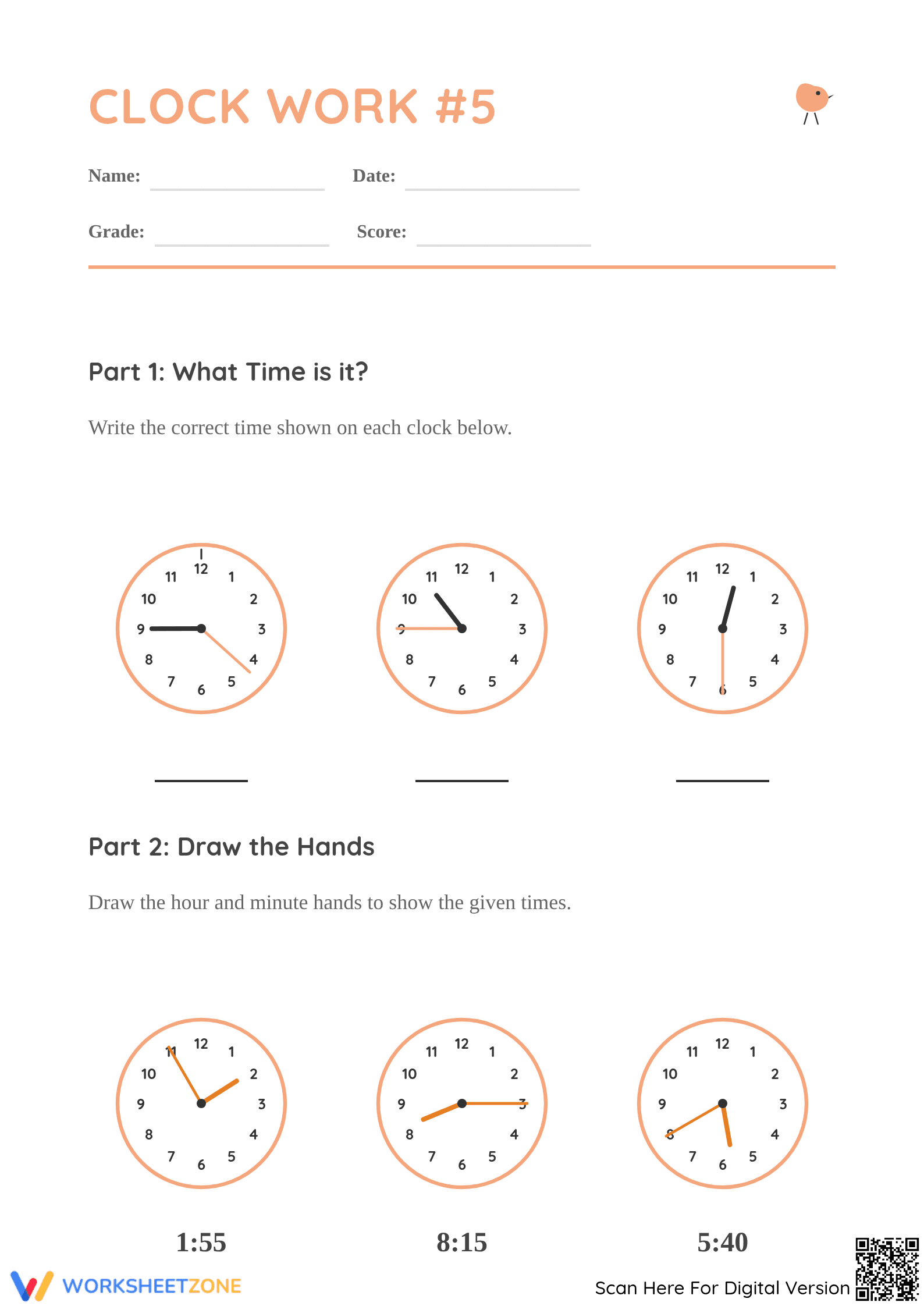
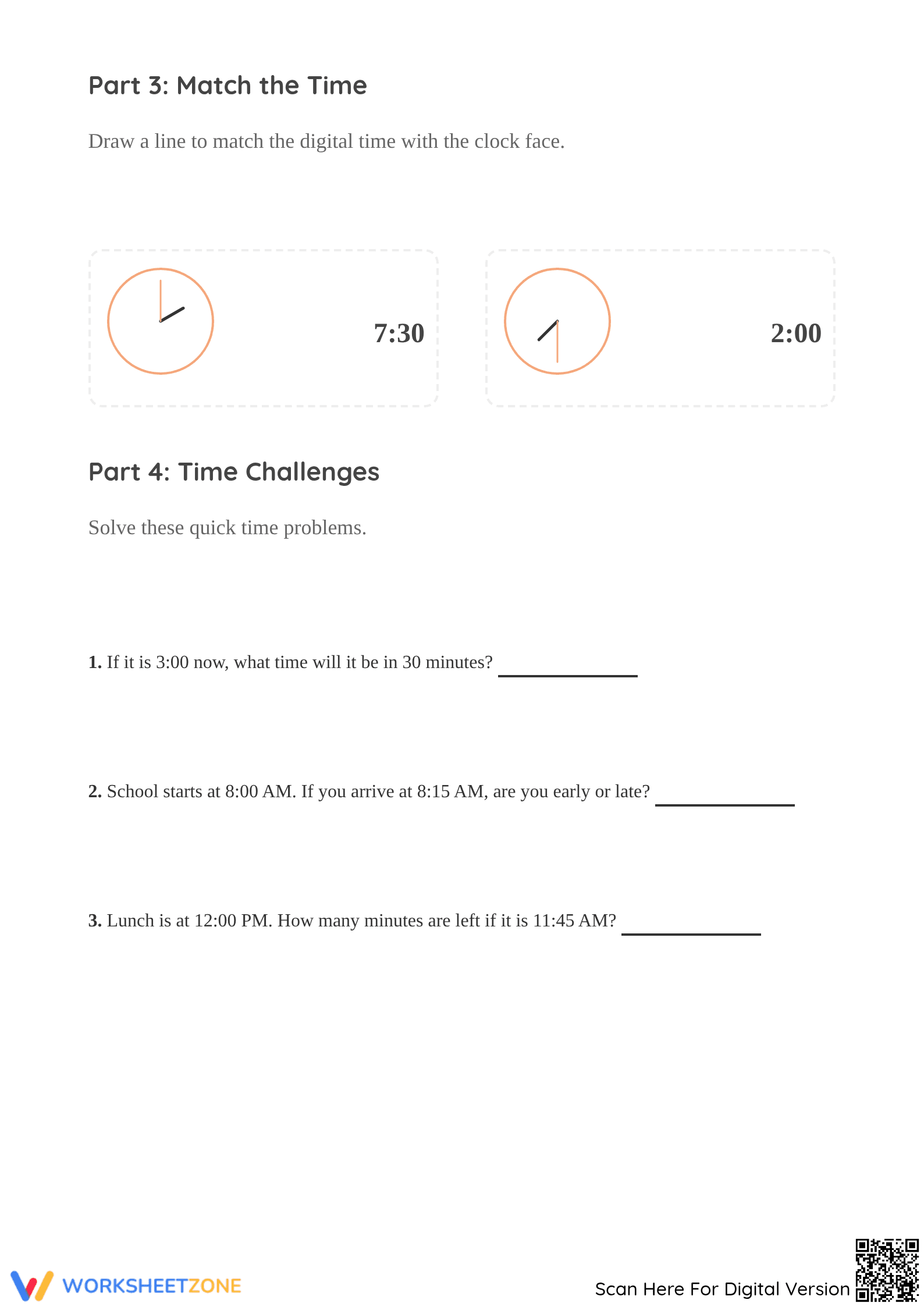
Mastering the analog clock is a foundational second-grade milestone. This worksheet helps students tell and write time from analog and digital clocks to the nearest five minutes. By engaging with multiple representations, learners build the fluency required for temporal reasoning and schedule management.
At a Glance
- Grade: 2 · Subject: Mathematics
- Standard:
2.MD.C.7— Tell and write time from analog and digital clocks to the nearest five minutes- Skill Focus: Analog Clock Reading and Drawing
- Format: 2 pages · 11 problems · Answer key included · PDF
- Best For: Small group instruction or independent practice
- Time: 15–20 minutes
What's Inside
This two-page PDF features four sections to scaffold student understanding. Part 1 requires reading three analog clocks and writing the digital equivalent. Part 2 provides digital times for drawing hands on blank faces. Page two introduces matching exercises and three word-problem challenges applying time-telling to real-world scenarios. An answer key is included.
Skill Progression
- Guided Identification: Establishing baseline recognition through analog visuals and direct digital conversion.
- Active Construction: Drawing hands to reinforce the specific relationship between hour and minute indicators.
- Independent Application: Using matching and word problems to challenge students with durations and contextual time.
This model follows the gradual-release I Do, We Do, You Do framework to ensure conceptual mastery.
Standards Alignment
Aligned with CCSS.MATH.CONTENT.2.MD.C.7, students tell and write time to the nearest five minutes. Word problems also support mathematical reasoning and problem-solving skills essential for early elementary achievement. Both standard codes can be copied directly into lesson plans, IEP goals, or district curriculum mapping tools.
How to Use It
Use this during the "You Do" phase. After demonstrating with a manipulative clock, distribute these for independent practice. Observe students during Part 2 to ensure they distinguish between the hour and minute hands. This serves as an excellent formative assessment, typically taking 15 to 20 minutes to complete.
Who It's For
Designed for second-grade students who have mastered half-hour increments. It is also effective for third-grade intervention or special education settings where visual scaffolds are beneficial. Pair this with a physical classroom clock or a routine passage to provide context for the word problems.
Developing proficiency in telling time is a critical component of the "Measurement and Data" domain in early mathematics. Research from Fisher & Frey (2014) emphasizes that the gradual release of responsibility—moving from reading clocks to drawing hands and finally solving contextual problems—is essential for long-term retention of procedural skills. According to the NAEP framework, students who can accurately tell time to the nearest five minutes by the end of second grade demonstrate significantly higher competency in later work involving elapsed time and complex scheduling. This worksheet addresses 2.MD.C.7 by providing the multiple exposures needed to move students from basic recognition to fluid application. By integrating analog reading with digital writing and word-based challenges, the resource ensures that learners internalize the 60-minute cycle and the role of the five-minute interval as a multiplicative building block for future fraction and ratio work in upper elementary.


