


























Views
Downloads


Printable Telling Time to 5 Minutes Worksheet | Grade 2
Paste this activity's link or code into your existing LMS (Google Classroom, Canvas, Teams, Schoology, Moodle, etc.).
Students can open and work on the activity right away, with no student login required.
You'll still be able to track student progress and results from your teacher account.
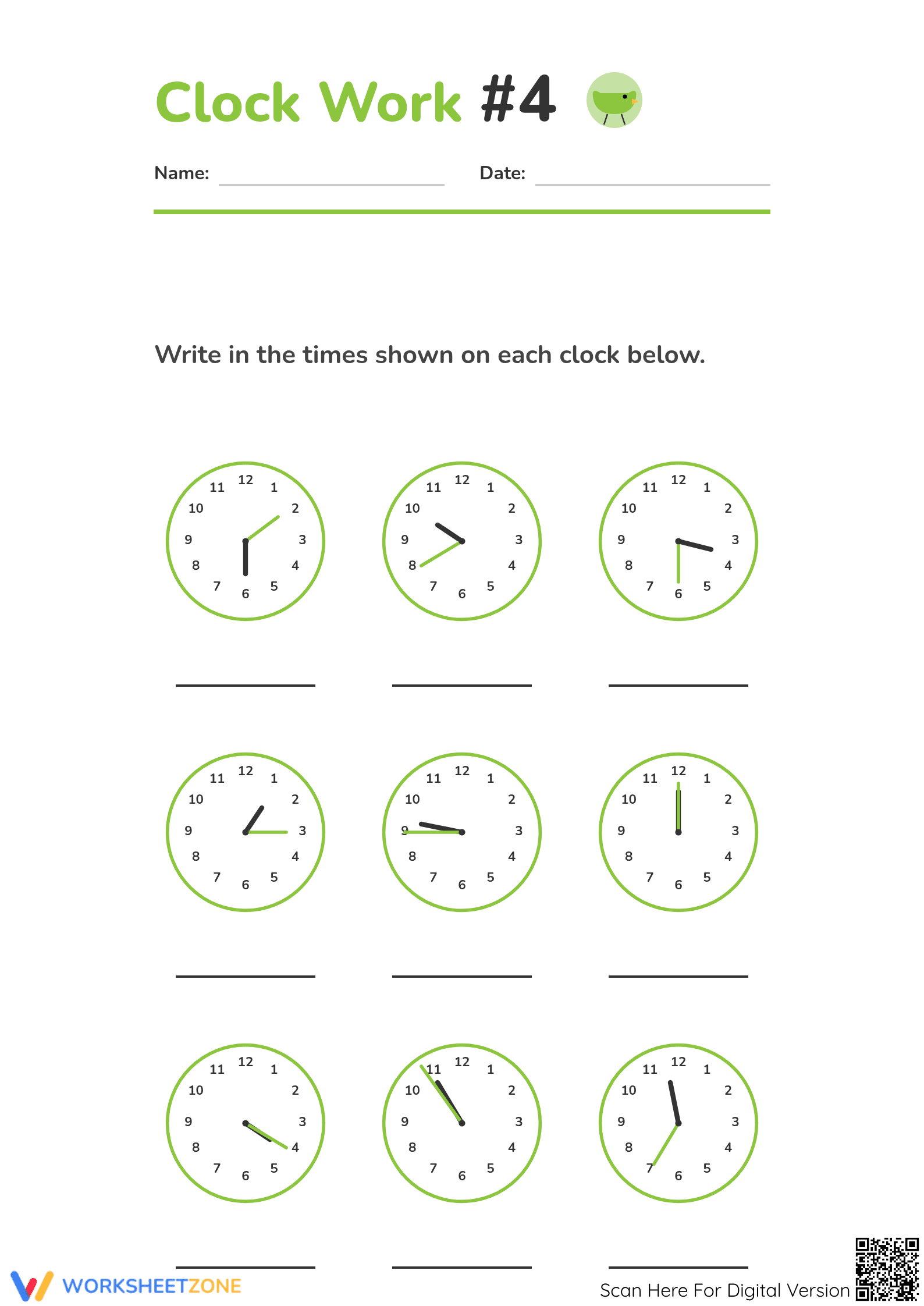
This Grade 2 math worksheet provides comprehensive practice for students learning to tell and write time to the nearest five minutes. By alternating between reading analog clock faces and drawing hands to represent digital times, students develop a dual-fluency that solidifies their understanding of the clock's circular number line and five-minute intervals.
At a Glance
- Grade: 2 · Subject: Math
- Standard:
2.MD.C.7— Tell and write time from analog and digital clocks to the nearest five minutes- Skill Focus: Five-minute intervals and clock hand placement
- Format: 2 pages · 15 problems · Answer key included · PDF
- Best For: Independent math centers or morning work
- Time: 15–20 minutes
This two-page resource is designed with clarity and focus. The first page features nine analog clocks where students must observe the position of the hour and minute hands to write the correct digital time. The second page shifts the cognitive demand, providing six digital timestamps and requiring students to accurately draw both the shorthand for the hour and the longhand for the minute on analog faces. A complete answer key is included for rapid grading.
- Guided Practice (9 Tasks): Students begin by decoding existing visual information from nine analog clocks, focusing on identifying the correct five-minute increment represented by the minute hand.
- Supported Practice (6 Tasks): The second phase requires students to translate digital time into a spatial representation, requiring precise placement of both clock hands.
- Independent Practice: The worksheet concludes with tasks that require students to manage the "approaching hour" position of the hour hand during late-interval times like 11:50 or 5:45.
This progression follows the gradual-release model, moving from observation to construction to ensure students build conceptual confidence before being asked to create their own models.
The primary alignment is 2.MD.C.7: "Tell and write time from analog and digital clocks to the nearest five minutes, using a.m. and p.m." This worksheet focuses specifically on the mechanical skills of reading and representing these times on analog faces. Both standard codes can be copied directly into lesson plans, IEP goals, or district curriculum mapping tools.
Use this worksheet as a formative assessment after introducing the concept of counting by fives around the clock face. During independent work, observe if students mistakenly count individual minute ticks or if they can skip-count using the numbers 1-12. This resource also serves as an excellent "quick-check" or exit ticket to verify mastery before moving into time-word problems or elapsed time concepts.
This resource is tailored for second-grade students but serves as a vital intervention tool for third graders who need a refresher on analog mechanics. It is particularly effective for learners who benefit from high-contrast visuals and clean layouts. Pair this with a physical classroom clock or an interactive digital whiteboard tool for maximum instructional impact.
Mastering the analog clock remains a foundational spatial reasoning skill in the primary grades, directly supporting later success with fractions and number lines. According to the RAND AIRS 2024 report on elementary numeracy, the ability to translate between different mathematical representations—such as the digital-to-analog conversion found in this 2.MD.C.7 worksheet—is a key indicator of mathematical fluency. This resource targets the specific skill of skip-counting by fives within a circular geometry, a concept that bridging the gap between basic arithmetic and measurement. By providing 15 structured opportunities for practice, this worksheet ensures students move beyond simple hourly identification to granular five-minute precision. The inclusion of "drawing tasks" on the second page forces a higher level of cognitive processing than simple multiple-choice identification, adhering to evidence-based practices for long-term retention in early mathematics.


