




























Views
Downloads

2.MD.C.7 Worksheet: Telling Time — Grade 2 Aligned

Paste this activity's link or code into your existing LMS (Google Classroom, Canvas, Teams, Schoology, Moodle, etc.).
Students can open and work on the activity right away, with no student login required.
You'll still be able to track student progress and results from your teacher account.
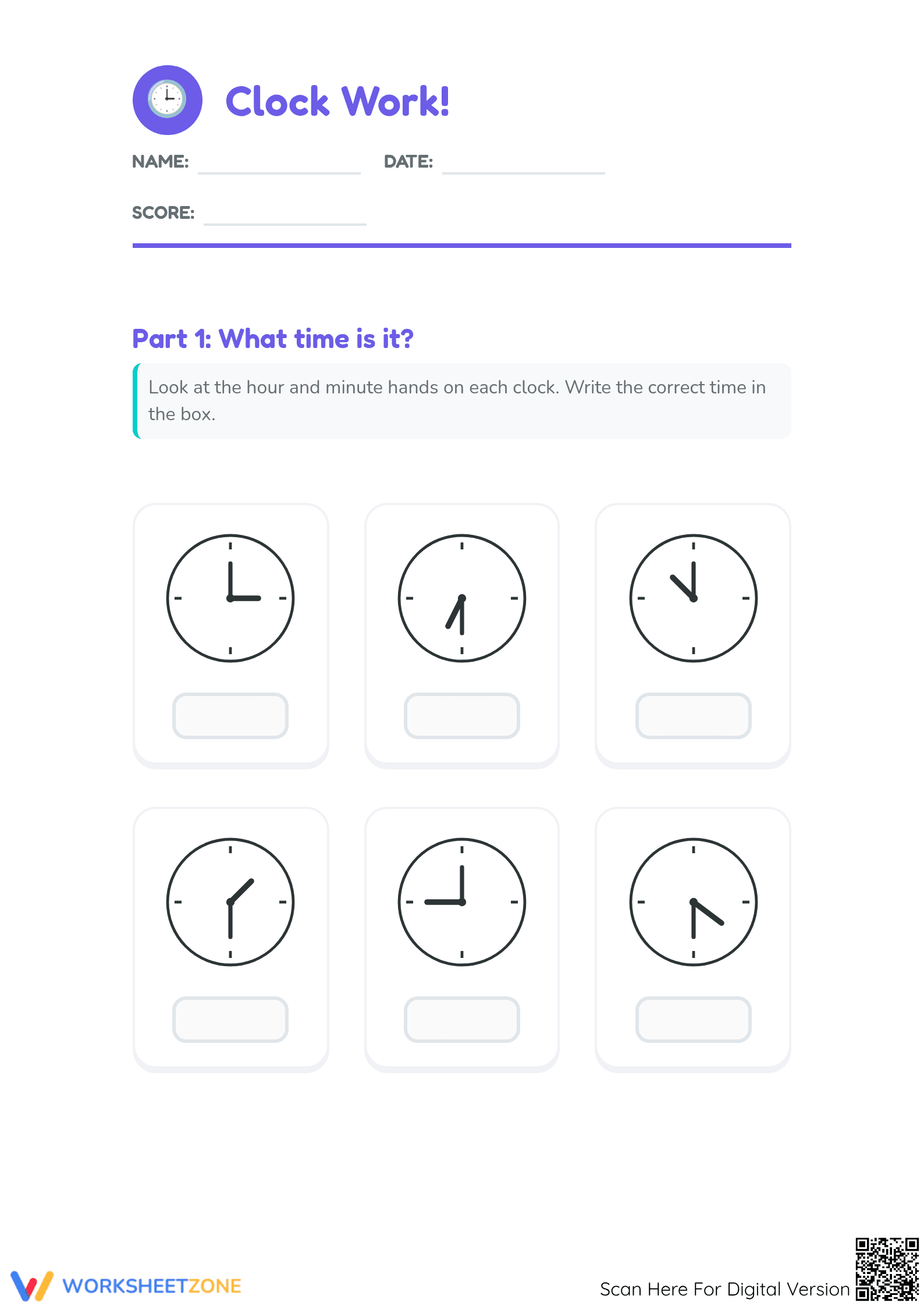
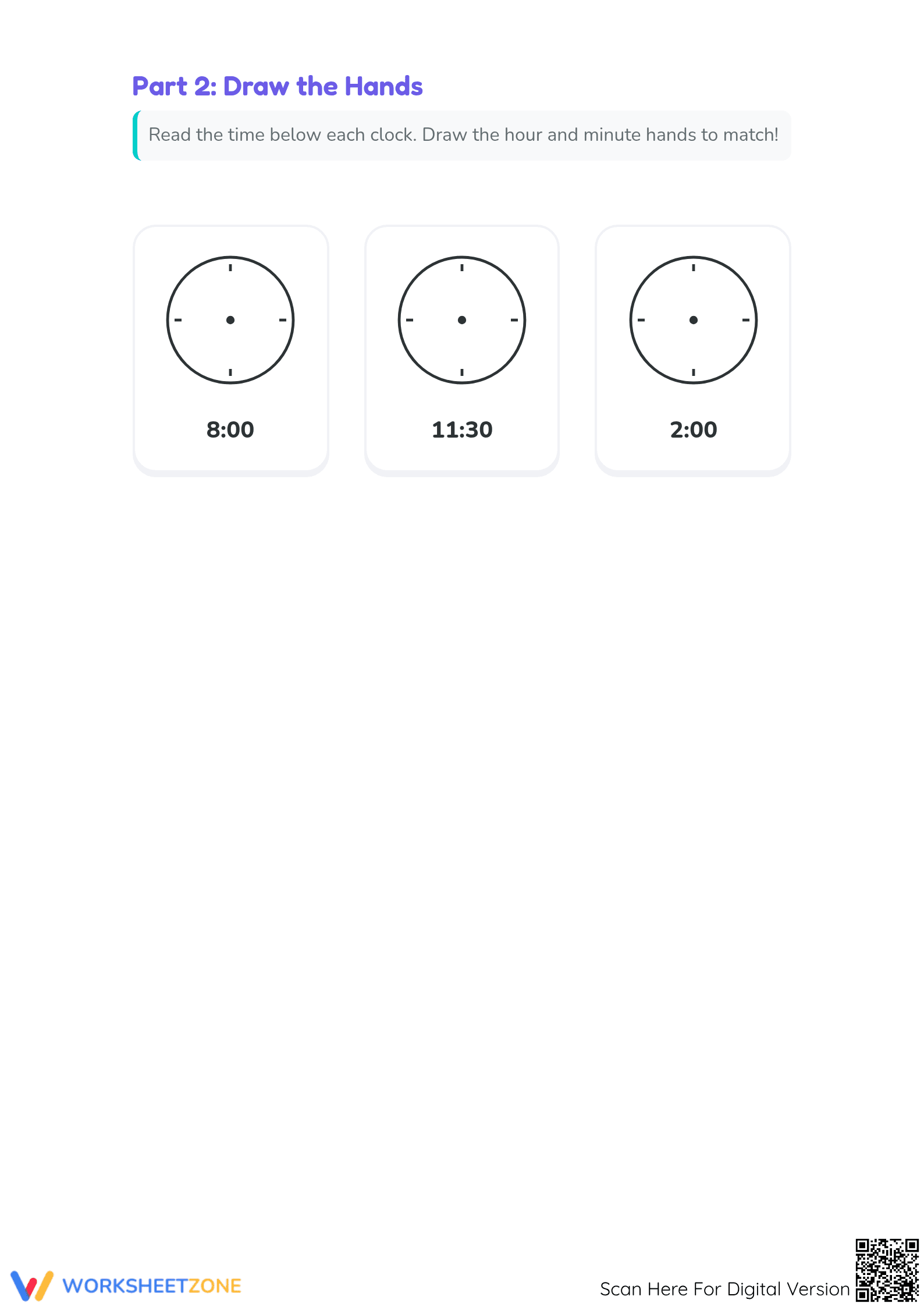
This printable Grade 2 math worksheet provides a structured approach to mastering analog clocks. Students will practice reading clock faces and drawing hands to represent specific digital times, ensuring they can accurately communicate time to the nearest five minutes. This essential resource bridges the gap between abstract concepts and daily application.
At a Glance
- Grade: 2 · Subject: Math
- Standard:
2.MD.C.7— Tell and write time from analog and digital clocks to the nearest five minutes- Skill Focus: Analog Clock Reading & Hand Placement
- Format: 2 pages · 9 problems · Answer key included · PDF
- Best For: Individual practice and formative assessment
- Time: 15–20 minutes
What's Inside
The worksheet includes two focused sections across two high-quality pages. Part one presents six analog clock faces where students identify and write the digital time in provided response boxes. Part two provides three digital times, requiring students to precisely draw the hour and minute hands. A full answer key is included for immediate feedback and grading efficiency.
Mastery Evidence
Tasks are mapped directly to 2.MD.C.7 sub-skills, ranging from whole-hour identification to the placement of the hour hand during half-hour intervals. Educators can use these parts to identify whether students struggle with decoding the visual face or conceptualizing the spatial relationship of the hands. Scores provide clear evidence of student progress, easily documented in IEP folders or gradebooks for standards-based reporting.
Standards Alignment
This resource aligns with `2.MD.C.7`: "Tell and write time from analog and digital clocks to the nearest five minutes." It also supports 1.MD.B.3 as a foundational prerequisite for students needing scaffolding. Both standard codes can be copied directly into lesson plans, IEP goals, or district curriculum mapping tools to ensure compliance and instructional focus.
How to Use It
Use this as a formative assessment after instruction on five-minute intervals. Observe students in Part 2; a common error is drawing the hour hand directly on the number for half-past times, providing a perfect teachable moment for spatial reasoning. This set takes 15 to 20 minutes and works well as a ticket to leave or independent center activity.
Who It's For
This activity is for second-grade students developing fluency with non-digital timekeepers. It benefits visual learners and students requiring fine motor practice through drawing clock hands. For differentiation, teachers can pair this with a physical manipulative clock to help students understand the movement of the hands before committing answers to paper.
Research from the RAND AIRS 2024 report emphasizes that multiple modalities—switching between reading and drawing—are critical for developing temporal reasoning in elementary students. By requiring both identification from a face and manual placement of hands, this worksheet adheres to high-quality instructional material standards. Fisher & Frey (2014) note that these checking-for-understanding tasks are essential for the gradual release of responsibility. This structured approach ensures students understand the rotational logic of time measurement. Standard 2.MD.C.7 demands that students move beyond the hour and half-hour, and this focused practice provides the repetition to secure that skill. This alignment with rigorous educational research makes it an effective tool for any classroom seeking to meet federal and state proficiency goals in mathematics while providing students with a clear path toward conceptual clock mastery.


