


























Views
Downloads

Classifying Matter Worksheet | Grade 7 Science Printable
Paste this activity's link or code into your existing LMS (Google Classroom, Canvas, Teams, Schoology, Moodle, etc.).
Students can open and work on the activity right away, with no student login required.
You'll still be able to track student progress and results from your teacher account.
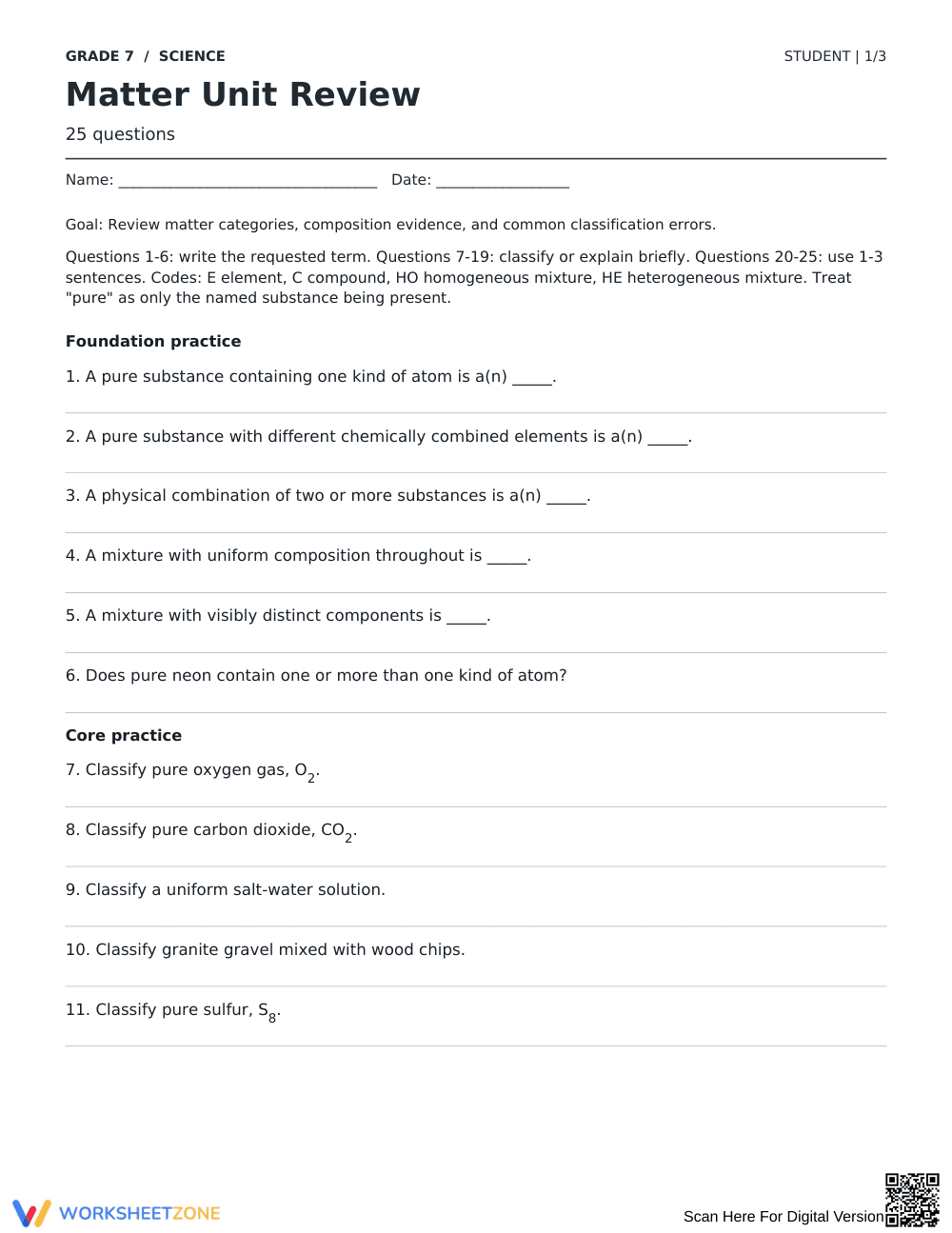
This physical science review equips Grade 7 students to classify pure substances and mixtures using composition evidence. Students complete 25 targeted items to distinguish elements, compounds, homogeneous mixtures, and heterogeneous mixtures, building conceptual mastery before advancing to molecular modeling.
At a Glance
- Grade: 7 · Subject: Science
- Standard:
MS-PS1-1— Describe atomic composition of simple molecules and extended structures- Skill Focus: Classifying matter into elements, compounds, and mixtures
- Format: 3 pages · 25 problems · Answer key included · PDF
- Best For: Unit review and formative assessment
- Time: 30–40 minutes
What's Inside
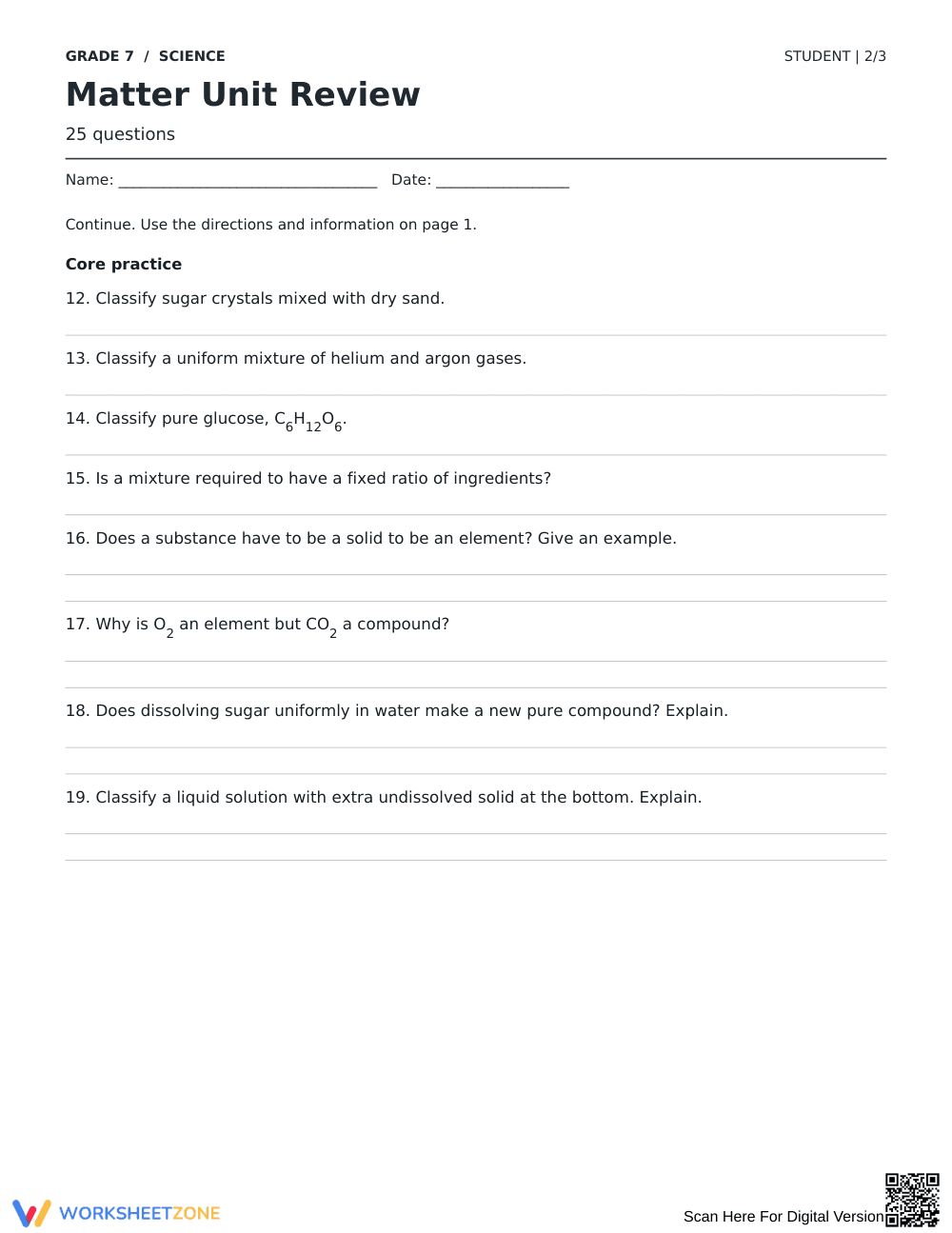
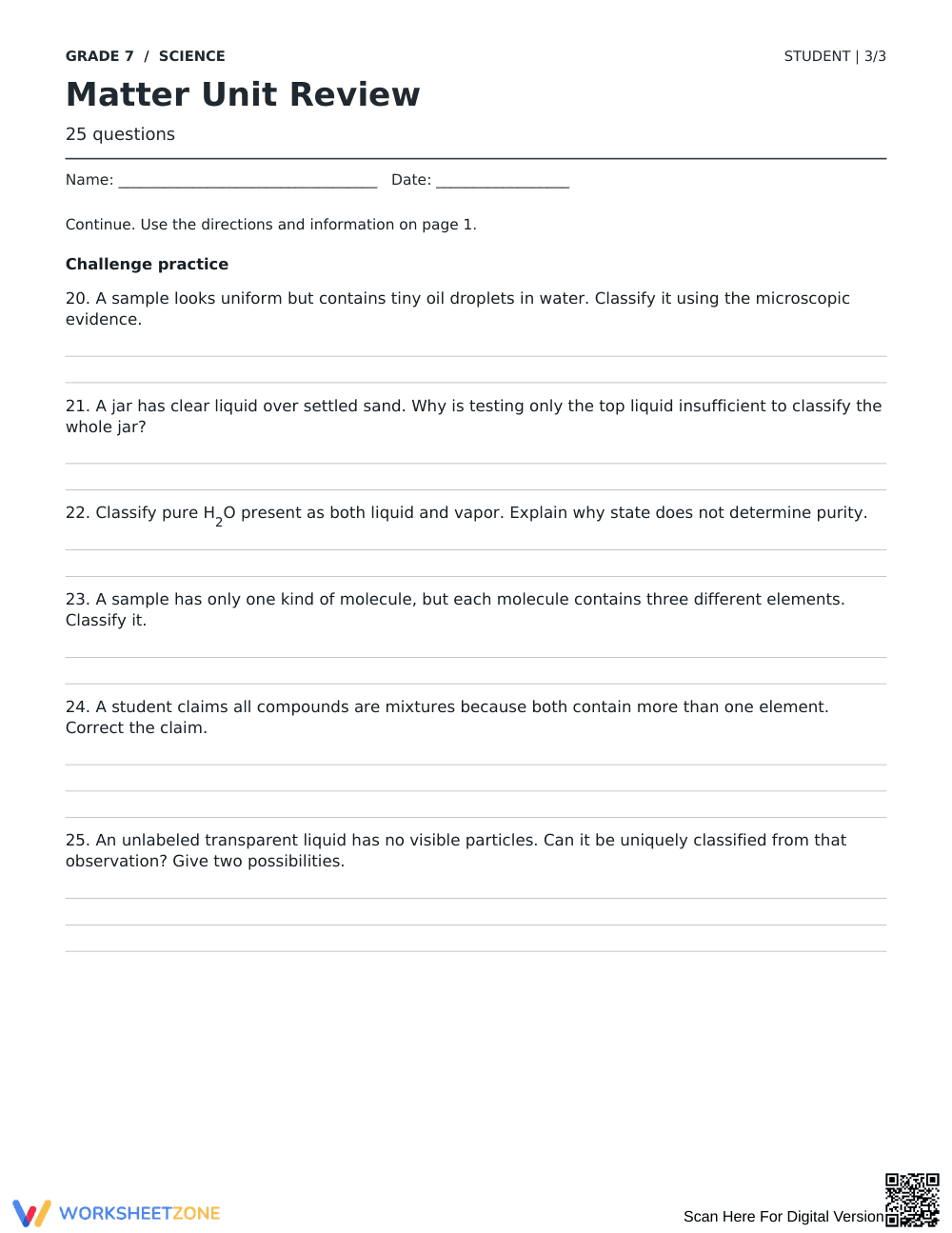
The 3-page student worksheet includes 25 questions divided into three difficulty tiers: fill-in-the-blank vocabulary terms, chemical formula classifications (such as O2 and C6H12O6), and short-response explanation items. A complete 2-page teacher answer key provides solutions, accepted reasoning variants, and a 51-point scoring guide.
Skill Progression
- Guided practice (Questions 1–6): Six foundational questions reinforce core definitions, prompting students to identify terms like element, compound, and mixture from descriptive clues.
- Supported practice (Questions 7–19): Thirteen core classification problems challenge students to apply letter codes and explain distinctions across chemical formulas and physical mixtures.
- Independent practice (Questions 20–25): Six rigorous challenge prompts require students to write short justifications resolving common misconceptions about phase changes and mixtures.
This structure follows the gradual release of responsibility model, moving from basic recall to in-depth analysis.
Standards Alignment
This worksheet aligns primarily with `MS-PS1-1`: "Develop models to describe the atomic composition of simple molecules and extended structures." It reinforces supporting standard `MS-PS1-2` by requiring students to analyze characteristic properties to differentiate substances. Both standard codes can be copied directly into lesson plans, IEP goals, or district curriculum mapping tools.
How to Use It
Administer this review after direct instruction on matter classification as a summative unit review or mid-unit check. Alternatively, assign the foundation and core sections during class while reserving the challenge items for small-group intervention. During independent work, check whether students confuse diatomic elements with compounds; expect completion within 30 to 40 minutes.
Who It's For
This resource serves general education Grade 7 science classrooms, introductory physical science units, and intervention groups requiring tiered practice. Pair this printable with physical molecular model kits or a periodic table anchor chart to connect chemical symbols to concrete molecular structures.
Research from Fisher & Frey (2014) demonstrates that structured gradual-release frameworks significantly improve student retention of abstract science concepts. This physical science resource targets standard MS-PS1-1 by guiding Grade 7 students through classifying matter into elements, compounds, and mixtures. By moving systematically from foundational vocabulary recall to core classification of chemical formulas and finally to multi-sentence explanatory challenges, the 25-item progression directly addresses documented middle school misconceptions regarding chemical bonding versus physical blending. Scaffolded practice items allow students to isolate key criteria, such as fixed ratios and uniform distribution, before engaging in complex molecular modeling tasks. Science educators can utilize the structured 51-point evaluation rubric to diagnose specific student errors in chemical reasoning, ensuring instructional alignment with NGSS physical science performance expectations while supporting targeted, data-driven remediation in general or special education classrooms.


