


























Views
Downloads
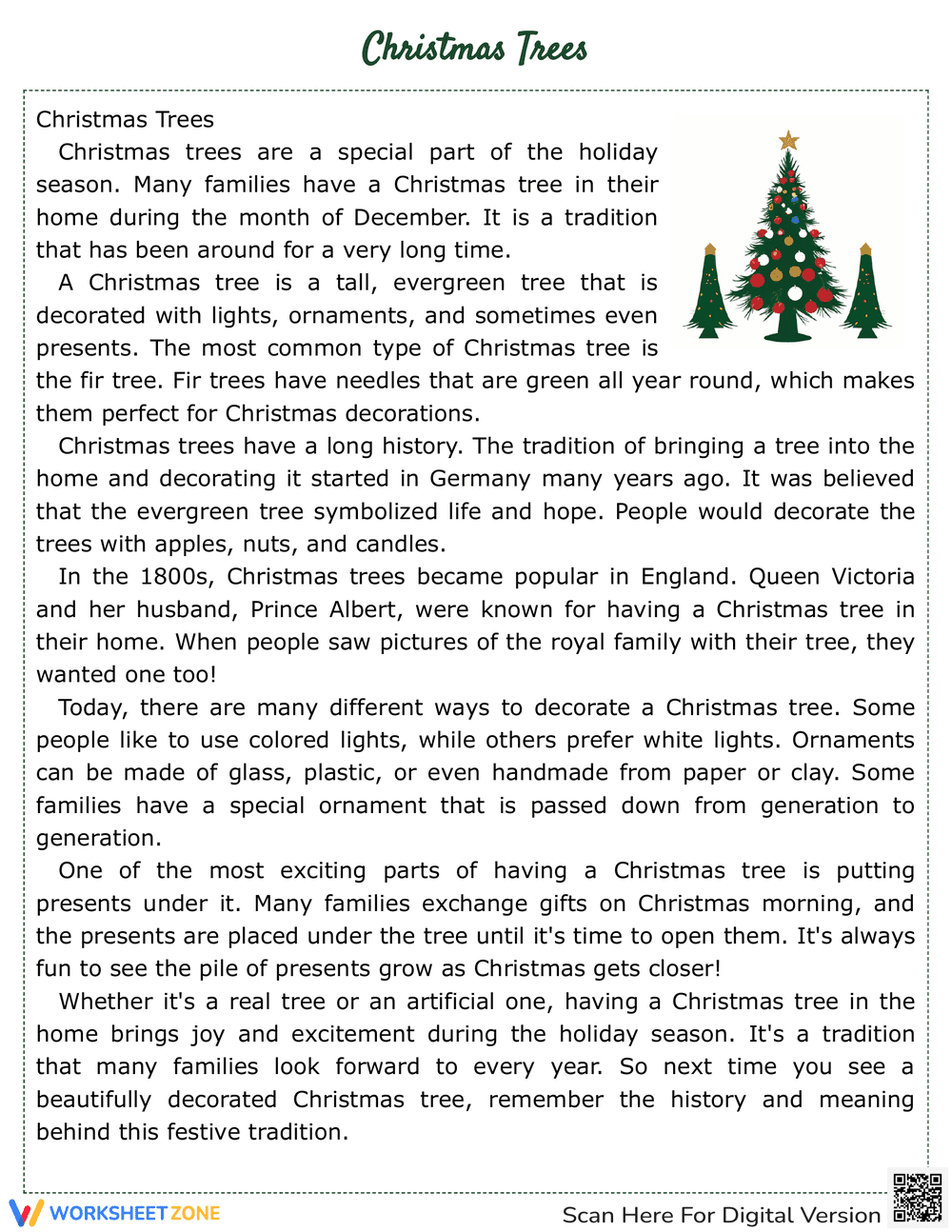


Christmas Trees Reading Comprehension | Grade 2 Essential
Paste this activity's link or code into your existing LMS (Google Classroom, Canvas, Teams, Schoology, Moodle, etc.).
Students can open and work on the activity right away, with no student login required.
You'll still be able to track student progress and results from your teacher account.
This Christmas Trees Reading Comprehension worksheet provides students with a structured way to practice informational text analysis. By engaging with the history and traditions of holiday evergreens, learners develop the ability to locate specific details and answer text-dependent questions. This resource ensures students master key literacy skills while exploring seasonal cultural history.
At a Glance
- Grade: 1-3 · Subject: ELA
- Standard:
CCSS.ELA-LITERACY.RI.2.1— Ask and answer questions to demonstrate understanding of key details in a text- Skill Focus: Reading Comprehension
- Format: 2 pages · 10 problems · Answer key included · PDF
- Best For: Holiday literacy centers or morning work
- Time: 15–25 minutes
This 2-page PDF includes a comprehensive informational passage followed by 10 multiple-choice questions. The question set is designed to test recall, inference, and vocabulary within a clear, easy-to-read layout. Students will read about the origins of the tradition in Germany and its popularization in England.
Zero-Prep Workflow
- Print (30 seconds): Select the 2-page PDF and print enough copies for your class.
- Distribute (1 minute): Hand out the reading passage and question sheet as a standalone literacy activity.
- Review (5 minutes): Use the included answer key for quick grading or peer-review sessions.
Total teacher preparation time is under 2 minutes, making this an ideal solution for busy December schedules.
Standards Alignment
This resource is aligned with `CCSS.ELA-LITERACY.RI.2.1`, which requires students to ask and answer such questions as who, what, where, when, why, and how to demonstrate understanding of key details in a text. It also supports RI.3.1 by encouraging students to refer explicitly to the text as the basis for their answers. Both standard codes can be copied directly into lesson plans, IEP goals, or district curriculum mapping tools.
How to Use It
Assign this worksheet during your morning work block to settle students into a focused reading mindset. It also serves as an excellent formative assessment tool during a holiday-themed literacy center. Observe if students are flipping back to the first page to find evidence; this indicates they are utilizing active reading strategies. Completion typically takes 15 to 25 minutes.
Who It's For
This resource is designed for students in Grades 1, 2, and 3. It is particularly effective for ELL students who benefit from clear, chronological informational text. Pair this worksheet with a holiday-themed anchor chart or a short video about evergreen trees to provide additional visual context for struggling readers.
According to Fisher & Frey (2014), the use of informational texts with high-interest seasonal themes significantly increases student engagement and retention of reading strategies. This worksheet targets the CCSS.ELA-LITERACY.RI.2.1 standard by requiring students to extract specific facts about the history and cultural significance of Christmas trees. By answering 10 targeted questions, students demonstrate their ability to interpret non-fiction text structures and identify key details. Research indicates that structured, print-and-go resources reduce teacher burnout while maintaining instructional rigor during high-stress periods of the school year. This resource provides a reliable framework for assessing literal comprehension and inferential thinking in early elementary learners. The inclusion of historical context allows for cross-curricular connections between English Language Arts and Social Studies, fostering a more holistic learning experience for diverse student populations in the classroom.


