




























Views
Downloads
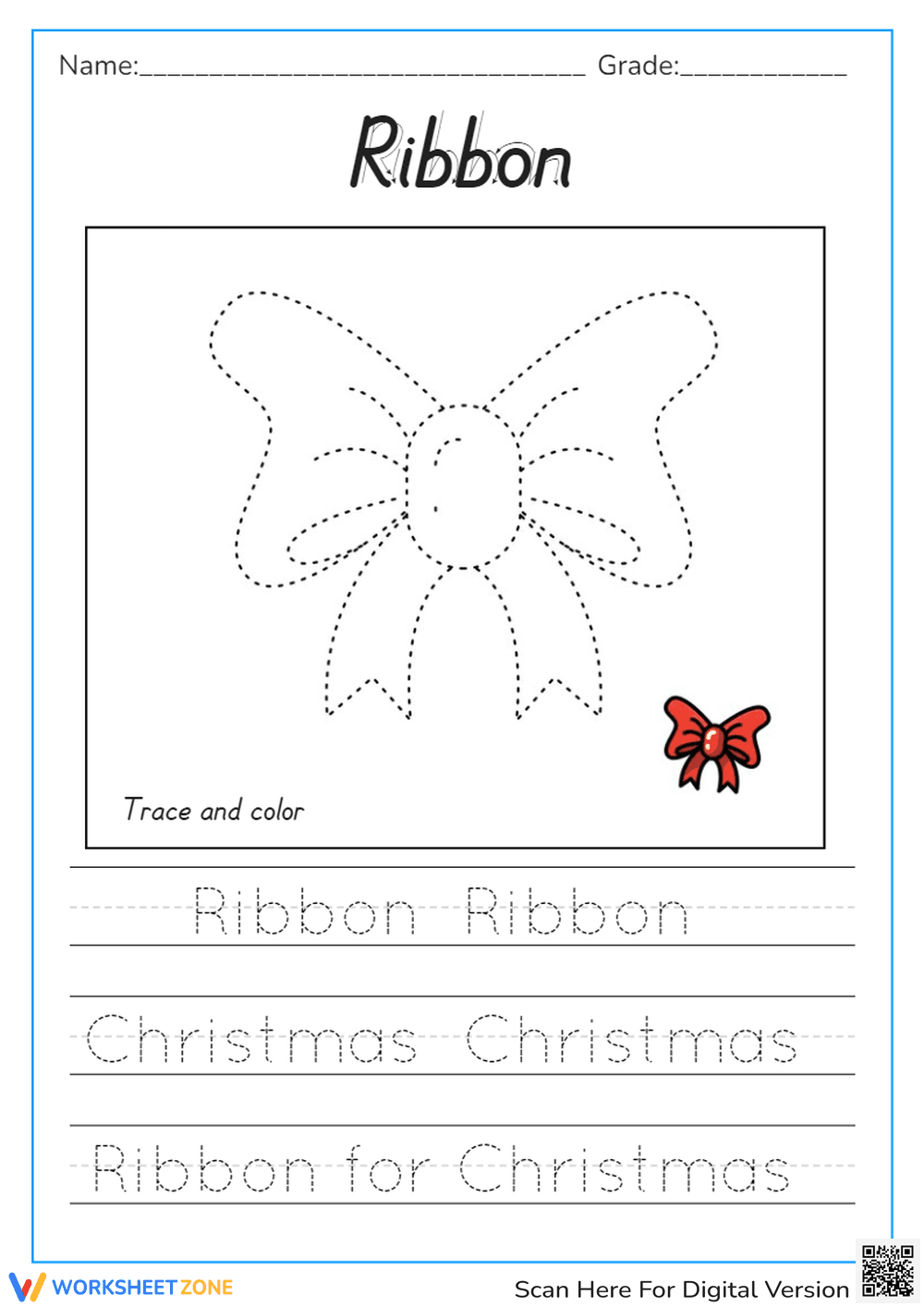

Christmas Ribbon Tracing | Essential Grade K-1 Worksheet

Paste this activity's link or code into your existing LMS (Google Classroom, Canvas, Teams, Schoology, Moodle, etc.).
Students can open and work on the activity right away, with no student login required.
You'll still be able to track student progress and results from your teacher account.
This Christmas-themed handwriting worksheet helps early learners develop essential fine motor control through festive tracing and coloring. Students practice precise pencil movements by outlining a decorative ribbon before transitioning to letter formation with holiday-specific vocabulary. It provides a structured yet engaging way to reinforce handwriting mechanics during the busy winter season.
At a Glance
- Grade: Kindergarten · Subject: Handwriting
- Standard:
CCSS.ELA-LITERACY.L.K.1.A— Print many upper- and lowercase letters with proper form- Skill Focus: Fine motor control and letter formation
- Format: 1 page · 6 tasks · No answer key required · PDF
- Best For: Morning work or holiday sub plans
- Time: 10–15 minutes
This single-page PDF features a large-scale ribbon graphic designed for tracing and coloring, which serves as a high-interest warm-up for small muscle coordination. Below the image, students find three primary-ruled lines containing dotted-line text. These include repetitive practice for the words "Ribbon" and "Christmas," followed by a short phrase to practice spacing and sentence-level flow.
The workflow for this resource is designed for maximum efficiency during high-energy holiday weeks. First, print the single-page PDF (30 seconds). Second, distribute the sheets to students with crayons and pencils (1 minute). Third, review student grip as they work independently (0 minutes prep). Total teacher preparation time is under two minutes, making it an ideal emergency sub plan.
This resource aligns with `CCSS.ELA-LITERACY.L.K.1.A`, which requires students to print many upper- and lowercase letters. By providing dotted-line scaffolds for both individual words and short phrases, the worksheet supports the transition from isolated letter practice to functional writing. Both standard codes can be copied directly into lesson plans, IEP goals, or district curriculum mapping tools.
Use this worksheet as a calming morning work activity during the month of December to settle students as they enter the classroom. It also functions effectively as a formative assessment tool; observe students as they trace the ribbon to identify those struggling with pencil pressure or directional strokes. Expect most Kindergarten students to complete the tracing and coloring within 15 minutes.
This activity is tailored for Kindergarten and first-grade students who are refining their grip and letter-size consistency. It is particularly helpful for students requiring occupational therapy support or extra fine motor practice. Pair this worksheet with a holiday-themed read-aloud or a direct instruction lesson on the letter "R" to create a cohesive literacy block.
Effective handwriting instruction in early childhood requires a blend of gross motor movements and specific letter formation practice. According to Fisher & Frey (2014), the gradual release of responsibility model is most effective when students are provided with clear scaffolds, such as the dotted-line tracing found in this resource. This worksheet addresses CCSS.ELA-LITERACY.L.K.1.A by focusing on the mechanical aspects of writing, which research suggests is a prerequisite for later compositional fluency. By integrating holiday themes like the Christmas ribbon, educators can maintain student engagement while targeting high-frequency vocabulary. The inclusion of both image tracing and word-level practice ensures that students develop the visual-motor integration necessary for academic success. This resource provides a structured environment for students to master the "print many upper- and lowercase letters" requirement, serving as a reliable tool for daily handwriting reinforcement or formative progress monitoring in the primary classroom.


