


























0
Views
0
Downloads

0.0
0
Save
0 Likes
Share
Choosing Correct Homophones: Practice and Learn
0 Views
0 Downloads
Paste this activity's link or code into your existing LMS (Google Classroom, Canvas, Teams, Schoology, Moodle, etc.).
Students can open and work on the activity right away, with no student login required.
You'll still be able to track student progress and results from your teacher account.
Information
Description
What It Is:
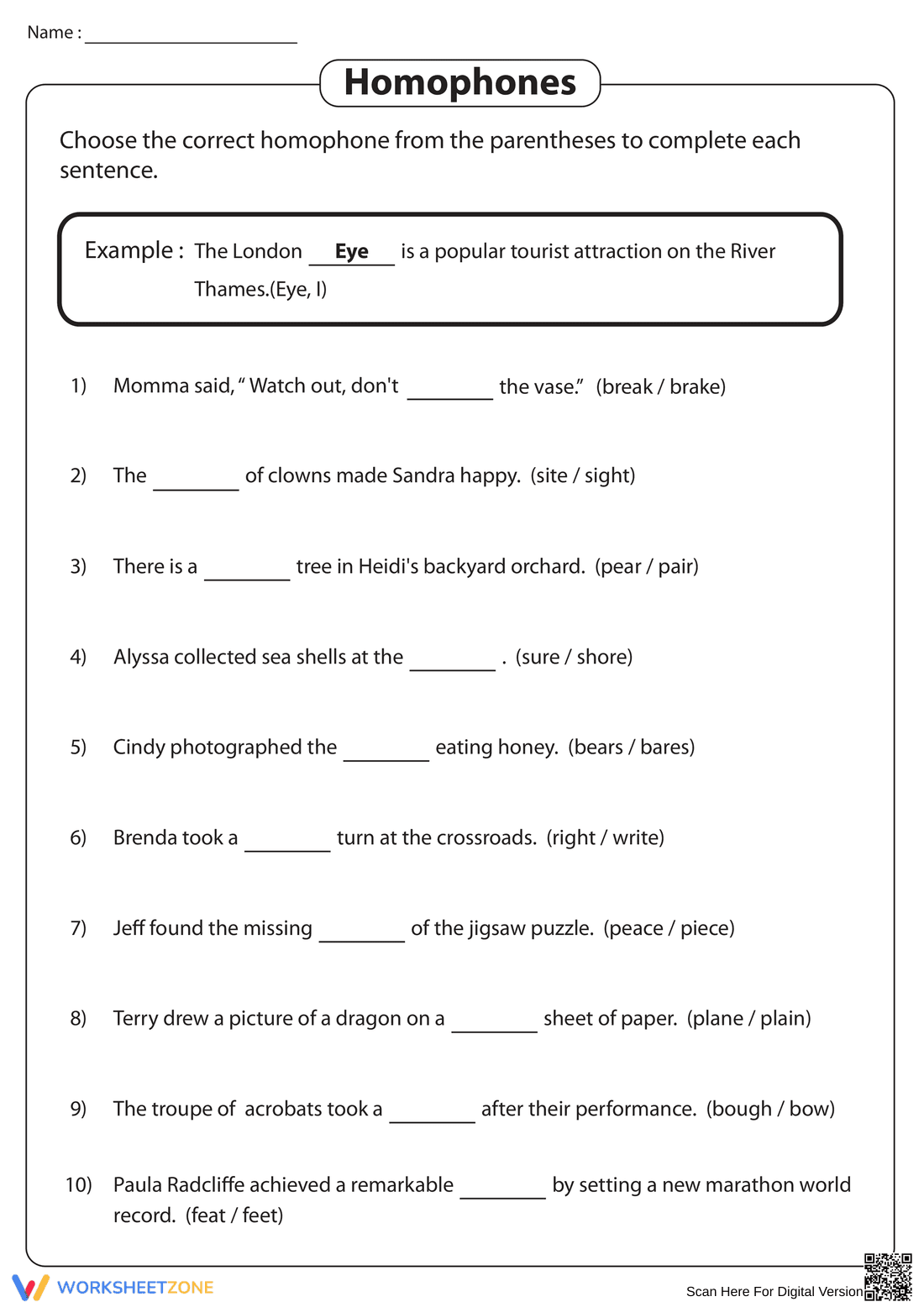
This is an educational worksheet focused on homophones. Students are presented with sentences where they must choose the correct homophone from a pair of words in parentheses to complete the sentence. An example sentence is provided for guidance: 'The London Eye is a popular tourist attraction on the River Thames. (Eye, I)'. There are ten sentences in total, using common homophone pairs such as break/brake, site/sight, pear/pair, sure/shore, bears/bares, right/write, peace/piece, plane/plain, bough/bow, and feat/feet.
Grade Level Suitability:
This worksheet is suitable for grades 2-4. The vocabulary and sentence structure are relatively simple, and the concept of homophones is typically introduced within this age range. The worksheet provides good practice for vocabulary building and understanding word meaning in context.
Why Use It:
This worksheet helps students improve their understanding and usage of homophones, which are words that sound alike but have different meanings and spellings. It reinforces vocabulary, reading comprehension, and attention to detail. By completing the sentences, students practice selecting the correct word based on context, improving their overall language skills.
How to Use It:
Students should read each sentence carefully and consider the meaning of the sentence. They should then choose the correct homophone from the pair provided in parentheses that best fits the sentence's meaning. Students can circle or underline the correct word or write it in the blank space provided.
Target Users:
This worksheet is ideal for elementary school students, particularly those in grades 2-4, who are learning about homophones. It can also be used as a review activity for older students who need to reinforce their understanding of these word pairs. Teachers and parents can use this worksheet as a supplementary activity to support language arts instruction.
This is an educational worksheet focused on homophones. Students are presented with sentences where they must choose the correct homophone from a pair of words in parentheses to complete the sentence. An example sentence is provided for guidance: 'The London Eye is a popular tourist attraction on the River Thames. (Eye, I)'. There are ten sentences in total, using common homophone pairs such as break/brake, site/sight, pear/pair, sure/shore, bears/bares, right/write, peace/piece, plane/plain, bough/bow, and feat/feet.
Grade Level Suitability:
This worksheet is suitable for grades 2-4. The vocabulary and sentence structure are relatively simple, and the concept of homophones is typically introduced within this age range. The worksheet provides good practice for vocabulary building and understanding word meaning in context.
Why Use It:
This worksheet helps students improve their understanding and usage of homophones, which are words that sound alike but have different meanings and spellings. It reinforces vocabulary, reading comprehension, and attention to detail. By completing the sentences, students practice selecting the correct word based on context, improving their overall language skills.
How to Use It:
Students should read each sentence carefully and consider the meaning of the sentence. They should then choose the correct homophone from the pair provided in parentheses that best fits the sentence's meaning. Students can circle or underline the correct word or write it in the blank space provided.
Target Users:
This worksheet is ideal for elementary school students, particularly those in grades 2-4, who are learning about homophones. It can also be used as a review activity for older students who need to reinforce their understanding of these word pairs. Teachers and parents can use this worksheet as a supplementary activity to support language arts instruction.


