


























Views
Downloads

Essential Homophones Worksheet | Grade 2 Aligned Printable
Paste this activity's link or code into your existing LMS (Google Classroom, Canvas, Teams, Schoology, Moodle, etc.).
Students can open and work on the activity right away, with no student login required.
You'll still be able to track student progress and results from your teacher account.
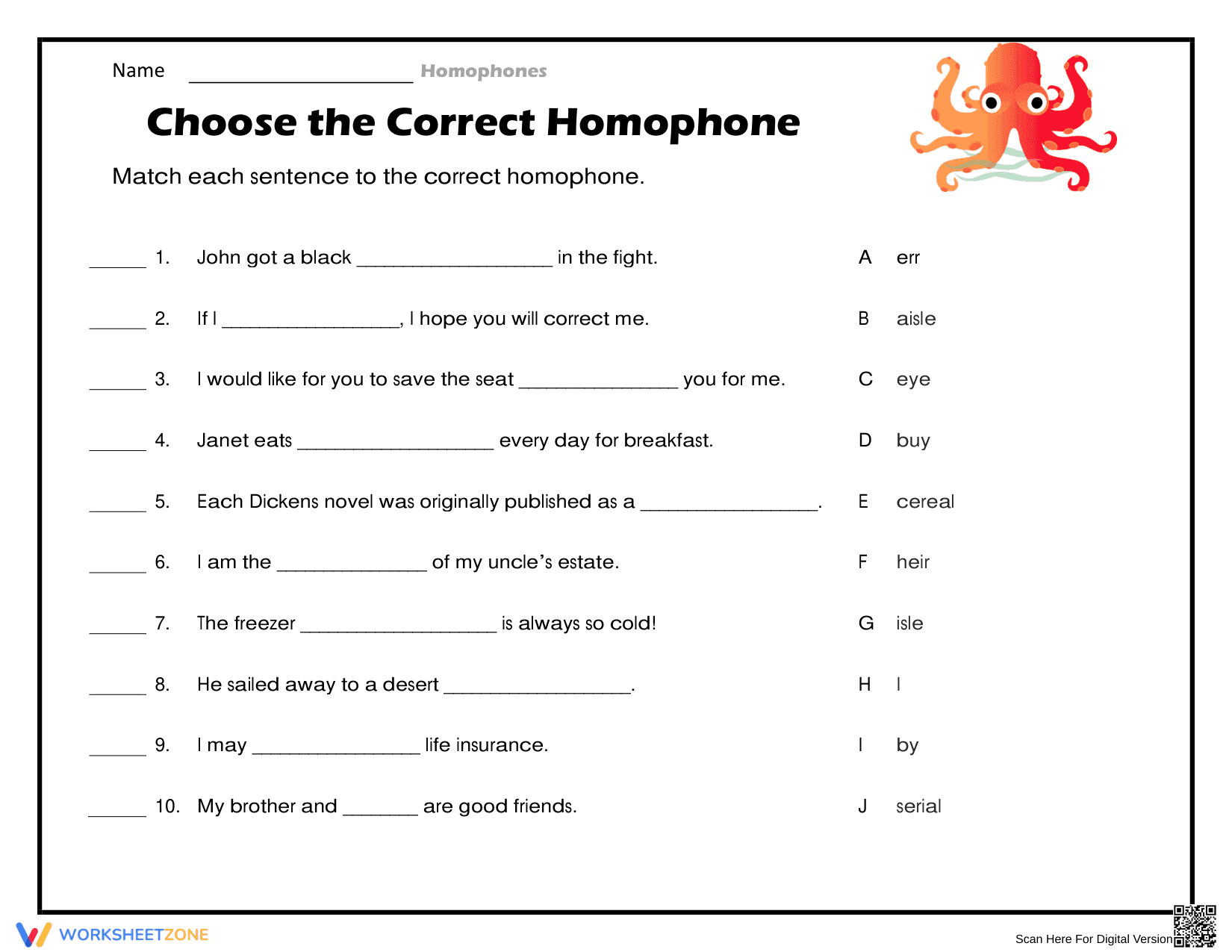
This Essential Homophones worksheet helps elementary students master frequently confused words through 10 targeted matching exercises. By identifying the correct spelling based on sentence context, learners strengthen their vocabulary and spelling precision. This zero-prep resource is perfect for consolidating grammar skills in Grade 2 or Grade 4 classrooms, helping students distinguish between pairs like heir and err.
At a Glance
At a Glance
- Grade: 2–4 · Subject: English Language Arts
- Standard:
CCSS.ELA-LITERACY.L.4.1.G— Correctly use frequently confused words (homophones) in sentences- Skill Focus: Homophone Identification & Context Clues
- Format: 1 page · 10 problems · Answer key included · PDF
- Best For: Independent practice or quick morning work
- Time: 10–15 minutes
What's Inside
The worksheet features a clean, one-page layout containing ten unique sentences. Students use a word bank of ten homophones, ranging from "I" and "eye" to "heir" and "aisle." The task requires students to read each sentence and match the correct lettered homophone to the blank. A full answer key is provided for rapid grading.
Zero-Prep Workflow
This resource follows a seamless three-step workflow. First, print the single-page PDF in under a minute. Second, distribute the sheets as a quick warm-up or bell-ringer activity. Third, review the answers collectively using the provided key to address common spelling misconceptions. Total teacher preparation time is under two minutes, making it ideal for sub plans.
Standards Alignment
This activity is primarily aligned with CCSS.ELA-LITERACY.L.4.1.G, requiring students to correctly use frequently confused words. While intended for Grade 2, the vocabulary level provides an excellent challenge for younger students while meeting high elementary expectations. Both standard codes can be copied directly into lesson plans, IEP goals, or district curriculum mapping tools.
How to Use It
Use this worksheet as a formative assessment after an introductory lesson. Observe if students use the process of elimination or struggle with academic vocabulary like "published" or "originally." It also works well in literacy centers where students work in pairs to discuss why one spelling is correct, fostering collaborative learning. Completion typically takes 15 minutes.
Who It's For
This printable is for Grade 2 through Grade 4 students moving beyond basic homophone pairs. It is particularly useful for English Language Learners (ELL) who find phonetic twins challenging. The worksheet pairs naturally with a homophone anchor chart or a short reading passage to provide broader literary context during direct instruction.
Research by Fisher & Frey (2014) emphasizes the critical importance of "word consciousness" and the direct instruction of homophones to prevent fossilized spelling errors. This worksheet addresses that fundamental need by providing a highly structured environment where students must actively discriminate between phonetic twins. By requiring learners to use complex context clues within varied sentences—including those involving "life insurance" or "uncle's estate"—it moves grammar practice from simple rote memorization to higher-order cognitive application. According to the NAEP framework, the ability to navigate the subtle nuances of the English language, such as homophones, is a key indicator of overall reading comprehension maturity. This Grade 2 and Grade 4 aligned resource, utilizing the specific standard CCSS.ELA-LITERACY.L.4.1.G, ensures students develop the linguistic precision necessary for long-term academic success. Teachers can confidently integrate this into their weekly curriculum as a proven method for improving student outcomes in language and vocabulary acquisition.


