


























Views
Downloads

Essential Grade 3 Life Cycles Worksheet: Chicken & Turtle
Paste this activity's link or code into your existing LMS (Google Classroom, Canvas, Teams, Schoology, Moodle, etc.).
Students can open and work on the activity right away, with no student login required.
You'll still be able to track student progress and results from your teacher account.
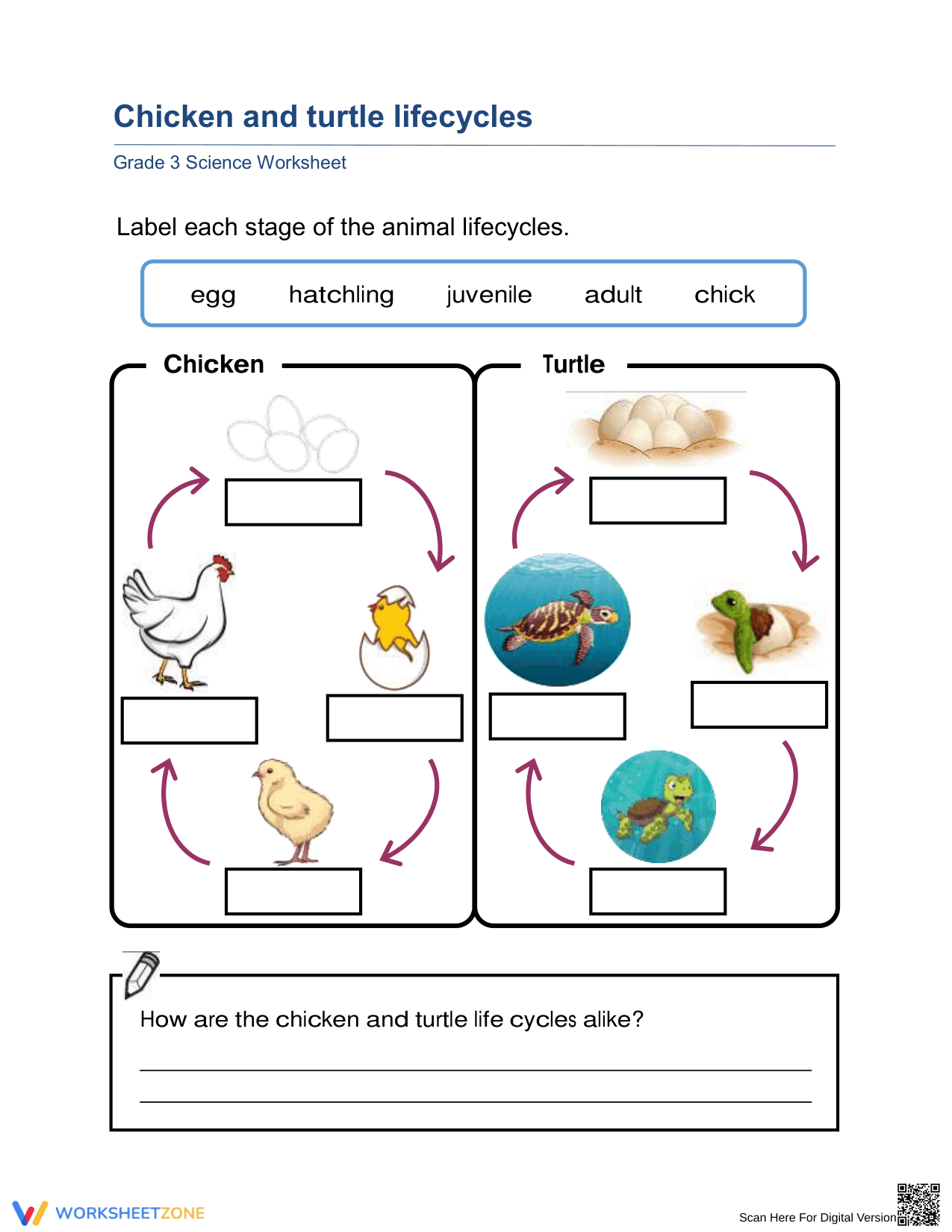
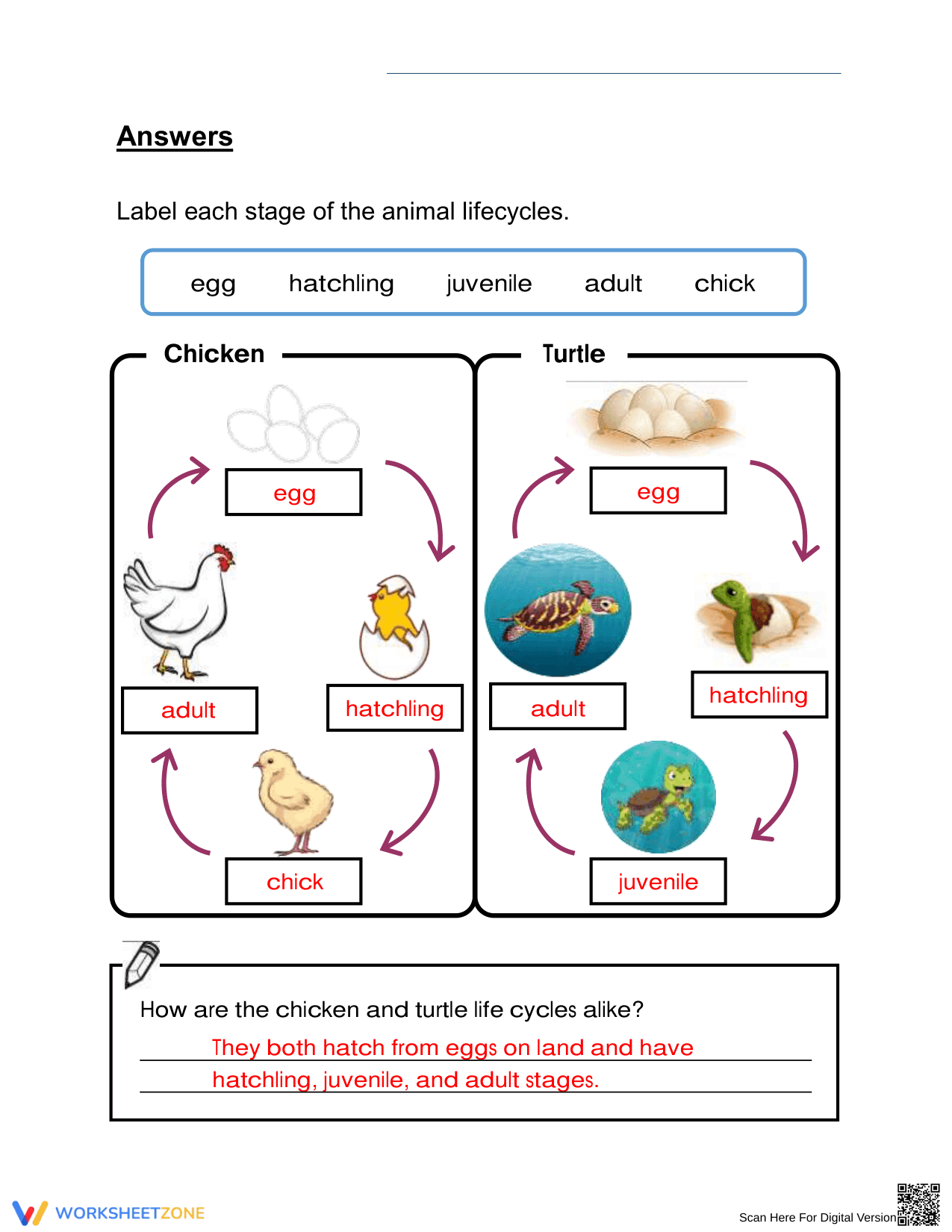
This Grade 3 science worksheet helps students master animal life cycles by comparing and contrasting chicken and turtle development. Students build foundational biological knowledge by labeling specific growth stages and synthesizing commonalities. This targeted practice ensures learners understand that while life cycles are unique, they share universal stages of birth and growth.
At a Glance
- Grade: 3 · Subject: Science
- Standard:
3-LS1-1— Develop models to describe that organisms have unique and diverse life cycles.- Skill Focus: Animal Life Cycle Stages
- Format: 1 page · 9 problems · Answer key included · PDF
- Best For: Independent practice or formative assessment
- Time: 15–20 minutes
Inside this resource, you will find a cleanly designed one-page worksheet featuring two circular life cycle diagrams. It includes a structured word bank with terms like egg, hatchling, and chick to support labeling eight distinct stages. The final section features a critical thinking prompt that requires students to write a short comparison, ensuring a deep understanding of the material.
Zero-Prep Workflow
- Print: Ready in 30 seconds for your entire class.
- Distribute: 1 minute to hand out and explain the word bank.
- Review: 5 minutes for a quick group check using the answer key.
Total teacher prep time is under two minutes, making this an ideal choice for emergency sub plans or morning work.
Standards Alignment
This worksheet is aligned to 3-LS1-1: "Develop models to describe that organisms have unique and diverse life cycles but all have in common birth, growth, reproduction, and death." Students demonstrate mastery by identifying specific developmental stages in both avian and reptilian species. This standard code can be copied directly into lesson plans, IEP goals, or district curriculum mapping tools.
How to Use It
Assign this worksheet after an introductory lesson on biological growth to check for student comprehension. It serves as an excellent formative-assessment tool; teachers should observe if students correctly differentiate between the "chick" and "hatchling" labels. The expected completion time for most third-grade learners is between 15 and 20 minutes.
Who It's For
This resource is designed for Grade 3 students but is adaptable for Grade 2 or Grade 4 life science units. The visual word bank provides essential scaffolding for English Learners and students requiring literacy support. It pairs naturally with a non-fiction reading passage about animal development or a classroom anchor chart showing universal life cycle patterns.
According to RAND AIRS 2024, utilizing visual models like circular diagrams significantly enhances a student's ability to internalize temporal sequences in science. This Grade 3 worksheet focuses on the 3-LS1-1 standard, requiring students to identify and compare animal life cycles. By labeling stages and synthesizing similarities, learners move beyond rote memorization into higher-order comparative analysis. Such structured practice is essential for building a robust scientific vocabulary and understanding the commonalities across diverse species. The inclusion of a comparison prompt aligns with best practices for integrating literacy within the science curriculum, ensuring that students can articulate their observations clearly. This resource provides a reliable, evidence-based method for evaluating student progress in life science units while maintaining a low-threshold, high-ceiling approach to classroom instruction.


