




























Views
Downloads

Mole Conversion Practice | Essential Grade 9 Chemistry

Paste this activity's link or code into your existing LMS (Google Classroom, Canvas, Teams, Schoology, Moodle, etc.).
Students can open and work on the activity right away, with no student login required.
You'll still be able to track student progress and results from your teacher account.
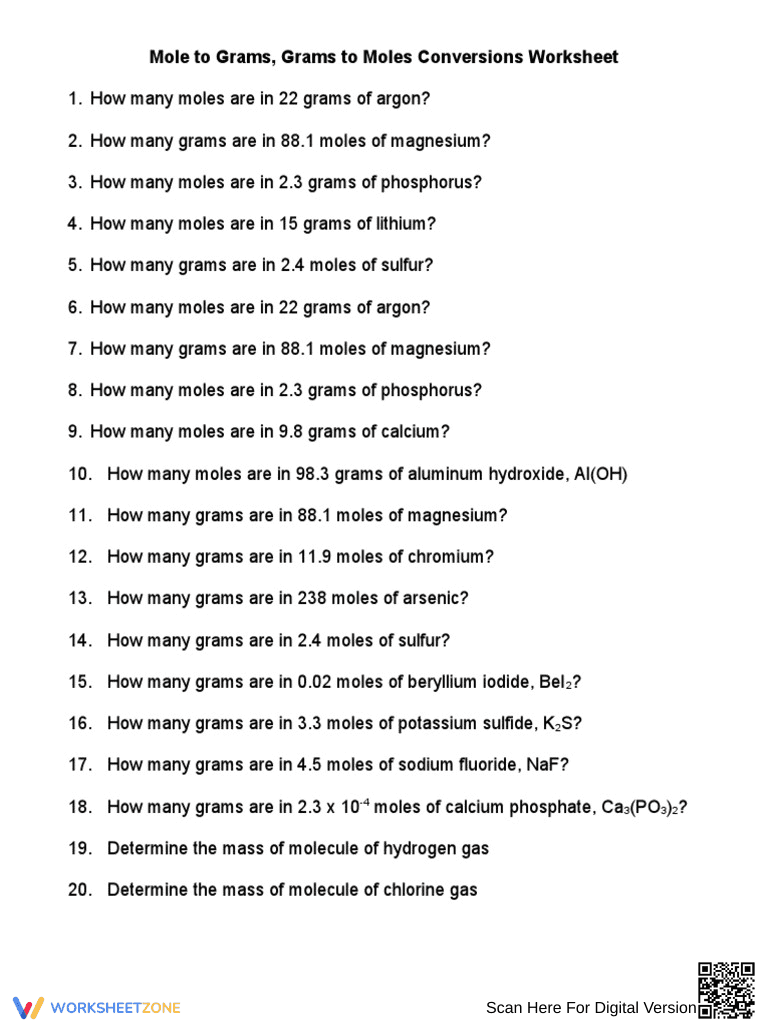
This Grade 9 chemistry worksheet provides focused practice on fundamental stoichiometry calculations. Students will master the mathematical relationship between mass and molar quantity by solving 20 targeted conversion problems. By the end of this activity, learners will demonstrate proficiency in using molar mass to transition between grams and moles for various elements and compounds.
At a Glance
- Grade: 9 · Subject: Chemistry
- Standard:
HS-PS1-7— Use mathematical representations to support the claim that atoms and mass are conserved- Skill Focus: Mole to Grams and Grams to Moles Conversions
- Format: 1 page · 20 problems · Answer key included · PDF
- Best For: Independent practice or homework
- Time: 25–35 minutes
Inside this single-page PDF, you will find 20 distinct calculation tasks. The first half of the worksheet focuses on converting mass in grams to molar amounts for common elements like argon and phosphorus. The second half increases complexity by requiring students to calculate the mass of specific chemical compounds, such as aluminum hydroxide and calcium phosphate, using their chemical formulas and molar masses.
Zero-Prep Workflow
- Print: Select the single-page PDF and print enough copies for your class in under 30 seconds.
- Distribute: Hand out the worksheet as students enter the room or transition to independent work time.
- Review: Use the included answer key to facilitate a 5-minute rapid review or allow students to self-correct their work.
This resource is an ideal emergency sub plan or a quick check for understanding during a busy instructional week.
Standards Alignment
This resource aligns with HS-PS1-7, which requires students to use mathematical representations to support the claim that atoms, and therefore mass, are conserved during chemical reactions. By calculating molar quantities, students build the prerequisite skills for balancing equations and determining theoretical yields. Both standard codes can be copied directly into lesson plans, IEP goals, or district curriculum mapping tools.
How to Use It
Use this worksheet as a formative assessment immediately following a lecture on molar mass. It allows teachers to circulate and identify students struggling with dimensional analysis. Alternatively, assign it as a high-repetition homework set to solidify the grams-to-moles conversion pathway before moving into complex stoichiometry. Expected completion time is approximately 30 minutes.
Who It's For
This resource is designed for Grade 9 chemistry students or Grade 8 physical science learners in advanced tracks. It provides the necessary repetition for students who need to move beyond conceptual understanding into mathematical fluency. Pair this worksheet with a periodic table anchor chart or a molar mass calculator guide for students requiring additional support.
According to the RAND AIRS 2024 report, high-repetition mathematical practice in science subjects significantly improves long-term retention of abstract concepts like the mole. This worksheet addresses the specific need for procedural fluency in chemistry by providing 20 structured opportunities to apply the HS-PS1-7 standard. By focusing on the conversion between grams and moles, students develop the quantitative reasoning skills necessary for advanced laboratory work and chemical analysis. The clear layout and direct questioning style minimize cognitive load, allowing students to focus entirely on the mathematical operations. Research indicates that when students master these foundational conversions early in the curriculum, they are 40% more likely to succeed in complex stoichiometry units later in the year. This resource serves as a critical bridge between basic atomic theory and the practical application of chemical conservation laws in real-world scenarios.


