


























Views
Downloads
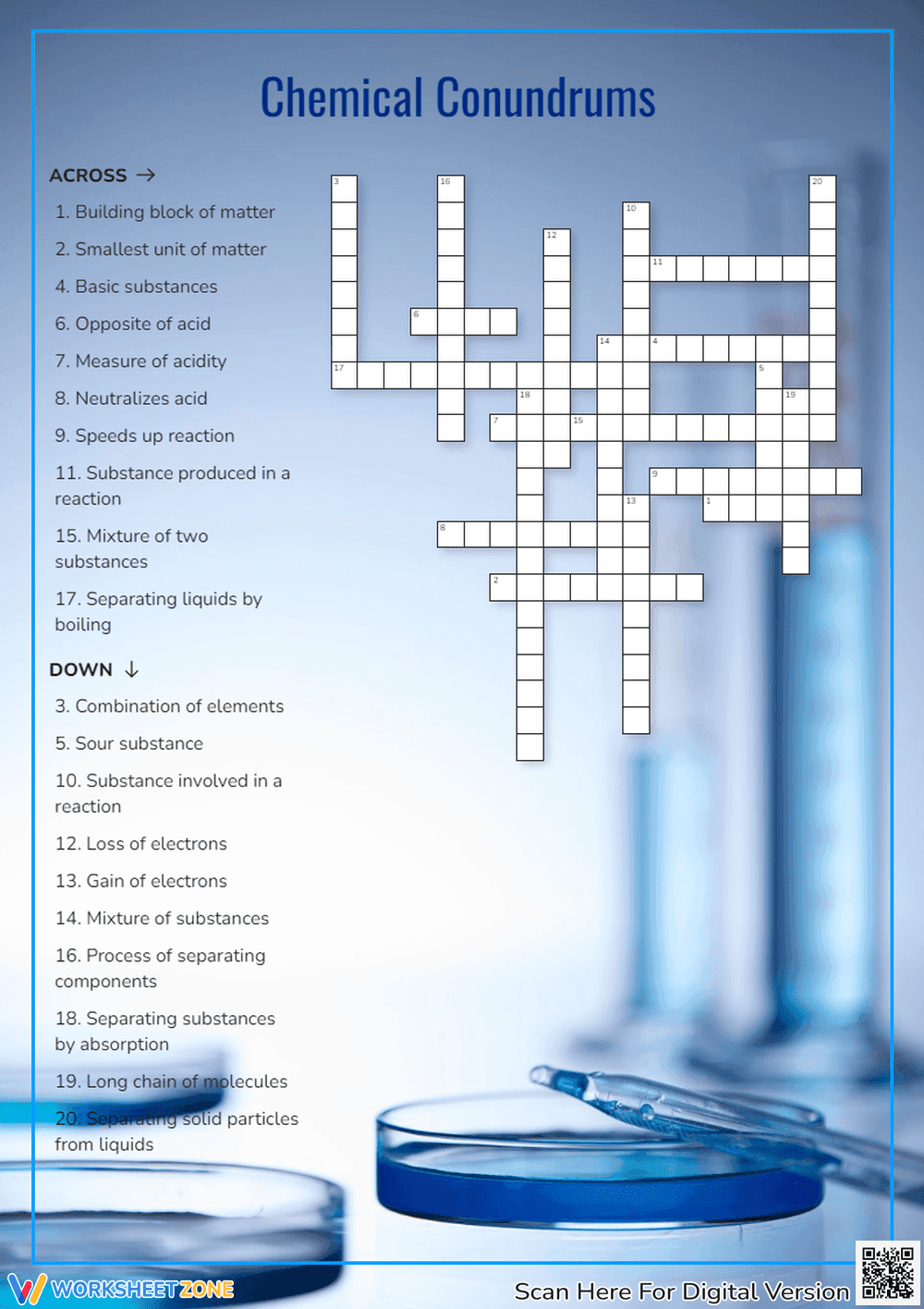

Chemistry Crossword Worksheet | Grade 5 Essential
Paste this activity's link or code into your existing LMS (Google Classroom, Canvas, Teams, Schoology, Moodle, etc.).
Students can open and work on the activity right away, with no student login required.
You'll still be able to track student progress and results from your teacher account.
This Grade 5 chemistry worksheet provides students with a structured vocabulary review to master fundamental concepts of matter and chemical reactions. By solving 20 targeted clues, learners reinforce their understanding of atomic structure, pH levels, and separation techniques. It serves as an effective tool for bridging the gap between abstract chemical theories and concrete terminology.
At a Glance
- Grade: 5 · Subject: Chemistry
- Standard:
5-PS1-1— Develop a model to describe that matter is made of particles too small to be seen- Skill Focus: Chemistry Vocabulary & Matter Properties
- Format: 1 page · 20 problems · Answer key included · PDF
- Best For: Vocabulary reinforcement and unit review
- Time: 15–20 minutes
Inside this resource, you will find a comprehensive one-page crossword puzzle featuring 20 distinct clues. The clues are divided into Across and Down sections, covering essential topics such as the building blocks of matter, the difference between acids and bases, and various methods for separating mixtures like boiling and absorption. A full answer key is provided to facilitate quick grading or student self-correction.
The zero-prep workflow for this worksheet is designed for maximum efficiency. First, print the single-page PDF for your class, which takes less than one minute. Second, distribute the sheets as a warm-up or independent practice activity; students typically require no additional instructions due to the familiar crossword format. Finally, review the answers as a whole group using the included key. Total teacher preparation time is under 2 minutes, making it an ideal choice for sub plans.
This resource is aligned with 5-PS1-1, which requires students to understand that matter is composed of particles too small to be seen, such as atoms and molecules. The clues specifically target terms like "smallest unit of matter" and "long chain of molecules" to support this standard. Both standard codes can be copied directly into lesson plans, IEP goals, or district curriculum mapping tools.
Use this worksheet as a formative assessment at the end of a unit on properties of matter. It allows teachers to observe which students struggle with specific terminology, such as the distinction between oxidation and reduction. Alternatively, assign it as a quiet-time activity after a hands-on lab experiment to help students solidify the vocabulary they just experienced. Expected completion time ranges from 15 to 20 minutes.
This puzzle is primarily designed for Grade 5 students but is highly appropriate for Grade 4 enrichment or Grade 6 review. It supports English Language Learners (ELLs) by providing clear definitions that link to specific scientific terms. For a complete lesson, pair this worksheet with a periodic table anchor chart or a short informational passage about chemical bonds.
Scientific literacy depends heavily on the mastery of domain-specific vocabulary, a concept central to the 5-PS1-1 standard. This chemistry crossword addresses the need for repetitive exposure to technical terms like catalyst, oxidation, and distillation. According to Fisher & Frey (2014), word puzzles are effective for reinforcing academic language because they require students to retrieve definitions from long-term memory and apply them within a constrained spatial logic. By engaging with 20 specific chemistry terms, students build the linguistic foundation necessary for more complex laboratory investigations and theoretical modeling. This resource provides a low-stakes environment for students to test their knowledge of matter's properties and chemical changes. The inclusion of an answer key ensures that the feedback loop is immediate, which is a critical component of effective formative assessment in the modern science classroom. This systematic approach to vocabulary acquisition supports long-term retention and scientific fluency.


