


























Views
Downloads


Literary Character Analysis Worksheet | Essential 10-12
Paste this activity's link or code into your existing LMS (Google Classroom, Canvas, Teams, Schoology, Moodle, etc.).
Students can open and work on the activity right away, with no student login required.
You'll still be able to track student progress and results from your teacher account.
This comprehensive literary character analysis worksheet empowers Grade 10-12 students to deconstruct complex protagonists and antagonists. By examining internal mechanics and external pressures, learners move beyond surface-level descriptions to evaluate how character development drives thematic meaning. It provides a rigorous framework for evidence-based literary criticism and classroom discussion.
At a Glance
- Grade: 10-12 · Subject: English Language Arts
- Standard:
CCSS.ELA-LITERACY.RL.11-12.3— Analyze how the author's choices develop and relate elements of a story- Skill Focus: Characterization & Textual Evidence
- Format: 3 pages · 7 tasks · Analysis Table · PDF
- Best For: Novel studies and short story analysis
- Time: 45–60 minutes
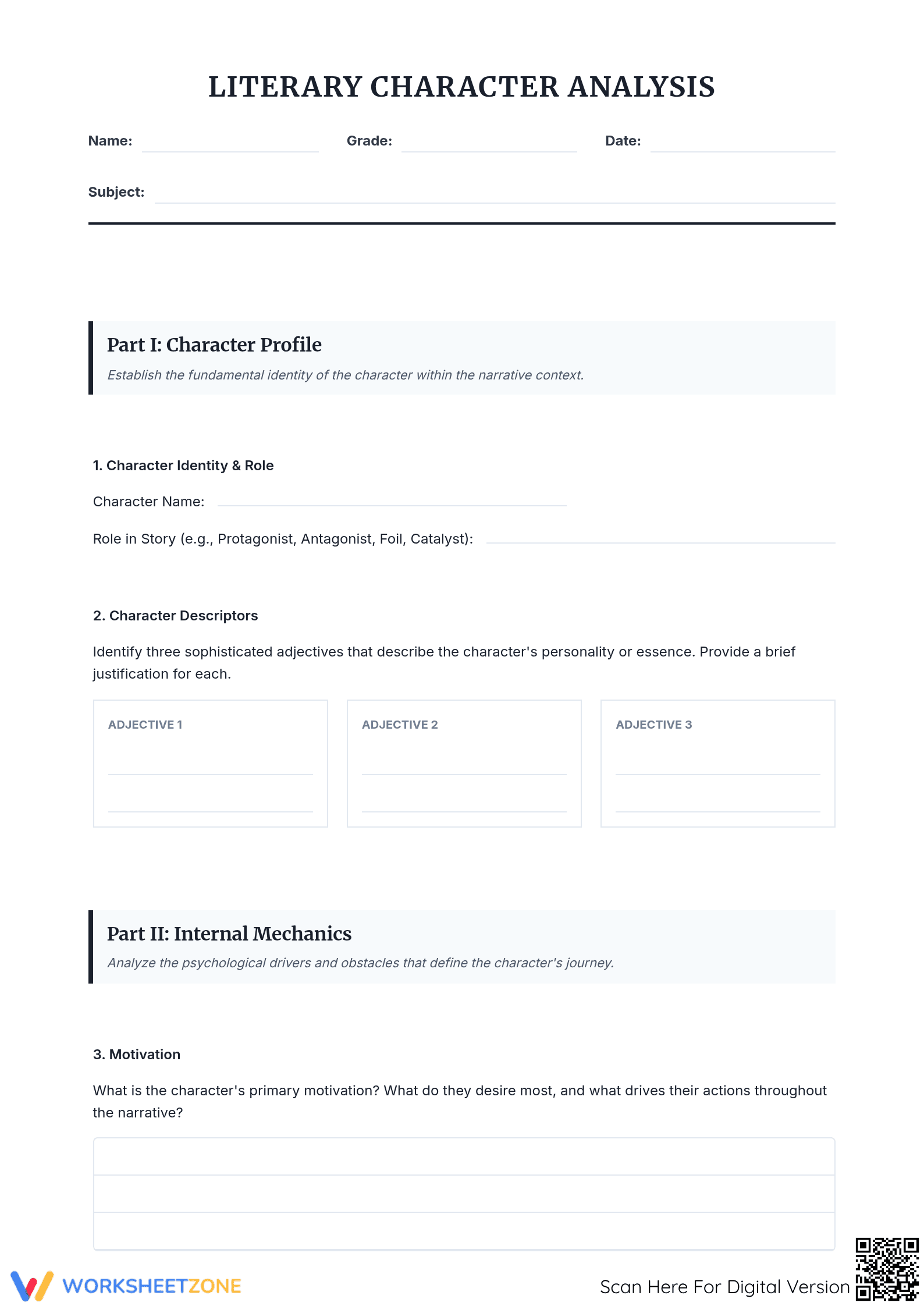
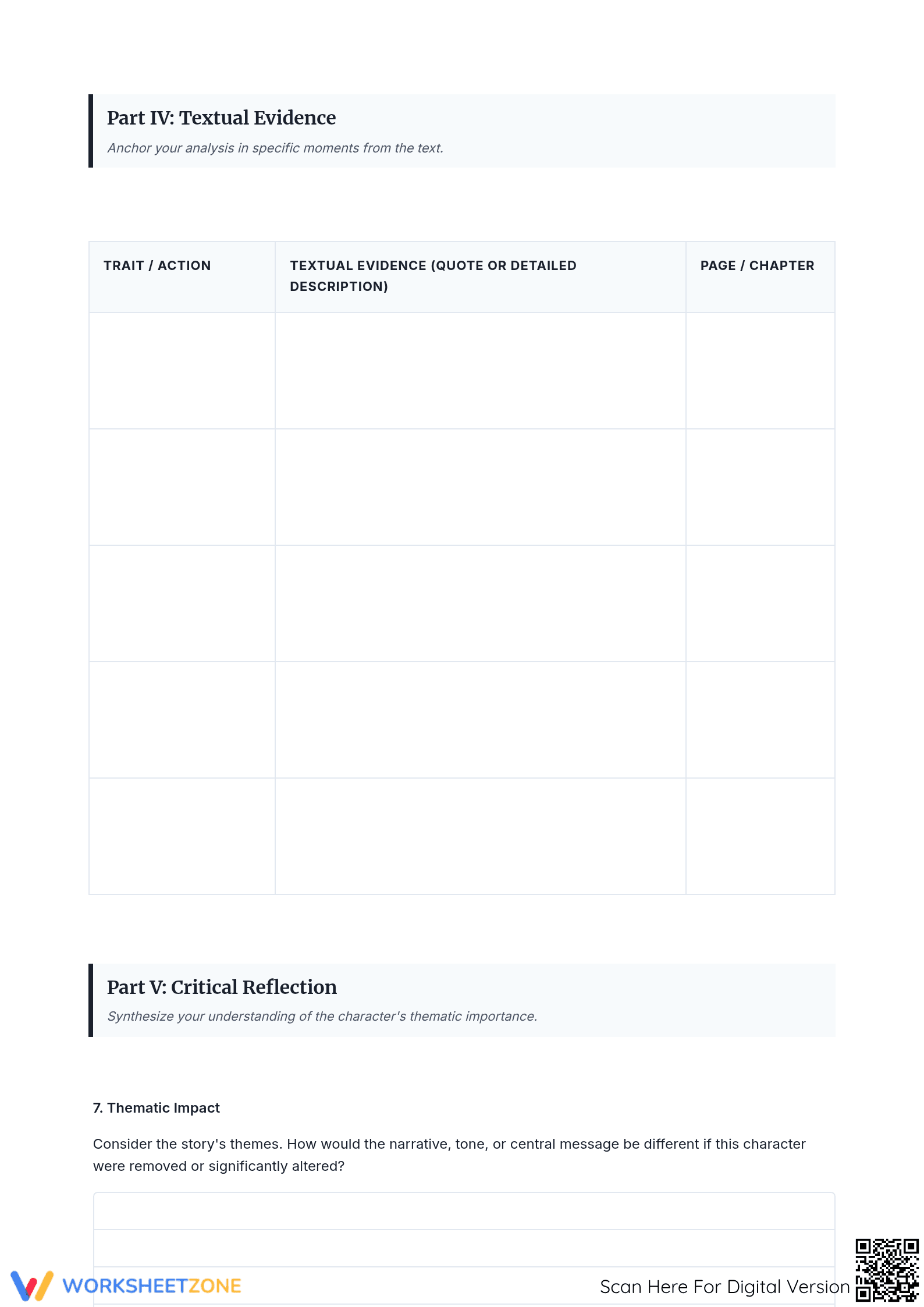
This 3-page PDF contains five distinct sections designed to scaffold deep reading. It includes a character profile for identity and descriptors, an internal mechanics section for motivation and conflict, and an evolution tracker for character arcs. A dedicated textual evidence table allows students to cite specific quotes and page numbers, while the final reflection connects character choices to the broader narrative theme.
Each of the 7 tasks maps directly to sub-skills of the CCSS RL.3 standard, ranging from identifying traits to synthesizing thematic impact. Teachers can use the textual evidence table to assess "Meeting" or "Exceeding" tiers based on the sophistication of the quotes selected. Scores from the critical reflection section can be entered directly into gradebooks or used for IEP progress notes regarding reading comprehension and analytical writing.
The primary focus is CCSS.ELA-LITERACY.RL.11-12.3, which requires students to analyze the impact of the author’s choices regarding how to develop and relate elements of a story or drama. This worksheet specifically targets the development of characters over the course of a text. Both standard codes can be copied directly into lesson plans, IEP goals, or district curriculum mapping tools.
Assign this worksheet during the middle of a novel study to track a character's progression, or as a summative assessment after completing a short story. For a formative assessment tip, observe students during the "Internal Mechanics" section to see if they can distinguish between internal and external conflicts. Expect completion within 45 to 60 minutes depending on text complexity.
This resource is tailored for high school and college-level English students who are ready for sophisticated literary theory. It works exceptionally well for AP English Literature students or as a scaffolded guide for learners who struggle to organize their thoughts for a formal essay. Pair this with a graphic organizer for plot or a direct instruction lesson on character archetypes.
According to research by Fisher & Frey (2014), the use of structured graphic organizers and evidence-based analysis tools significantly improves a student's ability to synthesize complex narrative elements. This worksheet leverages those findings by requiring students to anchor their subjective analysis in objective textual evidence. By focusing on CCSS.ELA-LITERACY.RL.11-12.3, the resource ensures that Grade 10-12 learners are not merely summarizing plots but are instead evaluating the architectural choices of the author. The inclusion of a dedicated evidence table mirrors the requirements of high-stakes assessments like the NAEP and SAT, where identifying the why behind a character's action is paramount. This 3-page tool provides the necessary scaffolding for students to transition from basic comprehension to the high-level critical thinking required in collegiate environments and professional literary criticism. It is a robust addition to any secondary ELA curriculum.


