


























Views
Downloads



Character Analysis & STEAL Method | Essential Grade 10-12
Paste this activity's link or code into your existing LMS (Google Classroom, Canvas, Teams, Schoology, Moodle, etc.).
Students can open and work on the activity right away, with no student login required.
You'll still be able to track student progress and results from your teacher account.
This high school English Language Arts worksheet guides students through the nuances of character development. By moving from basic trait identification to the sophisticated STEAL method, learners develop the analytical tools needed to decode complex literary figures. Students will identify traits, cite specific text evidence, and synthesize their findings through critical reflection.
At a Glance
- Grade: 10-12 · Subject: ELA
- Standard:
CCSS.ELA-LITERACY.RL.9-10.3— Analyze how complex characters develop over the course of a text- Skill Focus: Indirect Characterization (STEAL)
- Format: 3 pages · 9 tasks · Answer key included · PDF
- Best For: Literary analysis and character development units
- Time: 35–45 minutes
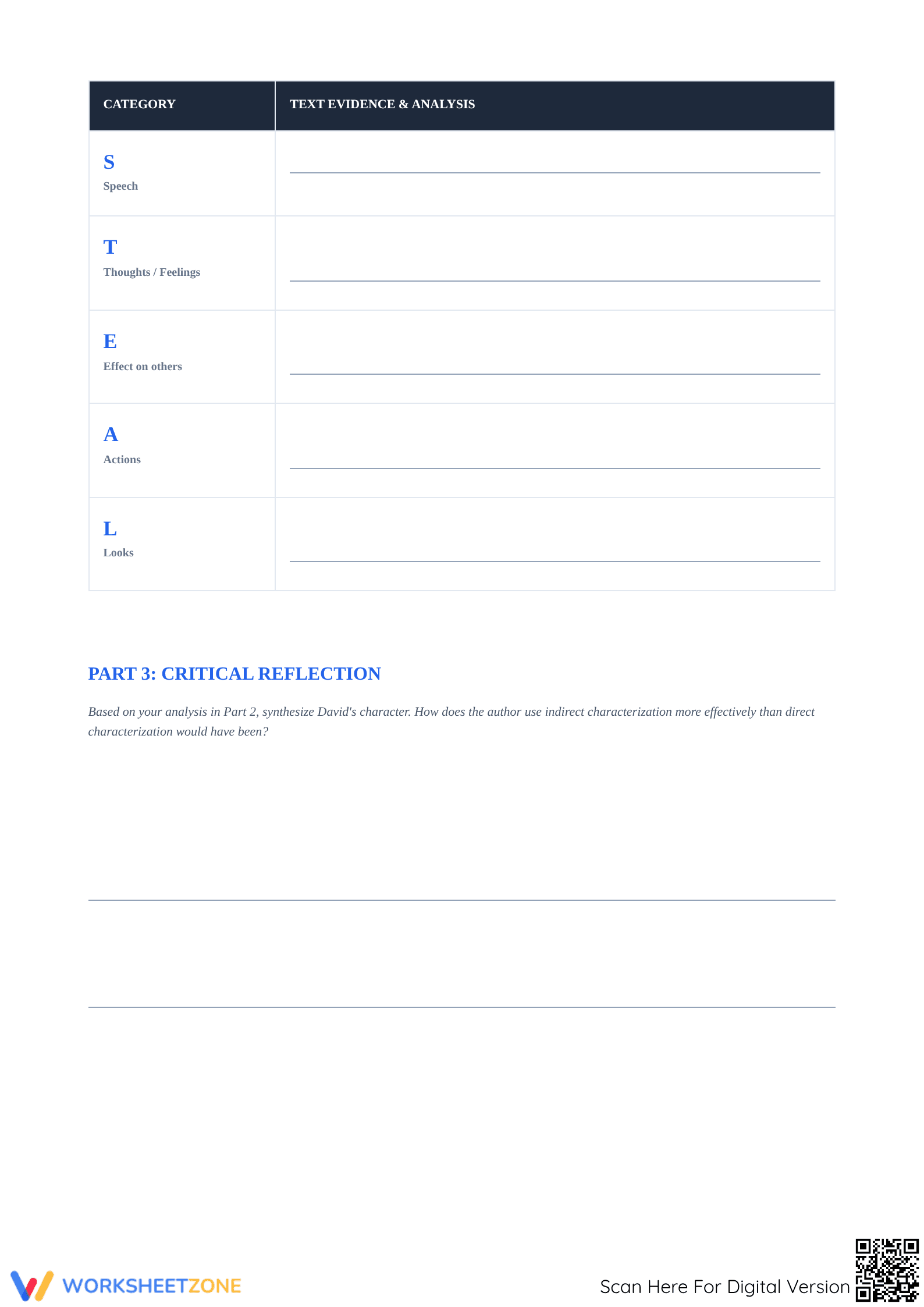
The 3-page PDF includes four distinct literary passages designed for deep analysis. The first section focuses on identifying traits and supporting them with evidence. The second section introduces the STEAL acronym (Speech, Thoughts, Effect, Actions, Looks) with a dedicated graphic organizer. A final critical reflection section requires students to synthesize their analysis and compare direct versus indirect characterization techniques. A full answer key is provided.
Skill Progression
- Guided Practice: Three short passages provide immediate opportunities to link character traits to specific textual evidence with clear prompts.
- Supported Practice: The STEAL method framework scaffolds the transition from simple observation to multi-dimensional character analysis using a structured table.
- Independent Practice: The final critical reflection task challenges students to evaluate authorial intent and the effectiveness of indirect characterization without external prompts.
This sequence follows a gradual-release model, ensuring students master the mechanics of characterization before tackling high-level synthesis.
Standards Alignment
This resource is primarily aligned with CCSS.ELA-LITERACY.RL.9-10.3, which requires students to analyze how complex characters develop, interact with others, and advance the plot or theme. It also supports CCSS.ELA-LITERACY.RL.11-12.3 by examining the impact of authorial choices in character development. Both standard codes can be copied directly into lesson plans, IEP goals, or district curriculum mapping tools.
How to Use It
Use this worksheet during the "during reading" phase of a short story or novel unit to help students track a protagonist's development. It serves as an excellent formative assessment tool; observe how students fill the STEAL table to identify if they struggle more with "Effect on others" versus "Speech." Expect students to spend approximately 40 minutes for a thorough completion.
Who It's For
This resource is designed for Grade 10 through College-level ELA students who need a structured approach to literary analysis. It is particularly effective for students who struggle to move beyond surface-level descriptions. Pair this with a character anchor chart or a direct instruction lesson on the difference between explicit and implicit characterization.
Characterization is a cornerstone of literary proficiency, yet many secondary students struggle to move beyond identifying basic traits to analyzing the mechanisms of character development. According to Fisher & Frey (2014), the use of structured scaffolds like the STEAL method facilitates the gradual release of responsibility, allowing students to internalize the analytical habits of expert readers. This worksheet addresses CCSS.ELA-LITERACY.RL.9-10.3 by providing 9 specific tasks that require students to bridge the gap between textual evidence and character inference. By requiring both evidence citation and critical reflection, the resource ensures that students are not merely identifying traits but are evaluating the author's craft. Research from the NAEP suggests that high-performing students consistently demonstrate the ability to integrate information across a text to form complex character profiles, a skill directly targeted by this three-page instructional tool.


