




























Views
Downloads


Character Analysis Portfolio | Grade 10-12 Essential

Paste this activity's link or code into your existing LMS (Google Classroom, Canvas, Teams, Schoology, Moodle, etc.).
Students can open and work on the activity right away, with no student login required.
You'll still be able to track student progress and results from your teacher account.
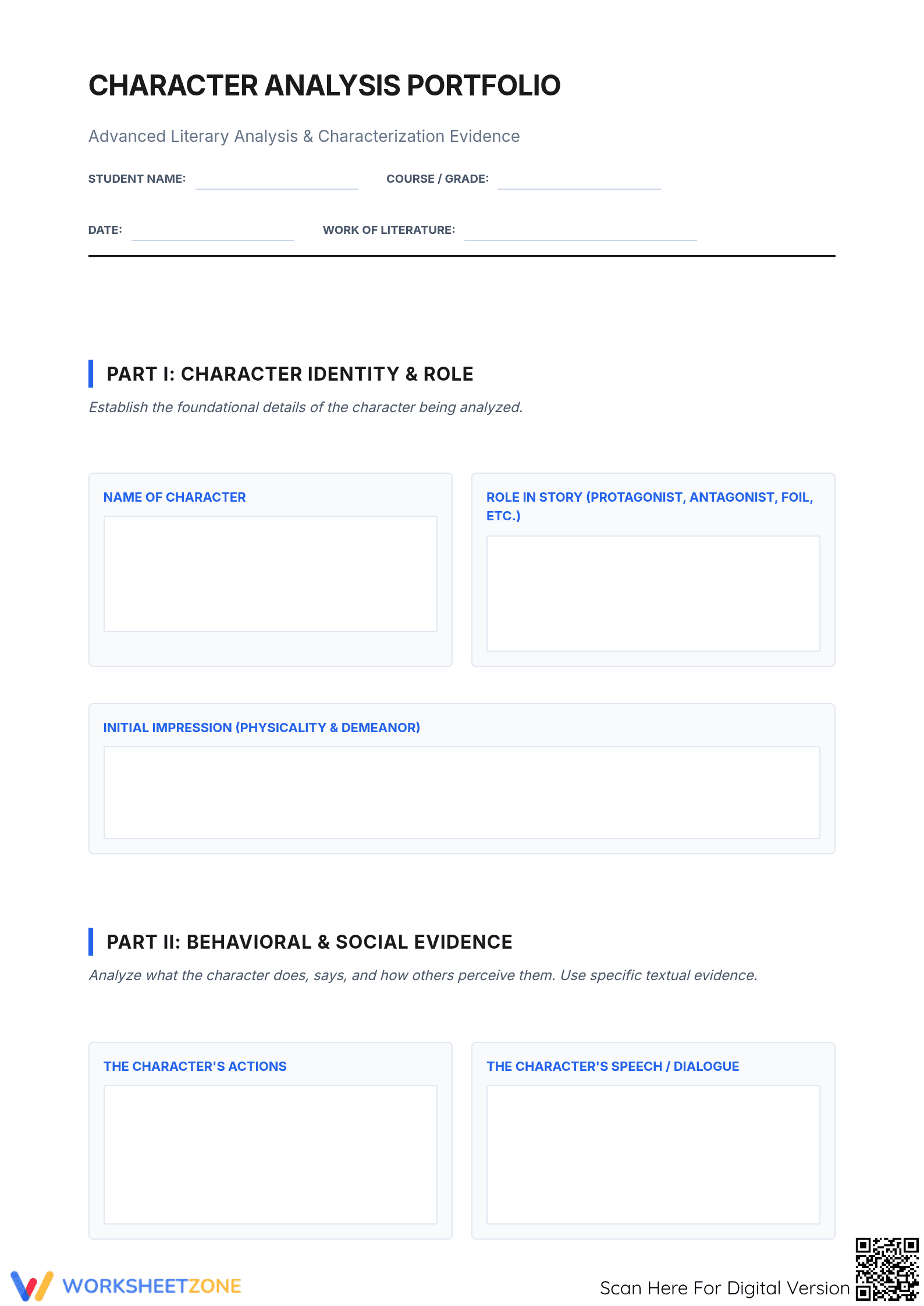
This advanced character analysis portfolio provides a structured framework for high school and college students to dissect literary figures. By moving from surface-level traits to deep psychological synthesis, students develop a nuanced understanding of how authors construct complex characters. It facilitates a rigorous examination of textual evidence to support literary claims.
At a Glance
- Grade: 10-12 · Subject: ELA
- Standard:
CCSS.ELA-LITERACY.RL.11-12.3— Analyze how complex characters develop over the course of a text- Skill Focus: STEAL Method & Character Evolution
- Format: 4 pages · 12 tasks · Answer key included · PDF
- Best For: Novel studies and short story analysis
- Time: 45–60 minutes
What's Inside
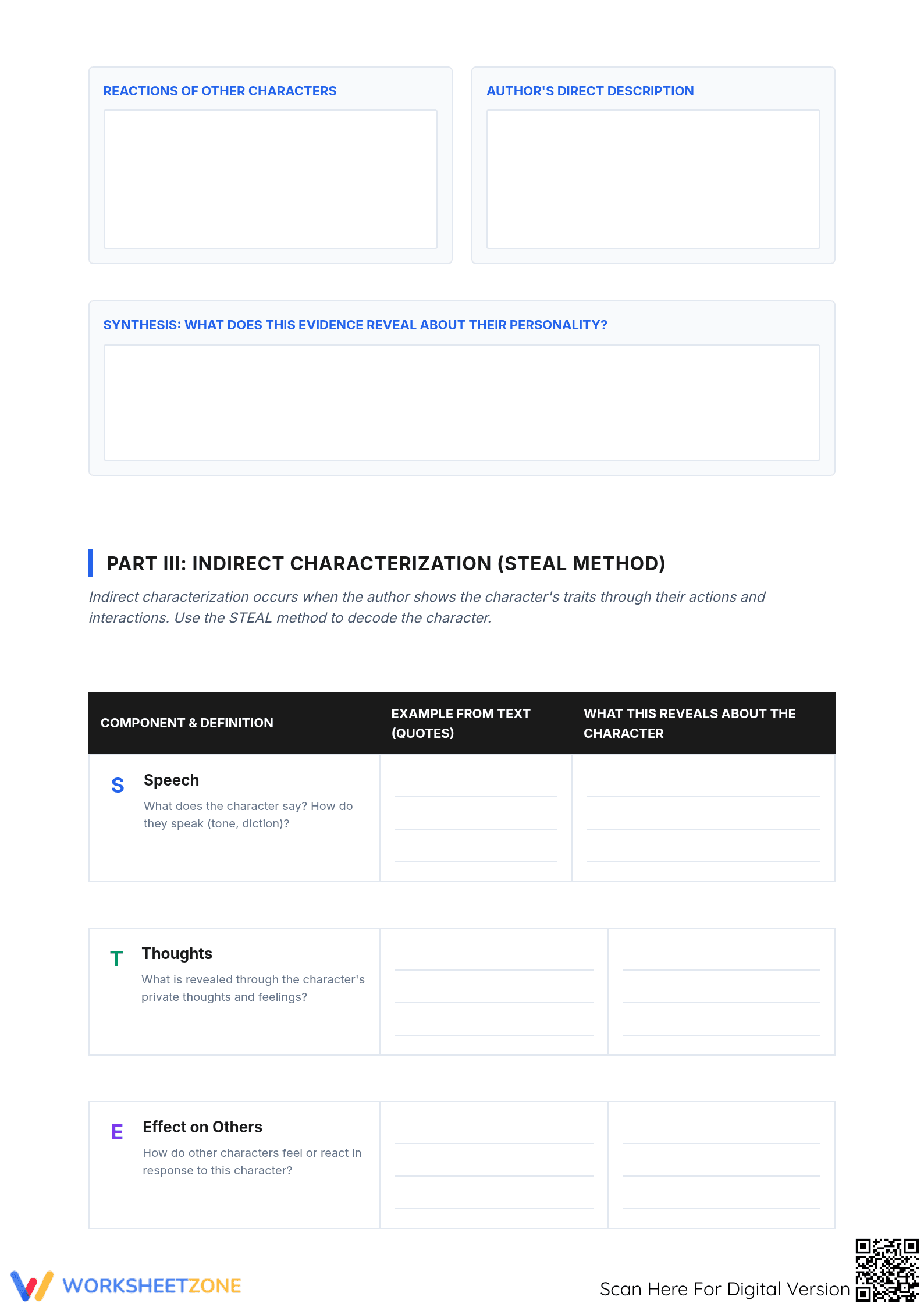
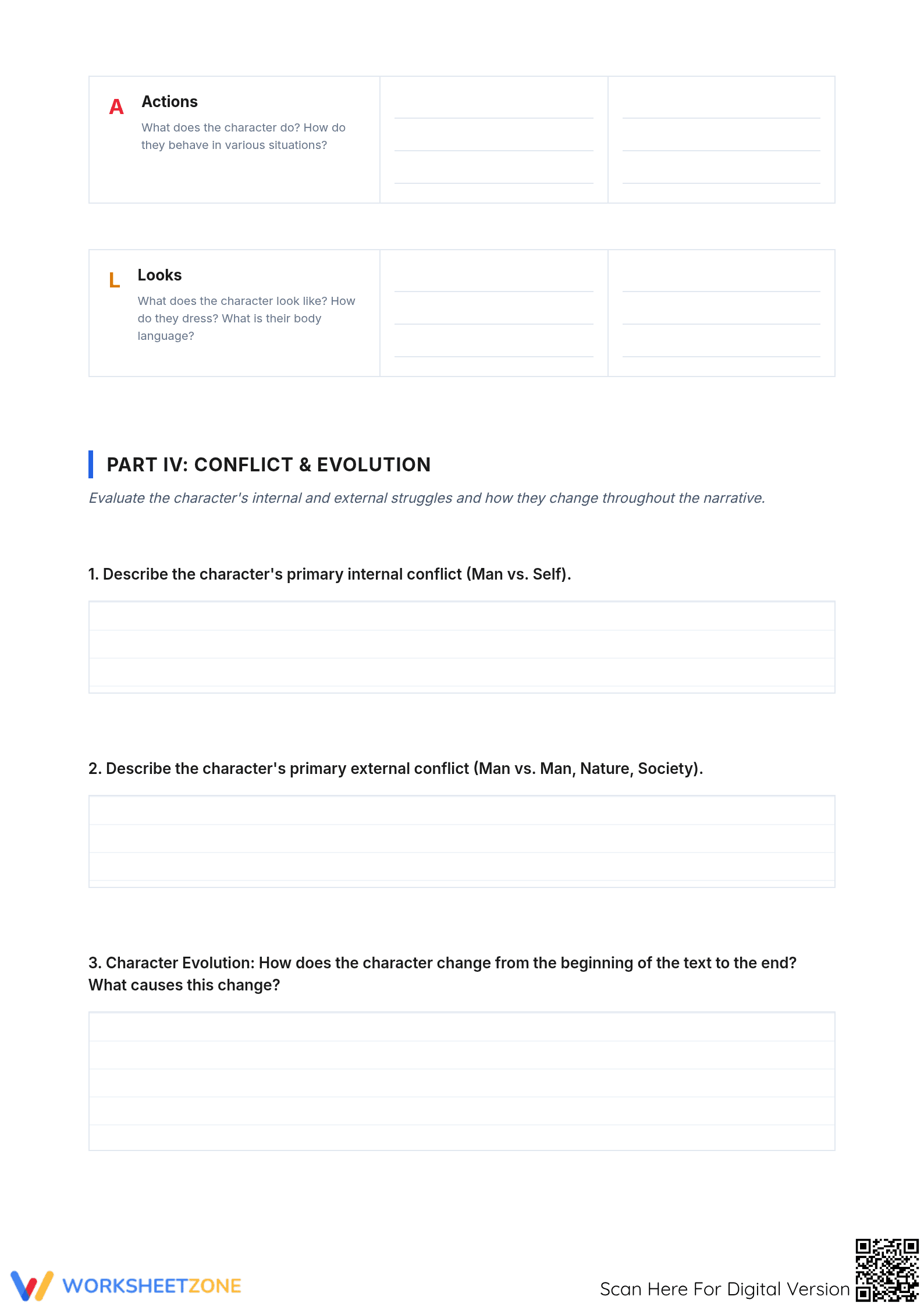
The 4-page PDF contains four distinct phases of analysis. Part I establishes identity and narrative roles. Part II focuses on behavioral evidence, including speech and social reactions. Part III utilizes the STEAL method (Speech, Thoughts, Effect, Actions, Looks) for indirect characterization. Finally, Part IV requires a critical evaluation of internal and external conflicts and character arc classification.
Zero-Prep Workflow
- Print: Select the 4-page packet or specific pages based on reading progress (1 minute).
- Distribute: Hand out during a novel study or after a short story reading (1 minute).
- Review: Facilitate a whole-class discussion to compare different interpretations of character motivations (15 minutes).
This resource is ideal for emergency sub plans or as a standard component of any literature unit.
Standards Alignment
The primary focus is `CCSS.ELA-LITERACY.RL.11-12.3`, which requires students to analyze the impact of the author's choices regarding how to develop and relate elements of a story or drama. It also supports RL.9-10.3 by tracking character interaction and development. Both standard codes can be copied directly into lesson plans, IEP goals, or district curriculum mapping tools.
How to Use It
Use this portfolio as a summative assessment at the conclusion of a major text or as a formative tracking tool throughout a unit. For formative use, have students complete one page per chapter to observe the character's evolution in real-time. Teachers should look for students' ability to distinguish between direct and indirect characterization during the STEAL method section. Expected completion time ranges from 45 to 60 minutes depending on text complexity.
Who It's For
This resource is designed for Grade 10, 11, 12, and introductory college literature courses. It is particularly effective for students who need a graphic organizer to manage complex textual evidence. Pair this worksheet with a character-focused anchor chart or a direct instruction lesson on the difference between static and dynamic characters.
According to the Fisher & Frey (2014) framework for close reading, providing students with structured scaffolds like the STEAL method is vital for moving beyond literal comprehension toward inferential analysis. This character analysis portfolio aligns with these research-based practices by requiring students to cite specific textual evidence for every claim they make about a character's personality or role. By utilizing the CCSS.ELA-LITERACY.RL.11-12.3 standard, the worksheet ensures that students are meeting high-school-level rigor in their literary evaluations. The four-page structure supports the gradual release of responsibility, allowing students to first identify basic traits before engaging in the higher-order thinking required to evaluate character evolution and conflict resolution. This systematic approach to characterization helps bridge the gap between reading a story and performing a professional-level literary critique, making it a staple for any secondary ELA classroom.


