


























Views
Downloads

Character Compare and Contrast Printable | Grade 2 ELA
Paste this activity's link or code into your existing LMS (Google Classroom, Canvas, Teams, Schoology, Moodle, etc.).
Students can open and work on the activity right away, with no student login required.
You'll still be able to track student progress and results from your teacher account.
This Grade 2 reading comprehension worksheet helps students build strong text-to-self connections by comparing a book character to themselves. By analyzing traits, experiences, and feelings, young readers deepen their understanding of literature while practicing essential compare and contrast skills in a highly visual format.
At a Glance
- Grade: 2 · Subject: ELA
- Standard:
CCSS.ELA-LITERACY.RL.2.3— Describe how characters respond to major events- Skill Focus: Character Analysis & Text-to-Self Connection
- Format: 1 page · 1 graphic organizer · No answer key · PDF
- Best For: Independent reading response
- Time: 15–20 minutes
What's Inside
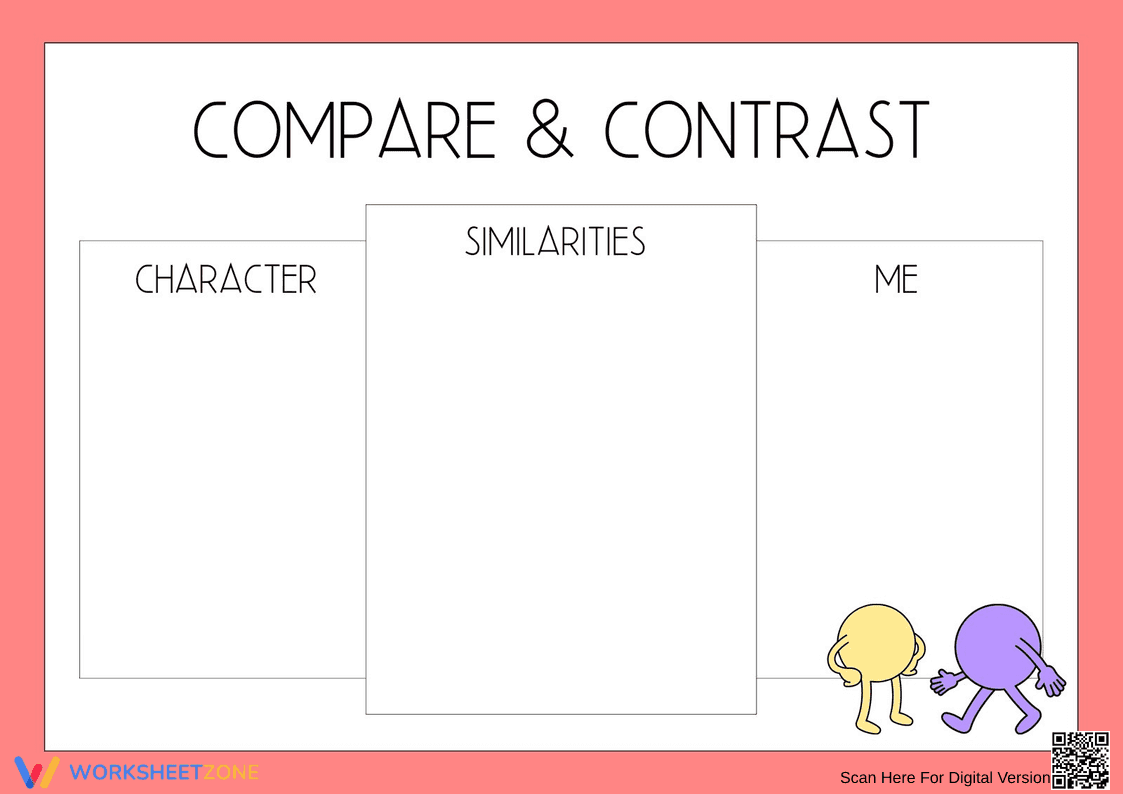
This single-page resource features a clean graphic organizer designed for early elementary students. It includes three sections: one for character details, one for personal traits, and a central box for similarities. The open-ended design provides ample space for writing or drawing, making it accessible for various learning styles without an answer key.
Zero-Prep Workflow
- Print (1 minute): The straightforward black-and-white design with minimal graphics ensures quick, ink-saving printing for the entire class.
- Distribute (1 minute): Hand out the graphic organizer immediately after a read-aloud or during independent reading time.
- Review (0 minutes): The intuitive layout requires no complex teacher modeling, allowing students to begin their analysis right away.
With a total teacher prep time of under two minutes, this resource is an ideal addition to emergency sub plans or last-minute literacy center rotations.
Standards Alignment
This activity is aligned to CCSS.ELA-LITERACY.RL.2.3, requiring students to describe how characters in a story respond to major events and challenges. By comparing the character's responses to their own potential reactions, students demonstrate a deeper grasp of character motivation. Both standard codes can be copied directly into lesson plans, IEP goals, or district curriculum mapping tools.
How to Use It
Teachers can utilize this graphic organizer during whole-group read-alouds by pausing halfway through the story and asking students to compare themselves to the protagonist. Alternatively, it serves as an excellent post-reading assessment for independent reading blocks. As a formative assessment tip, observe whether students are listing superficial physical traits or digging deeper into emotional responses and personality characteristics. Expected completion time ranges from 15 to 20 minutes depending on writing proficiency.
Who It's For
This worksheet is designed for second-grade students, though it functions well for first graders needing enrichment. The spacious boxes allow for differentiation; emerging writers can draw comparisons, while advanced students write complete sentences. It pairs perfectly with any fictional picture book featuring a strong main character.
Developing text-to-self connections is a critical component of early literacy that significantly enhances reading comprehension and student engagement. This resource targets CCSS.ELA-LITERACY.RL.2.3, prompting students to describe how characters respond to major events by comparing those reactions to their own lived experiences. According to Fisher & Frey (2014), utilizing structured graphic organizers for comparative thinking reduces cognitive load, allowing young learners to focus entirely on analytical reasoning rather than formatting their thoughts. By visually separating differences and similarities, students can systematically process complex character traits. This instructional approach not only builds foundational literary analysis skills but also fosters empathy and self-awareness in the classroom. The open-ended nature of the comparison ensures that every student can access the material at their current developmental level, making it a versatile tool for diverse educational settings and varying ability levels.


