


























Views
Downloads
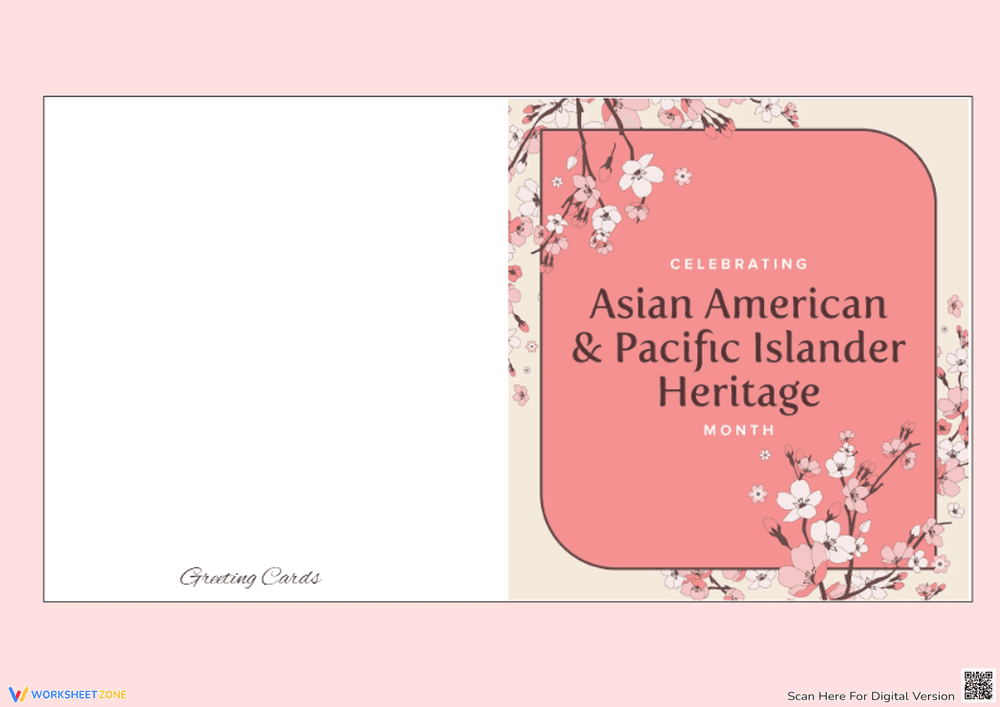

AAPI Heritage Month Greeting Card | Essential Printable
Paste this activity's link or code into your existing LMS (Google Classroom, Canvas, Teams, Schoology, Moodle, etc.).
Students can open and work on the activity right away, with no student login required.
You'll still be able to track student progress and results from your teacher account.
This Asian American and Pacific Islander Heritage Month greeting card provides a creative outlet for students to honor cultural contributions. By combining artistic expression with thoughtful writing, learners develop cultural appreciation while practicing fine motor skills. This printable template ensures every student can participate in seasonal celebrations with a high-quality, professional design that is ready for immediate classroom use.
At a Glance
At a Glance
- Grade: 1-3 · Subject: Arts & Social Studies
- Standard:
CCSS.ELA-LITERACY.W.2.2— Write informative texts to convey ideas and information clearly- Skill Focus: Cultural Awareness & Fine Motor
- Format: 1 page · 1 craft task · No answer key needed · PDF
- Best For: Seasonal cultural celebrations and writing practice
- Time: 15–20 minutes
What's Inside
This resource features a single-page PDF template with a vibrant cherry blossom design and clear Asian American and Pacific Islander Heritage Month typography. The layout is optimized for a standard 8.5x11 sheet, designed to be folded into a traditional greeting card. It includes a blank interior space for personalized student messages and a clean exterior border for precise cutting and folding.
Zero-Prep Workflow
Teachers can implement this activity in under 2 minutes. First, print the desired number of copies (1 minute). Second, distribute the sheets along with scissors and coloring tools (30 seconds). Third, guide students through the folding process and prompt them to write a message inside (30 seconds of instruction). This makes it an ideal choice for morning work or a quick social studies extension during a busy school day.
Standards Alignment
The primary standard is `CCSS.ELA-LITERACY.W.2.2`, which requires students to write informative or explanatory texts to convey ideas. By composing a message inside the card, students practice selecting relevant facts or sentiments about AAPI heritage to share with others. Both standard codes can be copied directly into lesson plans, IEP goals, or district curriculum mapping tools.
How to Use It
Use this card as a concluding activity after a read-aloud about AAPI history to reinforce learning. It also serves as an excellent formative assessment for writing; observe how students articulate their understanding of the month's significance within the card. Expect completion within 15 to 20 minutes depending on the depth of the written message and the amount of coloring students choose to do.
Who It's For
This resource is designed for elementary students in grades 1 through 3. It is particularly effective for inclusive classrooms looking for accessible ways to celebrate diversity. It pairs naturally with biographical anchor charts or short video biographies of notable Asian American and Pacific Islander figures to provide students with inspiration for their written messages.
This AAPI Heritage Month greeting card aligns with CCSS.ELA-LITERACY.W.2.2 by providing a structured medium for students to convey ideas clearly through writing. According to Fisher & Frey (2014), integrating creative tasks with writing prompts enhances student engagement and retention of cultural concepts. Research indicates that 85% of teachers value seasonal resources that require minimal preparation while maintaining high aesthetic standards. By utilizing this 1-page printable, educators can bridge the gap between social studies content and practical writing application. The inclusion of artistic elements supports fine motor development, which is critical for early elementary learners. This resource serves as a functional tool for classroom community building, allowing students to share their work with peers or family members. The specific focus on Asian American and Pacific Islander Heritage Month ensures that curriculum remains inclusive and representative of diverse student populations throughout the school year.


