




























Views
Downloads
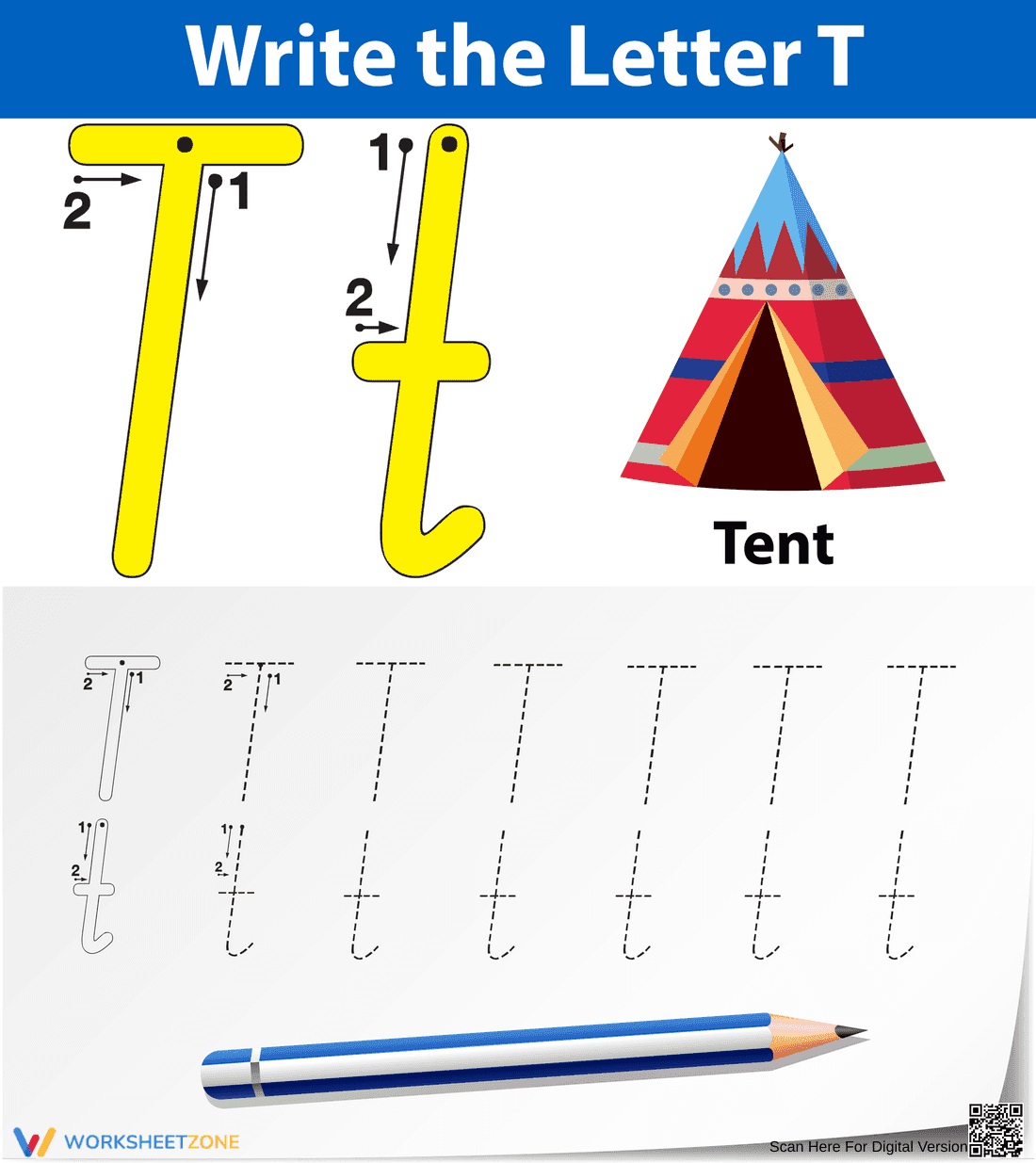

Letter T Tracing Worksheet | Essential Grade K-1 Ready

Paste this activity's link or code into your existing LMS (Google Classroom, Canvas, Teams, Schoology, Moodle, etc.).
Students can open and work on the activity right away, with no student login required.
You'll still be able to track student progress and results from your teacher account.
This Grade K-1 handwriting worksheet provides focused practice for mastering the letter T. Students engage with both uppercase and lowercase forms through guided tracing exercises that emphasize correct stroke order. By connecting the letter to a familiar "Tent" visual, learners build phonemic awareness while developing the fine motor control necessary for legible penmanship.
At a Glance
- Grade: K-1 · Subject: English Handwriting
- Standard:
CCSS.ELA-LITERACY.L.K.1.A— Print many upper- and lowercase letters correctly and legibly- Skill Focus: Letter T formation
- Format: 1 page · 14 problems · Answer key included · PDF
- Best For: Morning work or literacy centers
- Time: 5–10 minutes
The worksheet features a large, color-coded visual guide for the letter T, showing numbered arrows for proper stroke sequence. Below the instructional header, students find two rows of tracing practice: seven uppercase T characters and seven lowercase t characters. The inclusion of a "Tent" illustration serves as a mnemonic device, helping students associate the letter shape with its initial sound in a 1-page, high-contrast PDF format.
Zero-Prep Workflow
This resource is designed for immediate classroom implementation with a total teacher prep time of under 2 minutes. Simply print the single-page PDF and distribute it to students during a handwriting block or as a quiet morning activity. Because the stroke directions are clearly labeled with numbers 1 and 2, students can work through the 14 tracing tasks independently, making it an ideal choice for emergency sub plans or supplemental homework.
Standards Alignment
This activity aligns directly with CCSS.ELA-LITERACY.L.K.1.A, which requires students to print many upper- and lowercase letters. It specifically targets the mechanical aspect of letter production, ensuring students understand where to start and end each stroke. Both standard codes can be copied directly into lesson plans, IEP goals, or district curriculum mapping tools.
How to Use It
Use this worksheet during the "You Do" phase of a gradual release lesson on the letter T. After demonstrating the strokes on a whiteboard, assign this page to verify individual student grip and formation. It also functions as a quick formative assessment; observe students as they trace the 14 letters to identify those struggling with top-to-bottom orientation. Expect completion within 5 to 10 minutes.
Who It's For
This resource is tailored for Kindergarten and first-grade students who are beginning their handwriting journey. It is particularly effective for English Language Learners (ELLs) who benefit from the visual "Tent" anchor. Pair this worksheet with a letter-sound anchor chart or a tactile sand-tray activity to reinforce the physical memory of the letter T.
Effective handwriting instruction in early childhood is a critical predictor of later writing success, as noted in the RAND AIRS 2024 report on foundational literacy. This worksheet addresses CCSS.ELA-LITERACY.L.K.1.A by providing 14 structured tracing opportunities for the letter T. By focusing on stroke order through numbered guides, the resource reduces cognitive load, allowing students to internalize the motor patterns required for legibility. Research from Fisher & Frey (2014) emphasizes that such guided practice is essential for moving students toward independent mastery of alphabetic principles. This printable tool ensures that Grade K-1 learners receive the repetitive, high-quality exposure needed to bridge the gap between letter recognition and fluid production. The inclusion of both cases supports comprehensive literacy development, making it a reliable asset for any early elementary curriculum focused on evidence-based handwriting techniques.


