































By 6s: Complete Reasoning & Justification Guide

Paste this activity's link or code into your existing LMS (Google Classroom, Canvas, Teams, Schoology, Moodle, etc.).
Students can open and work on the activity right away, with no student login required.
You'll still be able to track student progress and results from your teacher account.
This Grade 3 math worksheet builds conceptual understanding of multiplication by 6s through structured reasoning and mathematical justification. Students examine dot arrays, analyze skip-counting tables, and defend why multiplication statements are true or false, developing durable mastery of core multiplication properties.
At a Glance
- Grade: 3 · Subject: Math
- Standard:
3.OA.D.9— Identify arithmetic patterns in multiplication tables and explain them using properties.- Skill Focus: Multiplication reasoning and pattern justification for 6s facts
- Format: 3 pages · 18 problems · Answer key included · PDF
- Best For: Small group instruction and skill reinforcement
- Time: 30–45 minutes
What's Inside
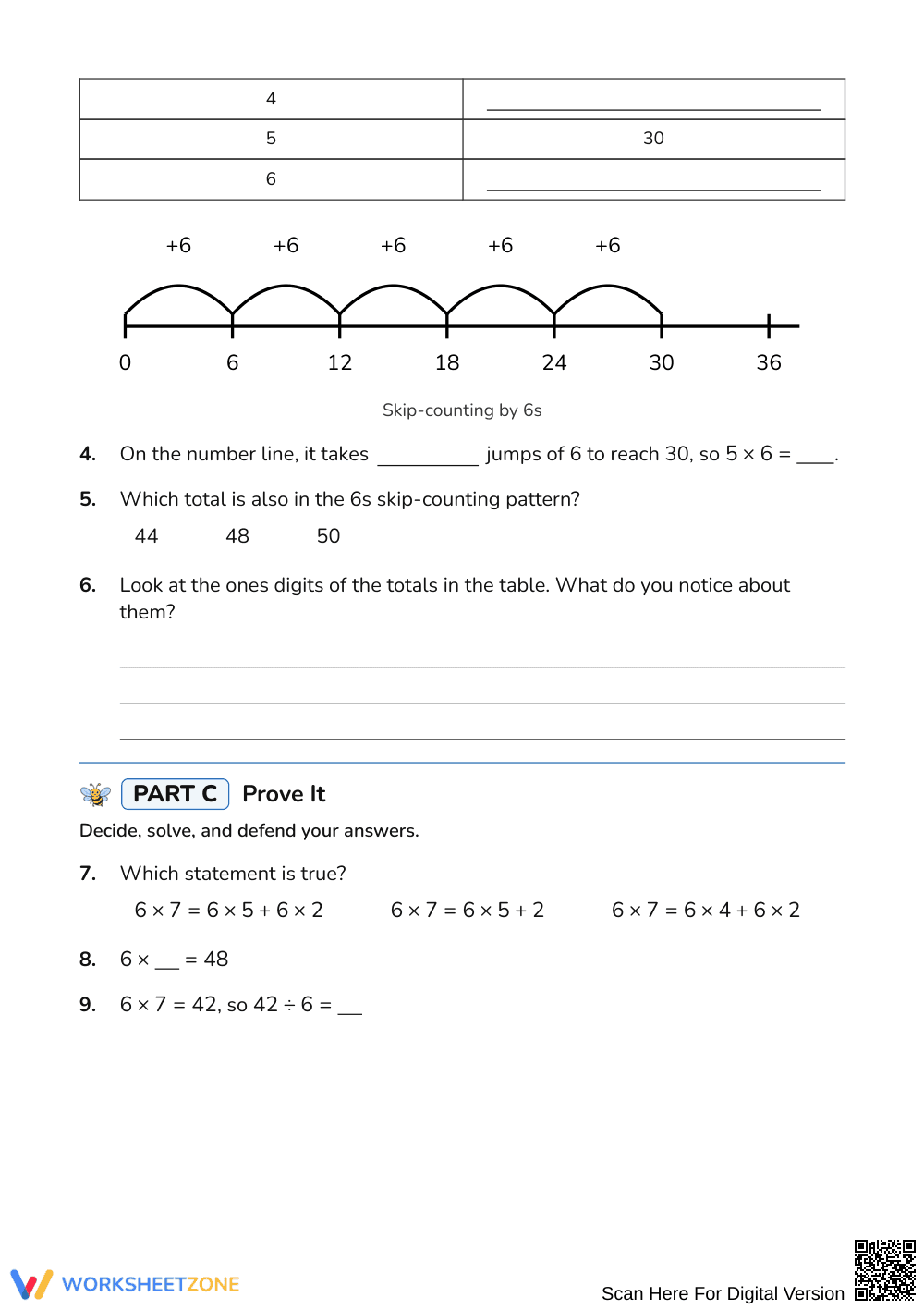
The 3-page printable contains 18 problems across three structured parts, complete with a 3-page answer key. Part A uses dot arrays and repeated addition models to investigate the commutative property. Part B uses ratio tables and number lines to examine skip-counting multiples and repeating ones digits. Part C challenges students with true-false statements, related division equations, and peer error analysis.
Skill Progression
- Guided practice (Part A, 4 problems): Visual dot arrays and repeated addition models help students explain commutative relationships.
- Supported practice (Part B, 6 problems): Structured tables and number lines support identifying multiples and ones-digit patterns.
- Independent practice (Part C, 8 problems): Non-routine tasks require students to disprove incorrect claims and defend parity rules.
This gradual-release sequence moves students smoothly from visual models to independent mathematical justification.
Standards Alignment
This worksheet aligns to primary standard 3.OA.D.9: Identify arithmetic patterns in multiplication tables and explain them using properties of operations. Supporting standard 3.OA.B.5 reinforces applying commutative and distributive properties as multiplication strategies. Both standard codes can be copied directly into lesson plans, IEP goals, or district curriculum mapping tools.
How to Use It
Use this worksheet after initial instruction on 6s facts for guided application, or assign it during math intervention. As a formative assessment tip, check whether students justify 6 × 8 using doubling strategies or fact recall. Expected completion time is 30 to 45 minutes.
Who It's For
This resource supports Grade 3 learners mastering multiplication facts and Grade 4 students needing conceptual intervention. Visual arrays and table models scaffold learning for English learners. Pair this worksheet with an anchor chart showing derived multiplication strategies.
According to Fisher & Frey (2014), structured opportunities for students to verbalize and write mathematical justifications are essential for converting procedural recall into enduring conceptual understanding. Standard 3.OA.D.9 requires Grade 3 learners to identify arithmetic patterns within multiplication structures and justify them using foundational properties of operations. This 18-problem worksheet operationalizes that research by requiring students to explain commutative arrays, discover alternating ones-digit patterns in multiples of 6, and construct rigorous proofs that evaluate peer claims. Rather than completing repetitive drill calculations, students defend mathematical methods using decomposition and doubling strategies. Research demonstrated in Fisher & Frey (2014) confirms that combining visual representations with systematic argumentation accelerates mastery across elementary mathematics domains. By providing clear progressions from guided array analysis to independent justification, this resource ensures students build the metacognitive habits necessary for long-term mathematical fluency and standards-aligned algebraic thinking.


