































By 6s: Complete Real-World Modeling Worksheet

Paste this activity's link or code into your existing LMS (Google Classroom, Canvas, Teams, Schoology, Moodle, etc.).
Students can open and work on the activity right away, with no student login required.
You'll still be able to track student progress and results from your teacher account.
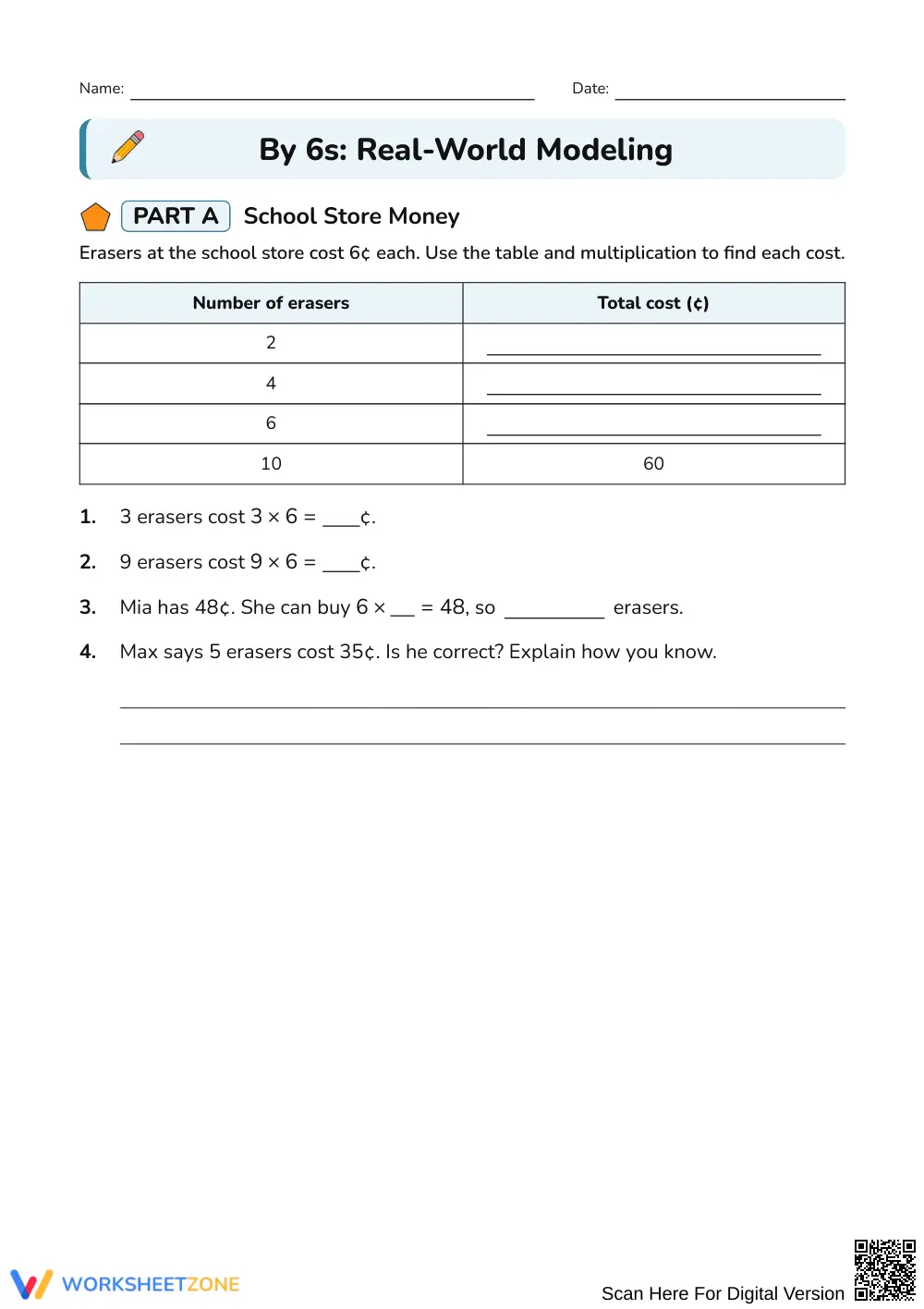
This Grade 3 math worksheet equips learners to master multiplication facts by 6 through authentic real-world contexts, including money, arrays, measurement, and geometry. Students translate visual and practical scenarios into multiplication equations and solve 17 targeted problems to build computational fluency and conceptual understanding.
At a Glance
- Grade: 3 · Subject: Math
- Standard:
3.OA.A.3— Solve multiplication word problems within 100 using arrays, equal groups, and measurement models- Skill Focus: Real-world modeling with ×6 multiplication facts
- Format: 3 pages · 17 problems · Answer key included · PDF
- Best For: Guided math stations and independent practice
- Time: 30–45 minutes
What's Inside
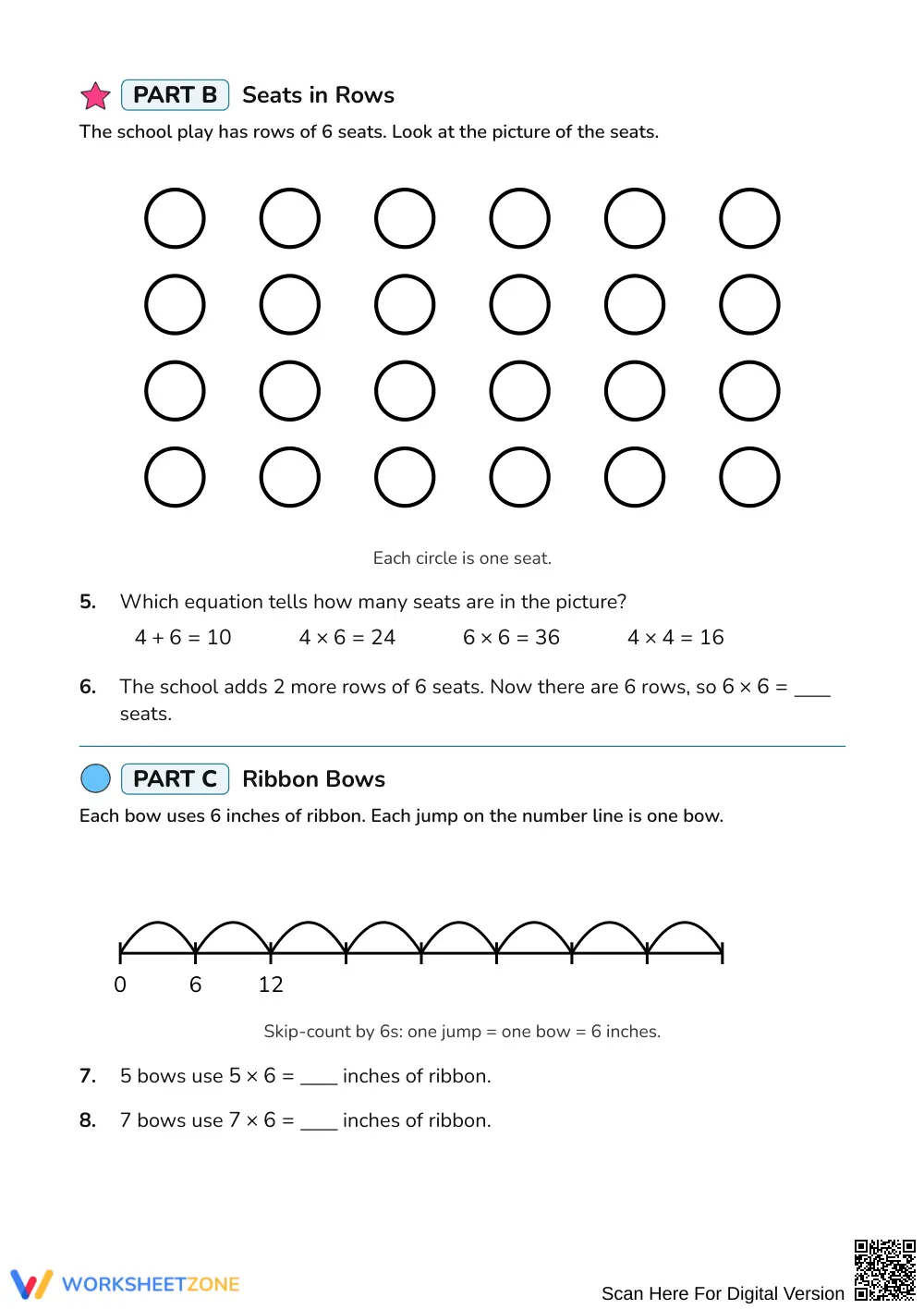
Spread across 3 student pages, the resource contains 17 varied tasks divided into four contextual sections: school store pricing tables, seating arrangement arrays, ribbon length number line models, and equal-sided hexagon perimeters. Tasks integrate equation matching, skip-counting jumps, fact family connections, and written mathematical explanations. A complete 3-page answer key provides worked-out solutions and model explanations for every item.
Skill Progression
- Guided Practice: Part A walks students through school store money scenarios, using structured ratio tables and worked examples to calculate costs before analyzing a common calculation misconception.
- Supported Practice: Parts B and C provide visual scaffolds, prompting students to interpret physical seating arrays and number line skip-counting jumps representing equal ribbon lengths.
- Independent Practice: Part D removes visual prompts, requiring students to calculate the perimeter of regular hexagons, write reciprocal fact family division equations, and justify their geometric reasoning in writing.
This sequence follows a gradual-release instructional model (I Do, We Do, You Do) that transitions learners from concrete tables to abstract geometric problem-solving.
Standards Alignment
This worksheet directly targets `3.OA.A.3`: Use multiplication and division within 100 to solve word problems in situations involving equal groups, arrays, and measurement quantities. It also supports `3.OA.C.7` by reinforcing fluent multiplication within 100 through contextual factor relationships. Both standard codes can be copied directly into lesson plans, IEP goals, or district curriculum mapping tools.
How to Use It
Deploy this worksheet during small-group guided math after introducing the sixes multiplication tables, or assign it during independent practice stations to evaluate student fluency. During the activity, observe whether students identify the multiplicative factor of 6 immediately or rely on repetitive additive skip-counting. Typical completion time ranges between 30 and 45 minutes.
Who It's For
This resource is designed for Grade 3 general education classrooms, math intervention groups, and students needing multi-representation practice with the sixes facts. Differentiate by providing physical counters for array construction or highlighting table patterns for struggling learners. Pair this worksheet naturally with an anchor chart depicting equal groups and arrays.
According to research highlighted in EdReports 2024, high-quality elementary mathematics materials must bridge conceptual understanding and procedural fluency through authentic problem contexts. This Grade 3 worksheet operationalizes standard 3.OA.A.3 by challenging students to model real-world situations with multiplication facts by 6 across diverse applications. Rather than presenting isolated arithmetic drill sheets, the 17 structured problems engage third graders in interpreting store prices, seating arrays, ribbon number lines, and regular polygon perimeter measurements. Students actively construct equations, evaluate mathematical errors, and articulate their quantitative reasoning using inverse fact families. EdReports 2024 underscores that structured contextual modeling reinforces long-term mathematical retention and prevents persistent additive misconceptions during early multiplication instruction. With an accompanying 3-page answer key and clear visual models, this resource delivers targeted, standards-aligned practice that substantiates student progress toward multiplication mastery.


