































By 3s: Reasoning & Justification - Complete Guide

Paste this activity's link or code into your existing LMS (Google Classroom, Canvas, Teams, Schoology, Moodle, etc.).
Students can open and work on the activity right away, with no student login required.
You'll still be able to track student progress and results from your teacher account.
This Grade 3 math worksheet builds conceptual understanding of multiplication by 3s through mathematical reasoning, justification, and pattern analysis. Students move beyond rote memorization to defend solutions, analyze arrays, critique errors, and explain numerical relationships using visual models and number lines to achieve lasting mastery.
At a Glance
- Grade: 3 · Subject: Math
- Standard:
3.OA.C.7— Fluently multiply within 100 using strategies such as relationship between operations- Skill Focus: Multiplication by 3s with reasoning and justification
- Format: 3 pages · 15 problems · Answer key included · PDF
- Best For: Small group intervention and guided practice
- Time: 25–35 minutes
What's Inside
This 3-page printable resource includes 15 varied problems featuring equal groups, array models, a marked number line, and written justification prompts. Students critique true-or-false claims, identify skip-counting patterns, eliminate non-belonging fact family equations, and solve comparison word problems. A complete 3-page answer key provides written response models for straightforward grading.
Skill Progression
- Guided Practice (Part A, 4 problems): Students examine equal groups and arrays with visual models to justify commutativity and connect repeated addition to multiplication.
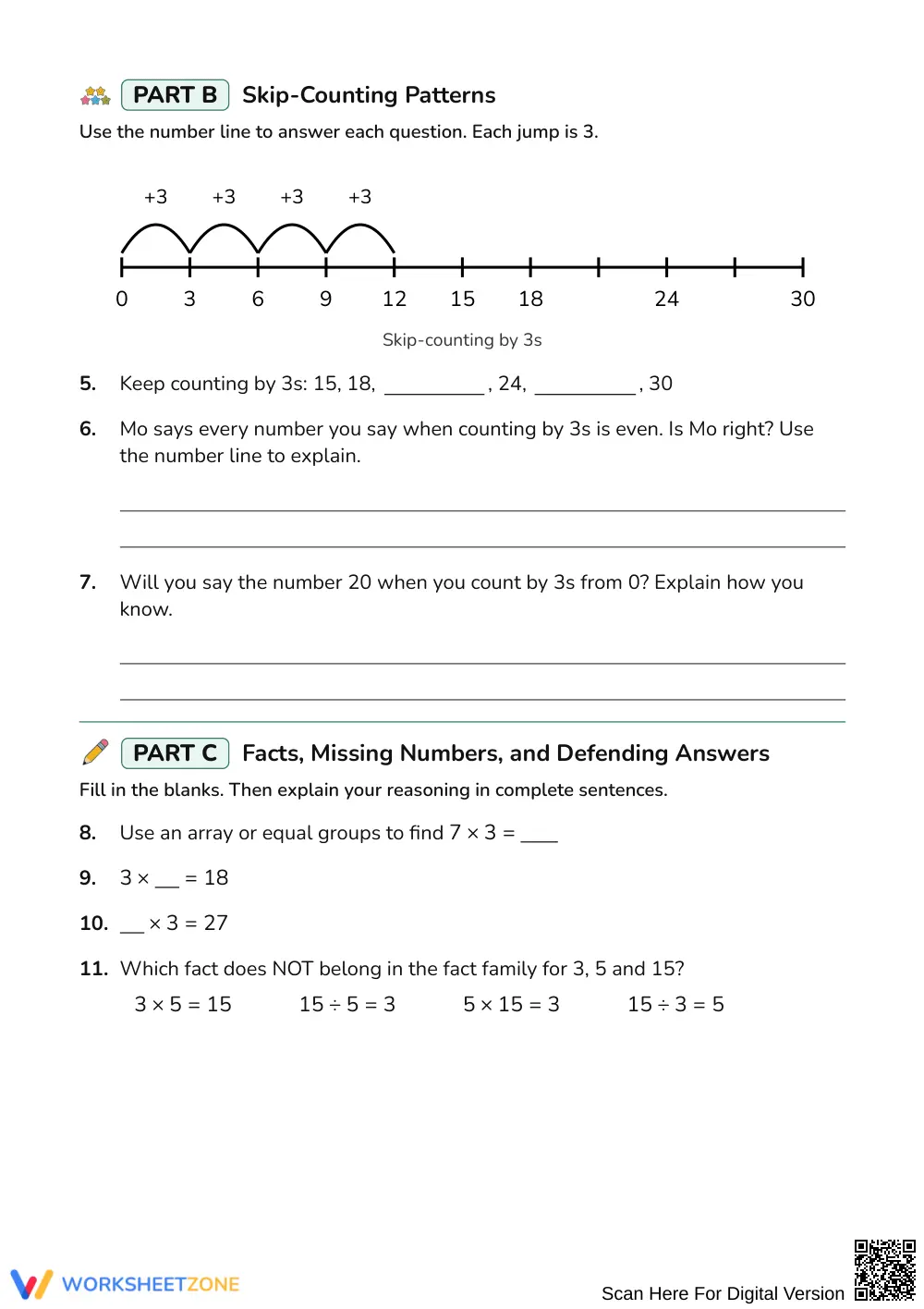
- Supported Practice (Part B, 3 problems): Students analyze a skip-counting number line to evaluate claims about odd and even numbers and defend non-multiples.
- Independent Practice (Part C, 8 problems): Learners solve missing-factor equations, identify incorrect fact family members, refute calculation errors, and solve multi-step word problems.
This sequence follows a gradual-release model, moving learners from scaffolded visual models to independent conceptual defense.
Standards Alignment
The primary focus aligns with `3.OA.C.7`: Fluently multiply and divide within 100, using properties of operations or the relationship between multiplication and division. The tasks also reinforce `3.OA.A.1` by interpreting products as equal groups. Both standard codes can be copied directly into lesson plans, IEP goals, or district curriculum mapping tools.
How to Use It
Use this worksheet after direct instruction on the 3s facts or during targeted small-group intervention. While circulating, observe whether students justify commutative properties using array dimensions rather than simply calculating answers. Expected completion time is 25 to 35 minutes.
Who It's For
This resource supports Grade 3 general education classes, math intervention groups, and students needing structured justification practice. Support learners by providing counters for arrays, or extend learning by having students create their own error-analysis problems. Pair with a multiplication anchor chart displaying equal groups.
According to Fisher & Frey (2014), structured opportunities for students to verbalize, defend, and write mathematical justifications are essential for converting routine procedural computation into durable conceptual schema. This Grade 3 worksheet operationalizes standard 3.OA.C.7 by challenging students to fluently multiply by 3s and justify their thinking through explanatory tasks rather than passive drill sheets. By analyzing visual arrays, disproving erroneous peer claims, and articulating number patterns on a structured number line, learners engage in metacognitive discourse that reinforces underlying operational properties. Fisher and Frey emphasize that intentional gradual-release frameworks provide the supportive scaffolding third-grade mathematicians need to transition successfully from concrete visual models to abstract algebraic reasoning. Consequently, completing these 15 structured reasoning prompts solidifies foundational multiplication fluency while cultivating the precise written communication skills required for sustained academic growth and standards mastery across elementary mathematics curricula.


