
































By 3s: Multiple Representations Printable Worksheet

Paste this activity's link or code into your existing LMS (Google Classroom, Canvas, Teams, Schoology, Moodle, etc.).
Students can open and work on the activity right away, with no student login required.
You'll still be able to track student progress and results from your teacher account.
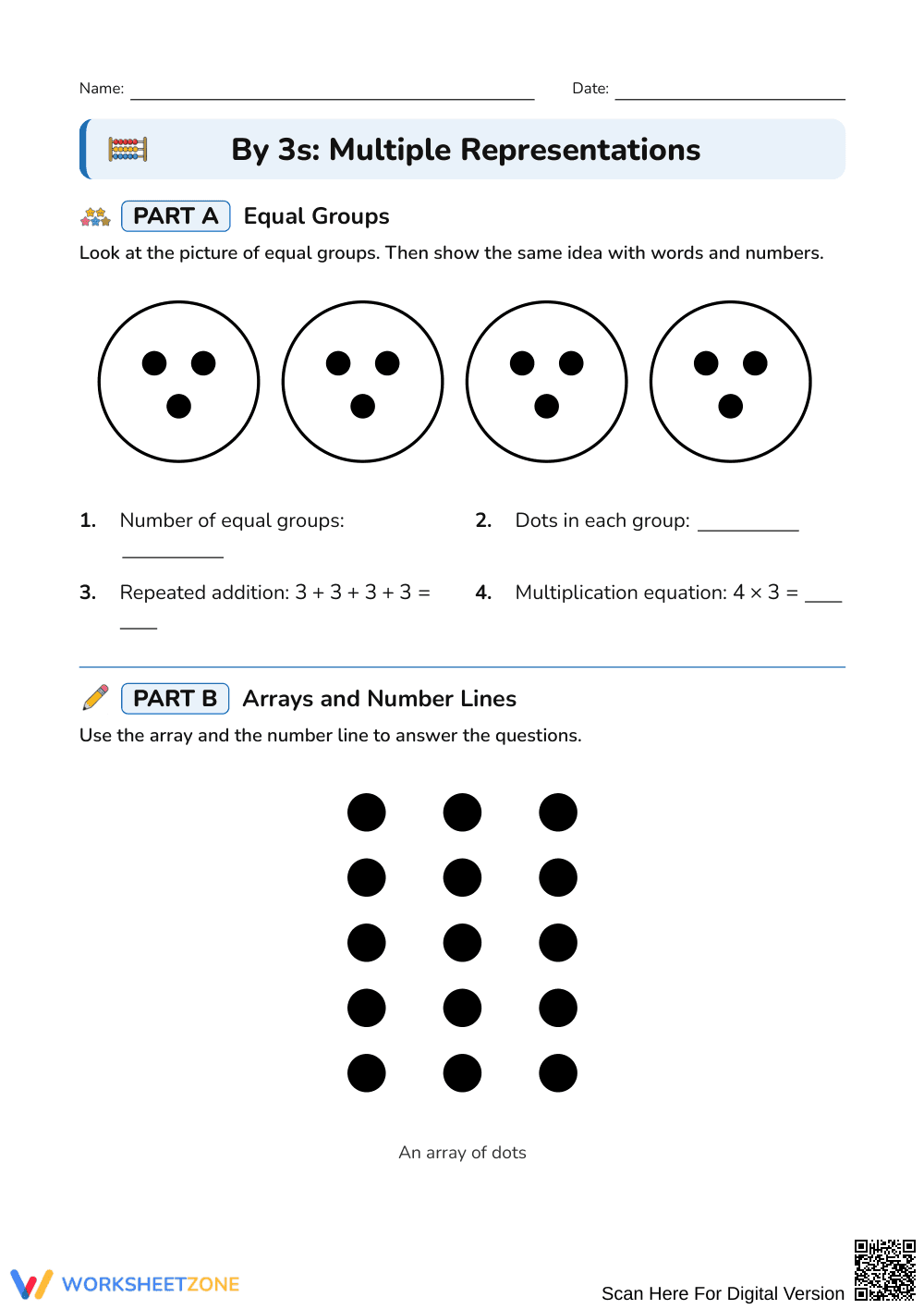
This Grade 3 math worksheet strengthens conceptual understanding of multiplication by 3 through multiple visual and symbolic models. Students complete 24 structured tasks to translate among equal groups, dot arrays, number line jumps, repeated addition, and word problems, developing mastery of foundational multiplication facts and related division concepts.
At a Glance
- Grade: 3 · Subject: Math
- Standard:
3.OA.A.1— Interpret products of whole numbers using equal groups, arrays, and repeated addition- Skill Focus: Translating representations of multiplication by 3
- Format: 3 pages · 24 problems · Answer key included · PDF
- Best For: Independent practice and small-group targeted intervention
- Time: 35–45 minutes
What's Inside
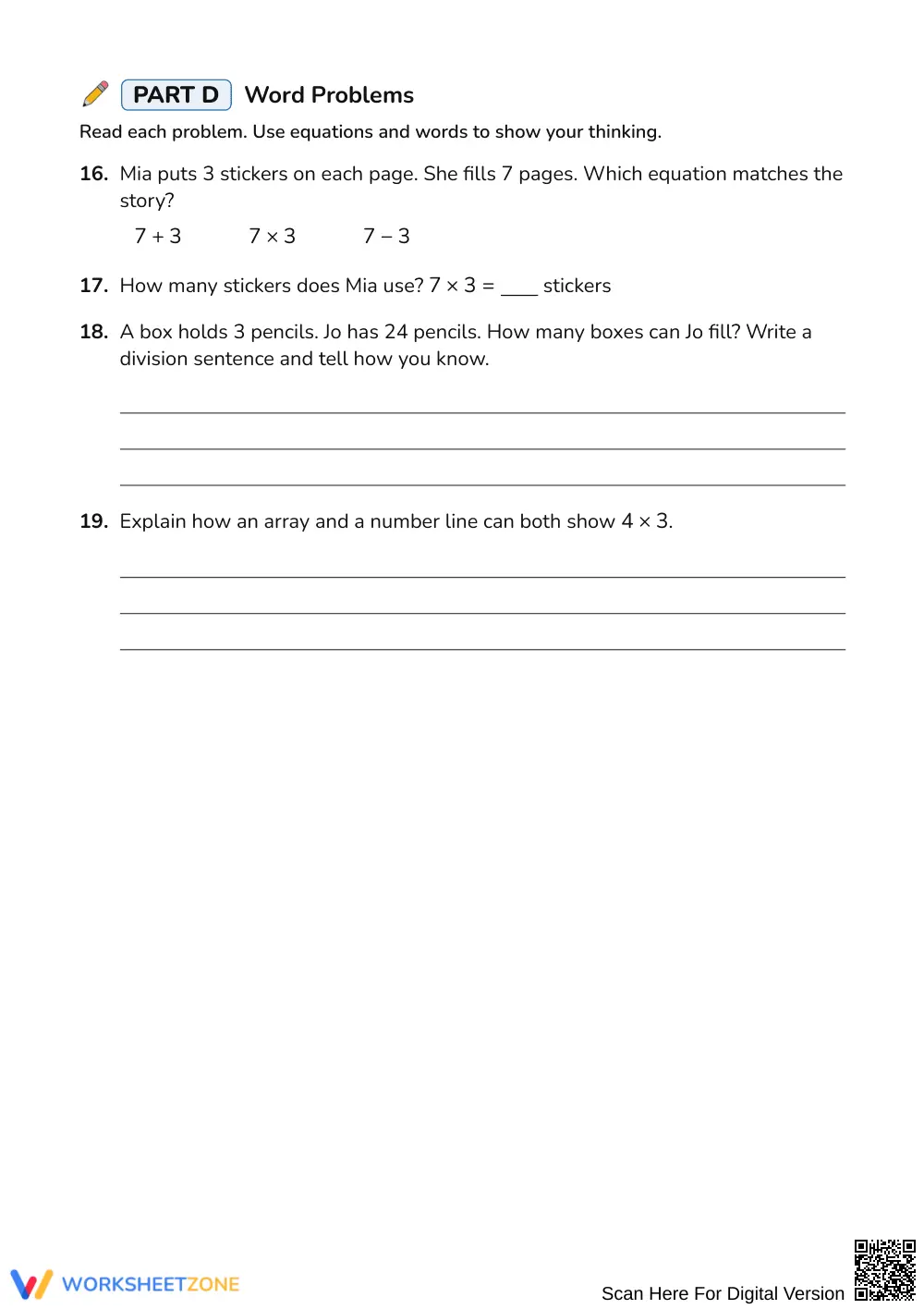
The 3-page printable worksheet contains 24 diverse math exercises across four structured parts. Students examine equal groups, analyze dot arrays, track number line hops, complete a fact comparison table, and solve word problems with written explanations. The resource includes clear response prompts and a 3-page answer key showing all solutions.
Skill Progression
- Guided practice (Tasks 1–6): Equal groups, dot arrays, and number lines provide visual scaffolding for writing initial multiplication equations.
- Supported practice (Tasks 7–18): A structured table links words, repeated addition, multiplication equations, and fact families with reduced visual cues.
- Independent practice (Tasks 19–24): Word problems and written justifications require students to explain connections between arrays and number lines independently.
This sequence follows the gradual-release framework, moving learners from visual models to abstract equations.
Standards Alignment
Primary standard `3.OA.A.1` focuses on interpreting products of whole numbers, such as viewing 4 × 3 as 4 groups of 3 objects. Supporting standard `3.OA.A.4` connects these models to finding unknown factors and quotients in related equations. Both standard codes can be copied directly into lesson plans, IEP goals, or district curriculum mapping tools.
How to Use It
Use this worksheet for independent seatwork following direct instruction on multiplication models, or assign it as a targeted math station. Formatively observe whether students connect repeated addition directly to equal groups without counting dots individually. Typical completion time is 35 to 45 minutes.
Who It's For
This worksheet supports Grade 3 students learning multiplication models and Grade 4 students needing conceptual intervention. Visual arrays assist multilingual learners, while structured rows support students with accommodations. Pair this activity with counters or a multiplication anchor chart.
According to Fisher & Frey (2014), student cognitive autonomy develops most effectively when instructional materials bridge concrete representations and formal symbolic expressions through structured gradual-release frameworks. Standard 3.OA.A.1 emphasizes interpreting products of whole numbers by systematically connecting physical quantities to equal groups, dot arrays, number line intervals, and repeated addition equations. When elementary math learners translate multiplication facts across diverse mathematical models, they form durable conceptual schemas that prevent common procedural errors in subsequent division and multi-digit operations. This 24-task worksheet operationalizes that foundational research by guiding Grade 3 students through visual groups, structured array comparisons, fact families, and contextual story problems. The deliberate progression ensures that students not only calculate products of 3 accurately but also articulate the multiplicative structure underpinning each equation, establishing the rigorous mathematical foundation highlighted in modern evidence-based curriculum frameworks.


