































By 2s: Essential Independent Accuracy Practice

Paste this activity's link or code into your existing LMS (Google Classroom, Canvas, Teams, Schoology, Moodle, etc.).
Students can open and work on the activity right away, with no student login required.
You'll still be able to track student progress and results from your teacher account.
This Grade 3 math worksheet builds fluent recall of multiplication facts involving twos through visual models, skip counting, missing factor relationships, and real-world word problems. Students move from concrete representations to abstract fact retrieval, achieving operational accuracy and conceptual understanding across 14 focused questions.
At a Glance
- Grade: Grade 3 · Subject: Elementary Math
- Standard:
3.OA.C.7— Fluently multiply within 100 using strategies such as the relationship between operations- Skill Focus: Multiplying by 2 fact accuracy
- Format: 2 student pages · 14 structured problems · Answer key included · PDF
- Best For: Independent accuracy practice and skill checks
- Time: 20–30 minutes
What's Inside
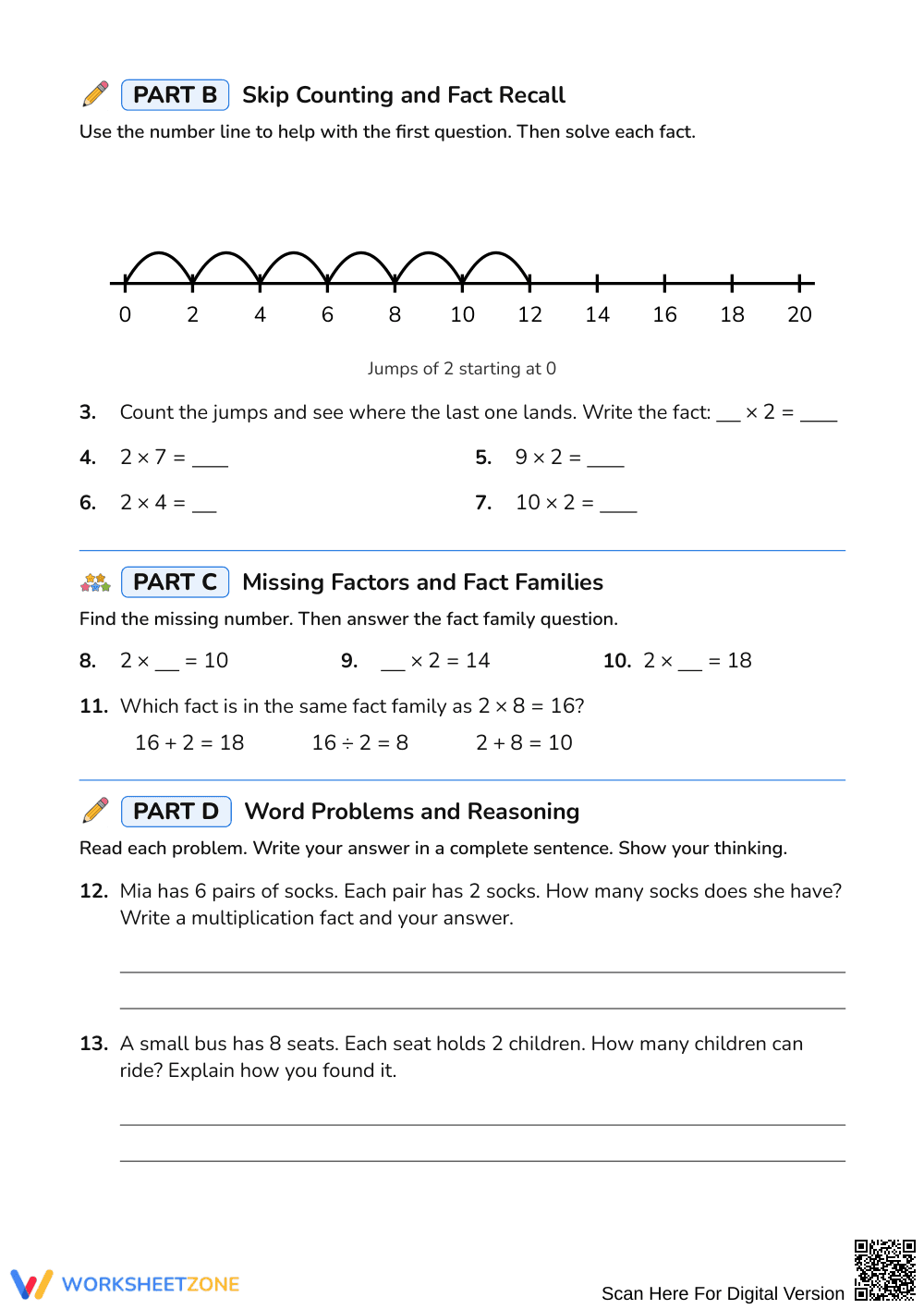
The 2-page worksheet presents 14 structured exercises arranged into four sections. Students solve equal-group and array tasks, practice skip counting and direct equations, identify missing factors with fact families, and solve two contextual word problems. A complete 2-page answer key provides clear solutions for rapid grading.
Skill Progression
- Guided practice (Part A, 2 tasks): Visual arrays and equal-group models anchor multiplication facts of 2 in concrete representations with low cognitive demand.
- Supported practice (Parts B and C, 10 tasks): Number lines, fact recall, and missing factors reinforce inverse relationships with moderate scaffolding.
- Independent practice (Part D, 2 tasks): Word problems require learners to extract values, write multiplication sentences, and justify their reasoning in writing.
This progression mirrors the gradual release of responsibility model, guiding students from visual scaffolding to independent fact mastery.
Standards Alignment
The primary focus aligns directly to `3.OA.C.7`: Fluently multiply and divide within 100, using strategies such as the relationship between multiplication and division. The resource also reinforces supporting standard `3.OA.A.3` by prompting students to solve word problems involving equal groups. Both standard codes can be copied directly into lesson plans, IEP goals, or district curriculum mapping tools.
How to Use It
Deploy this worksheet after direct instruction on factors of 2 as an in-class check or during independent math workshop stations. While circulating, observe whether students calculate ×2 facts via rhythmic skip counting or instant mental recall to target interventions. Expected completion time is 20 to 30 minutes.
Who It's For
This resource serves general education Grade 3 students building multiplication fluency and Grade 4 learners needing targeted fact intervention. Provide physical counters for Part A as a scaffold or prompt students to write related division facts for extension. Pair this activity with a doubles multiplication anchor chart.
Mastering basic multiplication facts under standard 3.OA.C.7 represents a vital developmental benchmark in elementary mathematics education. Research synthesized in EdReports 2024 emphasizes that fluency with single-digit multiplication, specifically multiplying by 2, establishes the essential cognitive foundation required for multi-digit operations, fractions, and proportional reasoning in upper elementary grades. Systematic independent practice that connects concrete representations to symbolic equations enables elementary students to transition efficiently from additive skip counting to automated fact retrieval. When instructional materials present structured visual models alongside missing factor equations and contextual word problem applications, learners internalize the inverse relationship between operations while strengthening mathematical retention. Implementing targeted accuracy practice ensures that Grade 3 students secure fluent multiplication within 100, directly preventing future procedural bottlenecks in intermediate math coursework and actively supporting long-term mathematical problem-solving competence across diverse classroom learning environments.


