


























Views
Plays

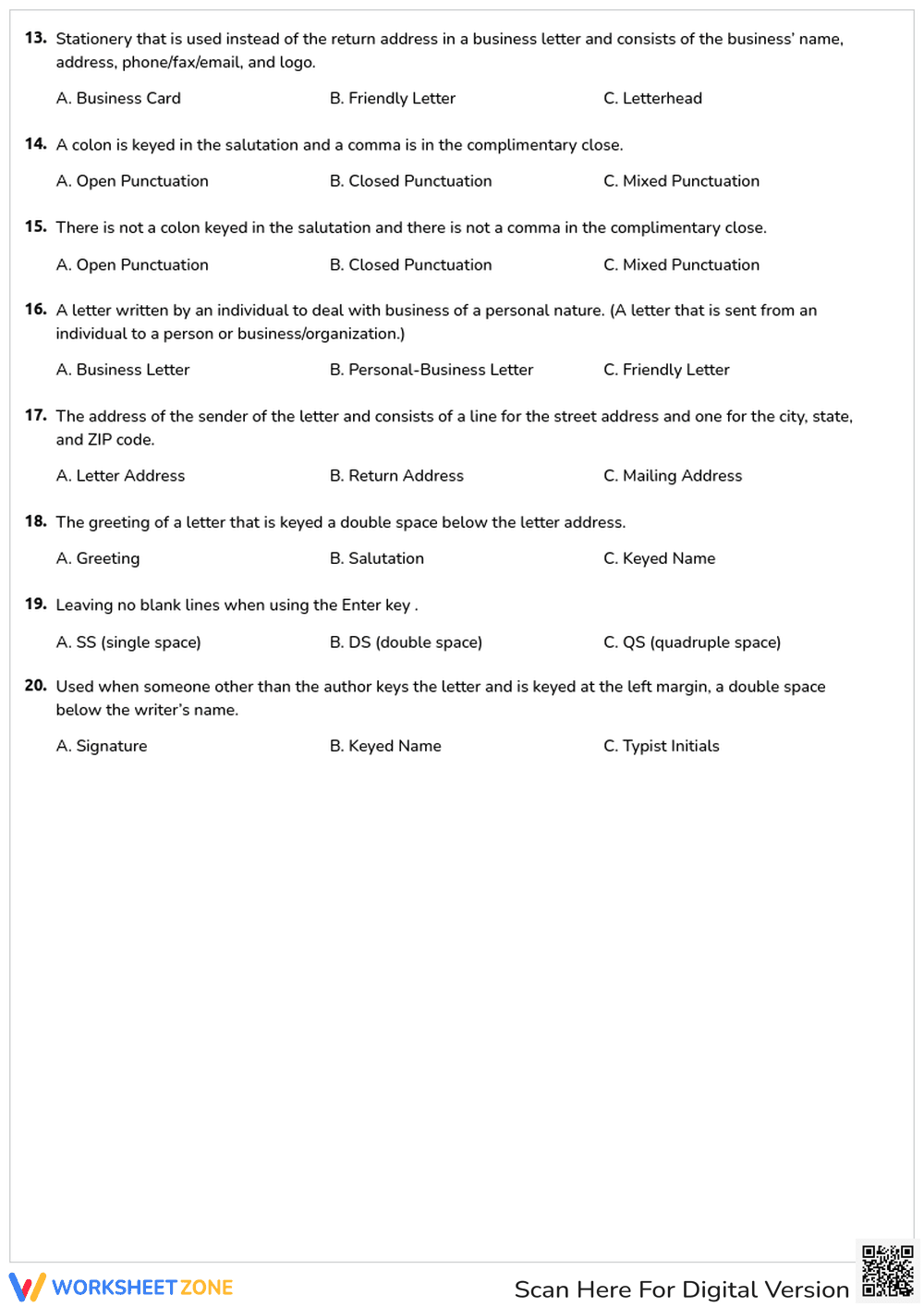

Printable Business Letter Vocabulary Worksheet | Grade 4
Paste this activity's link or code into your existing LMS (Google Classroom, Canvas, Teams, Schoology, Moodle, etc.).
Students can open and work on the activity right away, with no student login required.
You'll still be able to track student progress and results from your teacher account.
This printable business letter vocabulary worksheet helps students master essential formatting terms and professional communication concepts. By completing this focused multiple-choice quiz, learners will confidently identify key components like salutations, block style, and complimentary closes, ensuring their future writing is properly structured and formatted.
At a Glance
- Grade: 4 · Subject: ELA
- Standard:
CCSS.ELA-LITERACY.L.4.6— Acquire and use domain-specific words accurately.- Skill Focus: Business Letter Vocabulary
- Format: 2 pages · 20 problems · Answer key included · PDF
- Best For: Independent practice and assessment
- Time: 15–20 minutes
Inside this resource, educators will find a two-page assessment featuring 20 multiple-choice questions. Students read a formatting rule and select the correct term from three options. The clean layout minimizes visual distractions, helping students focus on recalling vocabulary. A complete answer key makes grading fast.
This resource offers a highly efficient zero-prep workflow:
- Print (1 min): Download the PDF and print the two-page assessment.
- Distribute (1 min): Hand out as a warm-up or quiz.
- Review (3 mins): Use the key to grade rapidly or project for peer-review.
With under two minutes of prep, this is an excellent addition to any sub plan.
This worksheet is strictly aligned to CCSS.ELA-LITERACY.L.4.6, requiring students to acquire and use accurately grade-appropriate general academic and domain-specific words and phrases. By focusing on the specific lexicon of professional correspondence, it also supports broader writing standards related to producing clear and coherent texts appropriate to task and purpose. Both standard codes can be copied directly into lesson plans, IEP goals, or district curriculum mapping tools.
Teachers can utilize this worksheet as a formative assessment after direct instruction on letter writing. It serves perfectly as independent practice before students draft business letters. As an observation tip, monitor which terms students struggle with—like confusing block style with alignment—to determine if a brief reteach is necessary. Expected completion time is 15 to 20 minutes.
This resource is designed for upper elementary students learning formal correspondence mechanics. It is highly effective for general education and special education students who benefit from the clear multiple-choice format. Pair this quiz with a visual anchor chart labeling the parts of a business letter.
Mastering domain-specific vocabulary is a critical stepping stone for students learning to navigate formal writing structures and professional communication. According to a recent EdReports 2024 analysis, explicit vocabulary instruction combined with targeted, low-stakes assessment significantly improves reading comprehension and writing coherence in upper elementary grades. When students acquire and use domain-specific words accurately, as outlined in CCSS.ELA-LITERACY.L.4.6, they are much better equipped to produce texts that meet professional and academic expectations. This worksheet provides the exact type of structured retrieval practice that cognitive science identifies as essential for long-term memory retention. By isolating the specific terminology of business correspondence—such as salutations, block formatting, and complimentary closes—educators can ensure learners have the foundational language necessary to discuss, analyze, and eventually draft their own formal letters with absolute confidence and precision.


